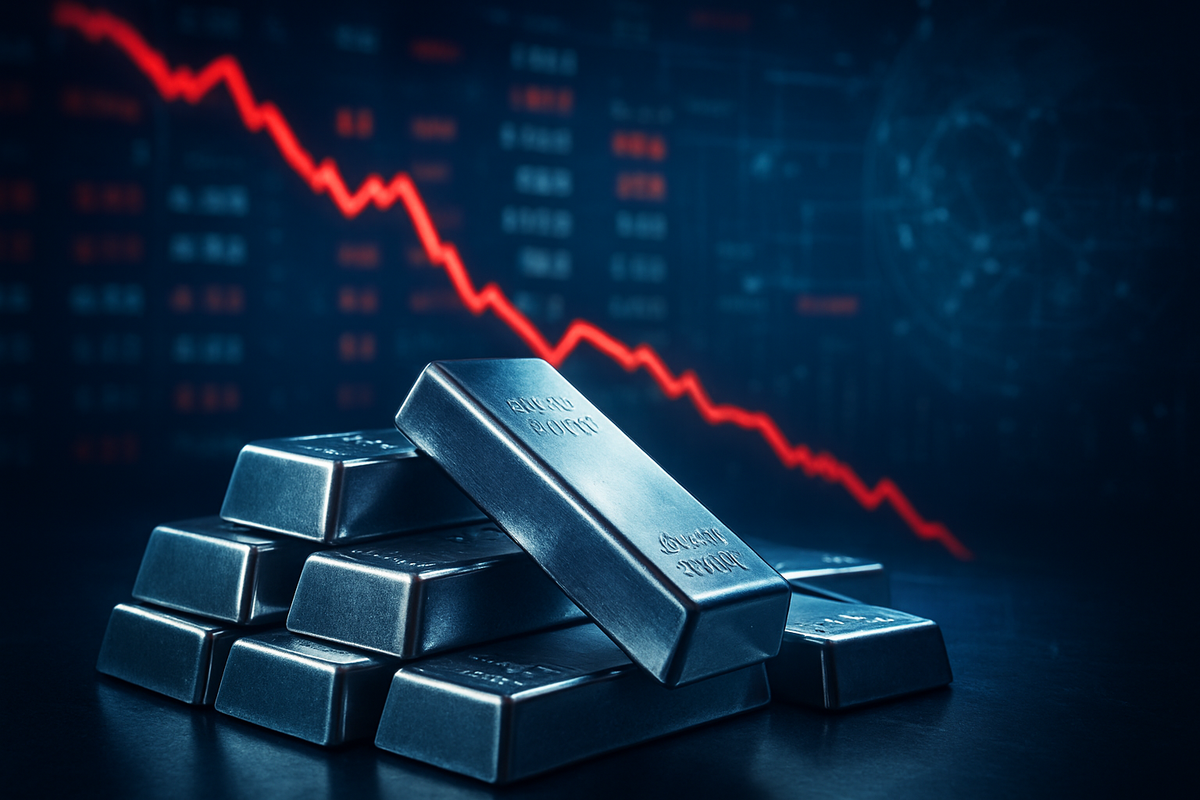
The global silver market experienced a sharp reality check on Wednesday, January 7, 2026, as spot prices retreated from their near-record highs, signaling a cooling of the "silver fever" that dominated much of the previous year. After closing 2025 as one of the world's best-performing assets with a staggering 140% gain, silver (XAG/USD) faced a significant intraday slump, falling between 2% and 4% to trade in the $77.60 to $79.60 per ounce range. This correction follows a brief, failed attempt to reclaim the $81 mark, as investors grapple with a combination of technical pressures and a shifting macroeconomic landscape.
The immediate implications of this slump are felt most acutely in the futures markets, where a wave of long liquidations has triggered stop-loss orders across major exchanges. While the metal remains historically expensive compared to its $30-per-ounce baseline from early 2024, the current volatility suggests that the "parabolic phase" of the silver rally may be transitioning into a period of painful consolidation. For market participants, the dip serves as a stark reminder that even the most robust bull markets are susceptible to the gravity of a strengthening U.S. Dollar and regulatory intervention.
A Perfect Storm of Margins and Rebalancing
The decline on January 7 was not a random occurrence but rather the result of several converging factors that hit the market simultaneously. Leading the charge was a decisive move by the CME Group, which raised margin requirements for silver futures for the second time in three weeks. The cost to maintain a March 2026 silver contract jumped from $22,000 to $32,500, a massive 47% increase designed to curb "speculative excess." This forced many highly leveraged retail and institutional traders to liquidate their positions to meet the new cash requirements, creating a downward price spiral during the New York trading session.
Furthermore, the first week of January marks the traditional annual rebalancing of major commodity indices, including the Bloomberg Commodity Index and the S&P GSCI. Analysts estimate that roughly $6 billion to $7 billion in mechanical selling of gold and silver futures occurred as these funds realigned their portfolios to new 2026 weightings. This "forced selling" coincided with a two-week high in the U.S. Dollar Index (DXY), which was bolstered by hawkish rhetoric from Federal Reserve officials. Richmond Fed President Thomas Barkin signaled that while rate cuts are on the horizon, the central bank remains wary of "sticky" 3% inflation, dampening the appeal of non-yielding assets like silver.
The timeline leading to this moment began in late December 2025, when silver hit an all-time high of $84.03. A "flash crash" during the thin liquidity of the holiday season saw prices drop 16% in just 48 hours, setting the stage for the current instability. While physical demand remains high, particularly in Asia, the "paper" market in the West is currently undergoing a violent deleveraging process that has left many late-cycle bulls underwater.
Winners and Losers in a Volatile Silver Landscape
The primary casualties of the January slump have been the major silver producers, whose stock prices often act as a leveraged play on the metal itself. Pan American Silver (NYSE: PAAS) and Hecla Mining (NYSE: HL) both saw their shares decline by more than 4% in early Wednesday trading. Similarly, First Majestic Silver (NYSE: AG) and Coeur Mining (NYSE: CDE) faced selling pressure as investors moved to lock in gains from what was a transformative 2025. For these miners, the concern is not just the spot price, but the increasing volatility which complicates long-term hedging strategies and capital expenditure planning for new projects.
On the other side of the ledger, the slump provides a temporary reprieve for industrial consumers, particularly in the green energy and technology sectors. Companies like JinkoSolar (NYSE: JKS) and Tesla (NASDAQ: TSLA), which rely heavily on silver for photovoltaic cells and EV electronics, have been struggling with soaring input costs. While a drop to $78/oz is still high by historical standards, any stabilization below the $80 threshold helps protect margins that were being squeezed to the breaking point. Meanwhile, tech giants like Nvidia (NASDAQ: NVDA) and Samsung Electronics (KRX: 005930) continue to see massive demand for silver-intensive AI hardware, making them the ultimate "winners" if the price correction allows for more predictable supply chain costs.
Asset managers have also seen a shift in flows. The iShares Silver Trust (NYSE Arca: SLV), managed by BlackRock (NYSE: BLK), recorded its largest single-day outflow of the new year as retail sentiment cooled. Conversely, some contrarian investors are viewing the dip as an entry point into the Sprott Physical Silver Trust (NYSE Arca: PSLV), betting that the underlying physical deficit—which has ballooned to over 5,000 tonnes—will eventually override the technical selling seen on the COMEX.
Macro Shifts: The AI Rotation and the China Factor
The recent slump reflects a broader shift in investor sentiment toward "risk-on" equities at the expense of precious metals. As the S&P 500 and Dow Jones Industrial Average hit record highs in early 2026, capital is rotating out of defensive havens and into the "picks and shovels" of the AI revolution. This creates a paradox for silver: while speculative capital is fleeing the metal to chase tech stocks, the physical build-out of the very data centers and power grids fueling the AI boom requires massive amounts of silver due to its unmatched electrical conductivity.
Geopolitical factors are also complicating the narrative. On January 1, 2026, China implemented a strict export licensing regime for silver, reclassifying it as a "strategic dual-use" material. By effectively "locking the gates" on a significant portion of the world’s refined silver supply to prioritize its domestic solar and EV industries, Beijing has created a massive premium for physical silver in Shanghai compared to Western exchanges. This divergence between Western "paper" prices and Eastern "physical" prices is a historical precedent that suggests the current slump may be a localized phenomenon in Western markets that cannot be sustained indefinitely.
Furthermore, the easing of the Venezuela crisis following the transition of power in late 2025 has reduced some of the "inflation-hedge" urgency that drove silver higher last year. As the U.S. moves to unblock Venezuelan oil exports, energy-driven inflation expectations have softened, giving the Federal Reserve more room to maintain its "higher-for-longer" stance on interest rates, which traditionally acts as a headwind for precious metals.
The Path Ahead: Support Levels and Strategic Pivots
In the short term, market analysts are watching the $75.00 support level closely. If silver fails to hold this floor, a further retreat toward the $70.00 psychological mark is possible as more margin calls are triggered. However, the long-term outlook remains underpinned by a structural supply-demand imbalance that shows no signs of resolving. Miners like Fresnillo (LSE: FRES) have warned that aging mines and a lack of new discoveries mean that silver production is likely to plateau or decline over the next three years, even as industrial demand from the "electrification of everything" continues to climb.
Strategic pivots are already underway. Solar manufacturers are aggressively researching "thrifting" techniques to reduce the amount of silver used in each cell, or substituting it with copper where possible. However, for high-end electronics and AI applications, silver’s unique properties make it nearly irreplaceable. This suggests that while the market may be experiencing a "technical reset" today, the fundamental drivers for a $100-per-ounce price target later in 2026 remain largely intact. Investors should expect continued volatility as the market attempts to find a new equilibrium between speculative deleveraging and physical scarcity.
Conclusion: A Necessary Correction in a New Era
The slump of January 7, 2026, marks a pivotal moment in the silver market’s evolution. It represents a transition from a period of unbridled speculative mania to a more calculated assessment of value in a high-interest-rate environment. The key takeaway for investors is that the "easy money" phase of the silver rally has concluded, replaced by a market that demands a deeper understanding of margin requirements, currency fluctuations, and geopolitical trade barriers.
Moving forward, the market will likely remain sensitive to Federal Reserve policy and the strength of the U.S. Dollar. However, the "China factor" and the relentless demand from the AI and green energy sectors provide a floor that was absent in previous silver cycles. While the current dip is painful for those who bought at the $84 peak, it may ultimately prove to be a healthy correction that clears out excess leverage and sets the stage for a more sustainable climb. In the coming months, investors should watch for a stabilization of margin requirements and any signs of China easing its export restrictions, as these will be the primary catalysts for the next major move in the "devil's metal."
This content is intended for informational purposes only and is not financial advice.