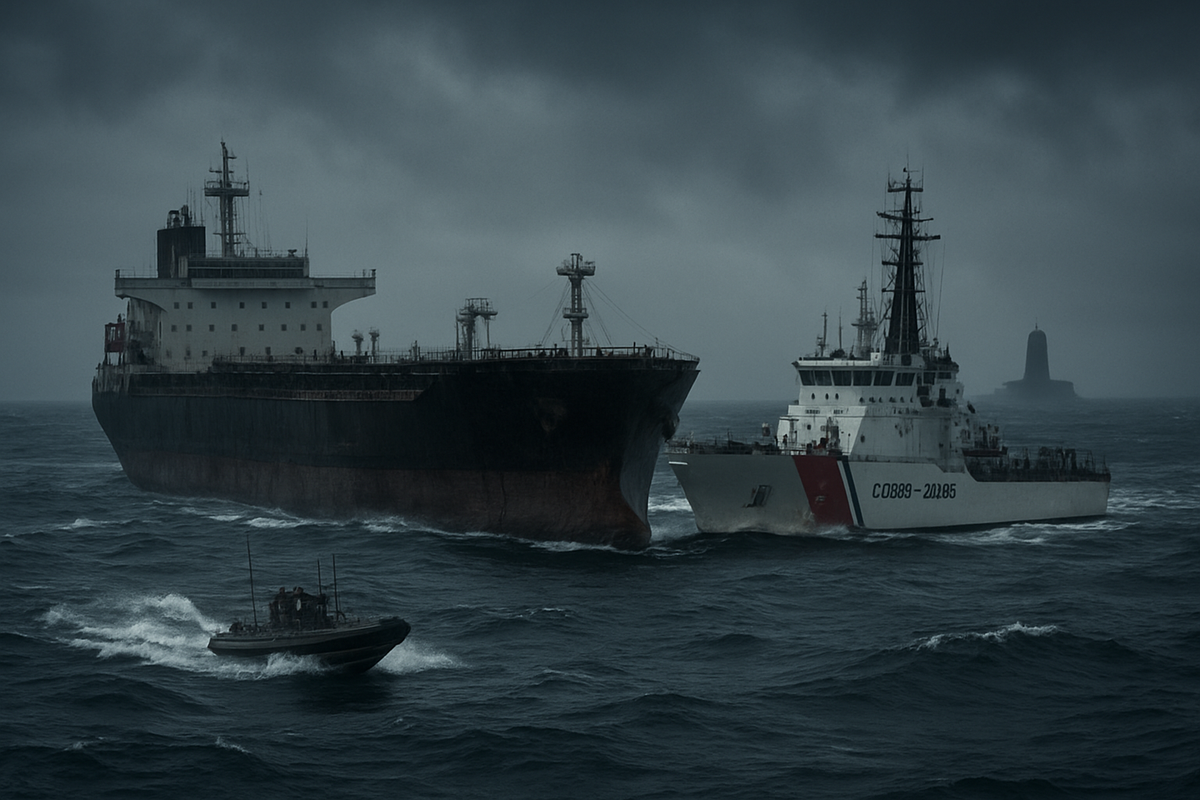
In a dramatic escalation of geopolitical tensions, U.S. maritime forces successfully boarded and seized the sanctioned oil tanker Marinera on January 7, 2026, following a high-seas pursuit that drew in Russian nuclear-powered assets. The incident, occurring approximately 300 miles south of Iceland, marks a pivotal shift from economic sanctions to direct military confrontation in the global energy markets. Despite the presence of a Russian Yasen-class submarine providing an armed escort, U.S. Coast Guard and Special Operations forces executed the seizure, signaling a "zero-tolerance" approach to the "shadow fleet" used by sanctioned nations.
The immediate implications for the energy market have been counterintuitive. While such a confrontation typically triggers a price spike, Brent Crude fell by 1.35% to $59.88 per barrel following the news. This market reaction stems from a significant global supply glut and the U.S. administration's announcement that it will refine and sell 50 million barrels of confiscated oil. The event has redefined the risks associated with transporting sanctioned crude, proving that even military protection may no longer guarantee safe passage for illicit shipments.
A Kinetic Turn in the Shadow Fleet War
The seizure of the Marinera (formerly known as the Bella 1) was the culmination of a multi-week pursuit that began in late December 2025 in the Caribbean Sea. The vessel, long identified as a key node in the transport of oil between Venezuela, Iran, and Russia, attempted to evade U.S. interception by painting over its name and re-registering under the Russian flag mid-voyage. The situation reached a boiling point on January 6, 2026, when Russia dispatched the nuclear submarine Kazan and several naval vessels to escort the tanker as it entered the North Atlantic, claiming sovereign protection under international maritime law.
The U.S. response, coordinated under the newly minted "Operation Southern Spear," involved a sophisticated multi-domain operation. The U.S. Coast Guard cutter Munro, supported by P-8 Poseidon surveillance aircraft manufactured by Boeing (NYSE: BA) and AC-130J gunships from Lockheed Martin (NYSE: LMT), maintained a perimeter around the tanker. By the morning of January 7, U.S. forces boarded the vessel, asserting that a mid-voyage change of flag did not invalidate existing seizure warrants. This move was mirrored by a secondary seizure of another vessel, the M/T Sophia, in the Caribbean, effectively tightening a naval blockade on sanctioned Venezuelan exports.
Initial market reactions were tempered by the sheer volume of global oil production. Analysts noted that the world is currently facing an oversupply of nearly 4 million barrels per day. The decisive U.S. action, coupled with the intent to dump seized oil back into the market, has suppressed the "geopolitical risk premium" that usually accompanies such naval standoffs.
Winners and Losers in the New Maritime Order
The escalation has created a sharp divide between traditional Western energy firms and those reliant on "shadow" logistics. Frontline PLC (NYSE: FRO) and Teekay Tankers Ltd. (NYSE: TNK) have emerged as indirect beneficiaries. As the risk of seizure for non-compliant vessels skyrockets, legitimate tanker rates for Very Large Crude Carriers (VLCCs) have surged to five-year highs, with spot rates reaching $137,000 per day. Buyers are increasingly shunning any tonnage with even a remote connection to Russian or Venezuelan interests, funneling business toward transparent, Western-insured fleets.
Conversely, Russian state-backed entities are facing an existential crisis in their logistics chain. Sovcomflot (MCX: FLOT), Russia's largest shipping company, has seen its operational footprint shrink as more of its vessels are blacklisted and tracked by Western intelligence. Similarly, Russian oil majors like Rosneft (MCX: ROSN) and Lukoil (MCX: LKOH) are finding it increasingly difficult and expensive to move product. The cost of "armed escorts" and the potential loss of entire hulls and cargoes to seizure are making the shadow fleet model economically unsustainable.
In the middle ground sits Chevron Corporation (NYSE: CVX). While the company continues to operate in Venezuela under specific U.S. Treasury waivers, the broader blockade and the subsequent infrastructure rebuilding that may follow a regime shift in Caracas present a complex landscape. Chevron stands to gain from a more stabilized, U.S.-aligned Venezuelan oil sector in the long run, even as it navigates the current volatility of the naval blockade.
The End of the Shadow Fleet’s Immunity
This event fits into a broader trend of "weaponized trade," where economic sanctions are increasingly enforced through kinetic military means. For years, the so-called shadow fleet operated in a legal gray area, using "dark" transshipments and flag-hopping to bypass Western price caps. The seizure of the Marinera under the nose of a Russian nuclear submarine suggests that the era of "plausible deniability" is over. The U.S. has demonstrated that it is willing to risk a direct naval skirmish to uphold the integrity of its sanctions regime.
The regulatory implications are profound. This incident sets a historical precedent that "sovereign protection" via re-flagging or military escort does not grant immunity for vessels already designated for sanctions violations. This challenges the traditional interpretation of the UN Convention on the Law of the Sea (UNCLOS) regarding the "exclusive jurisdiction" of a flag state. Competitors in the shipping industry must now account for the possibility that their vessels could be caught in a crossfire if they share sea lanes with sanctioned tankers.
Historically, this event draws comparisons to the "Tanker War" of the 1980s in the Persian Gulf, but with a modern twist: the primary weapon is not just the missile, but the legal seizure warrant backed by overwhelming surveillance and special operations capability.
Navigating the Volatile Horizon
In the short term, the market should expect Russia to retaliate, potentially through "asymmetric" means such as cyberattacks on energy infrastructure or harassment of Western commercial shipping in the Baltic or Black Seas. However, a full-scale naval war remains unlikely given the current global economic interdependencies. The strategic pivot for many energy-dependent nations will be to accelerate the diversification of their supply chains away from "high-risk" geopolitical zones.
A significant market opportunity may emerge in the marine insurance and maritime security sectors. As the "shadow" market collapses, the demand for high-tier insurance and transparent tracking technology will grow. Investors should look for potential scenarios where the U.S. maintains a permanent naval presence in key chokepoints to enforce what is essentially a global oil embargo on its adversaries. If the U.S. continues to successfully seize and sell sanctioned oil, it could create a new "Strategic Confiscation Reserve" that acts as a buffer against price volatility.
Summary and Investor Outlook
The seizure of the Marinera is a watershed moment in 21st-century geopolitics. It confirms that the U.S. is prepared to use its naval superiority to enforce economic mandates, even at the risk of a direct confrontation with another nuclear power. The key takeaways for investors are the resilience of oil prices in the face of oversupply and the increasing bifurcation of the global shipping industry into "safe" and "rogue" fleets.
Moving forward, the market will likely remain focused on the "Oversupply vs. Escalation" tug-of-war. While geopolitical friction usually drives prices up, the current structural surplus is providing a rare cushion. Investors should closely watch for any signs of Russian naval retaliation and the progress of "Operation Southern Spear." The ability of the U.S. to maintain this blockade without triggering a broader conflict will be the defining factor for energy markets in the coming months.
This content is intended for informational purposes only and is not financial advice.