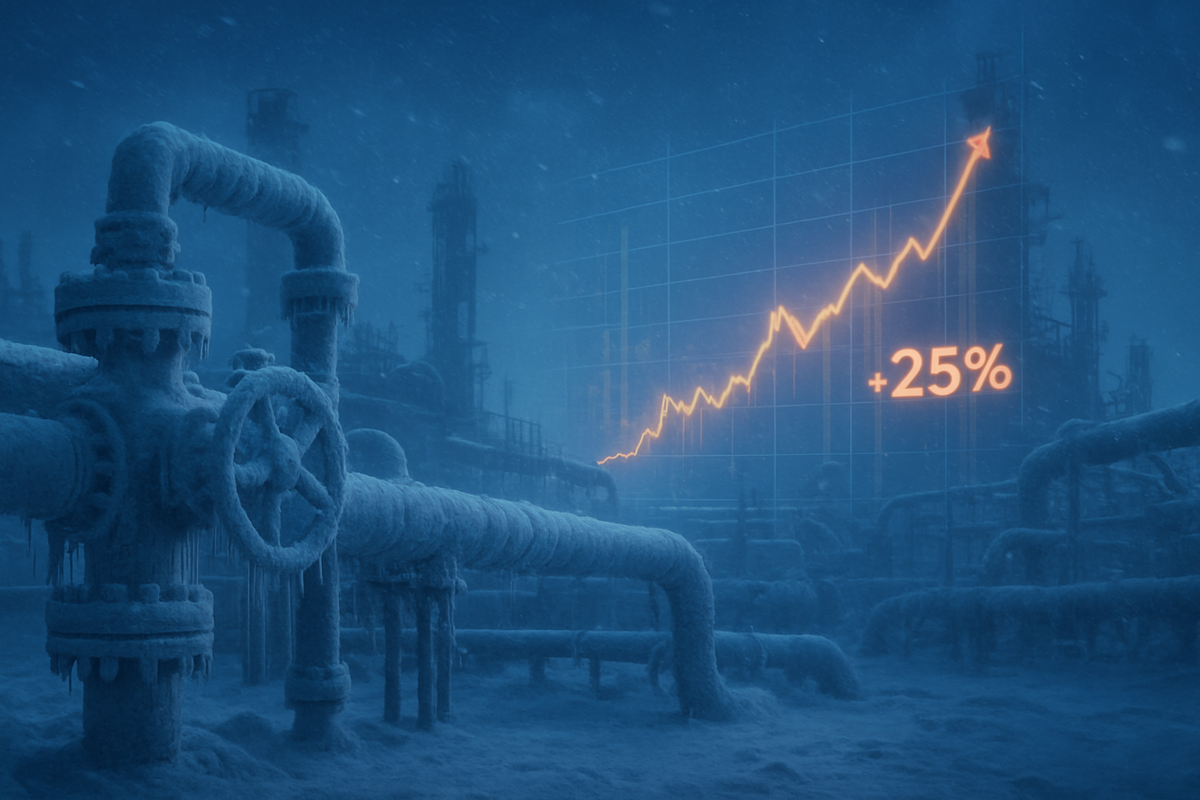
The U.S. natural gas market witnessed a staggering display of volatility this week as an unforgiving Arctic blast descended upon the Lower 48, sending demand to record highs and prices into the stratosphere. On Tuesday, January 20, 2026, February Nymex natural gas futures (NGG26) posted a historic single-day gain of 25.91%, closing up over 80 cents to settle near $3.89/MMBtu. By Thursday morning, January 22, the benchmark Henry Hub price had continued its ascent, touching $5.30/MMBtu as the physical reality of a supply-demand imbalance took hold of the trading floor.
The immediate implications are far-reaching, as the sudden price explosion forced a dramatic repositioning across the financial sector. The ProShares Ultra Bloomberg Natural Gas (NYSE Arca: BOIL) ETF, a leveraged fund designed to track twice the daily performance of natural gas futures, saw a massive 65% weekly move, rewarding aggressive bulls while decimating those caught on the wrong side of the trade. This rally was not merely a reaction to the mercury dropping; it was an explosive confluence of extreme meteorology, a "short-covering frenzy," and a domestic infrastructure system pushed to its absolute limits by the burgeoning energy needs of AI data centers and record LNG exports.
The Arctic Shock: A Day for the History Books
The timeline of this historic surge began in early January when meteorologists first detected a significant disruption in the stratospheric polar vortex. By mid-month, an intense Arctic air mass had crossed from western Canada into the United States, bringing wind chills as low as -50 degrees Fahrenheit to the Northern Plains and Upper Midwest. As temperatures plunged, the National Weather Service issued warnings that the freeze would reach as far south as central Texas, sparking fears of a repeat of the devastating "freeze-offs" seen during previous winter storms.
Market participants were largely caught off guard. Leading into the week of January 18, speculative short positions were at their highest levels since late 2024, as many traders bet on a continuation of the relatively mild winter seen in the months prior. However, when weather models flipped to "severely cold" over the weekend, a "massive short squeeze" ensued. The Kobeissi Letter and other market analysts noted that the intensity of the move was fueled by traders being forced to cover these short positions rapidly, leading to the largest three-day gain in the history of the natural gas market, with cumulative gains exceeding 75% in that window.
The physical supply of gas also suffered a significant blow. As temperatures hit sub-zero levels, water solidified inside pipelines and processing units in the Permian and Haynesville basins, causing "freeze-offs" that saw total U.S. production dip from 112 billion cubic feet per day (Bcf/d) to 110.5 Bcf/d in a matter of days. This reduction in supply occurred exactly as heating demand reached a fever pitch, creating a perfect storm for the 25.91% daily spike on January 20.
Energy Titans and the Leveraged Fallout: Winners and Losers
The surge has created a clear divide between the winners and losers in the energy sector. Major producers have seen their valuations jump alongside the commodity. Expand Energy (NASDAQ: EXE), the entity formed from the high-profile merger of Chesapeake Energy and Southwestern Energy, saw its stock rise nearly 10% during the rally. Despite the price spike, Expand Energy’s leadership maintained a stance of "production discipline," signaling a refusal to flood the market with new supply, which further supported the price floor. Similarly, EQT Corporation (NYSE: EQT), the second-largest U.S. producer, gained approximately 8.5% as it leveraged its recently acquired Mountain Valley Pipeline assets to move gas from Appalachia to high-priced Southeastern markets.
On the losing end of the spectrum were the short-sellers and some retail investors in leveraged instruments. While the United States Natural Gas Fund (NYSE Arca: UNG) provided a standard way to play the rally, it was the ProShares Ultra Bloomberg Natural Gas (NYSE Arca: BOIL) that saw the most dramatic action. The 65% weekly surge in BOIL effectively wiped out short positions but also highlighted the extreme risk of these 2x leveraged products, which can experience massive "decay" if the price trend reverses even slightly.
Utility companies also faced a "capacity crunch." Giants like Duke Energy (NYSE: DUK) and Southern Company (NYSE: SO) have been forced to navigate surging demand not just from residential heating, but from the massive power requirements of AI data centers, which now consume over 1 Bcf/d of natural gas. While many of these utilities have secured long-term supply deals with producers like EQT to insulate themselves from spot market volatility, the sheer scale of the January spike put immense pressure on their operational reserves.
Beyond the Cold: A Structural Shift in the Gas Market
This event is not an isolated weather phenomenon; it fits into a broader trend of structural tightening in the energy industry. Historically, the natural gas market could rely on significant "spare capacity" to buffer against cold snaps. However, heading into 2026, many major producers had slashed capital expenditures by up to 20% in response to previous price slumps. This lack of a safety net left the market vulnerable to the January shock. Furthermore, U.S. Liquefied Natural Gas (LNG) exports, led by players like Cheniere Energy (NYSE American: LNG), reached record levels of over 100 million metric tons in 2025, siphoning off gas that might have otherwise cushioned domestic storage.
The regulatory and policy implications are already beginning to surface. The PJM Interconnection region, which includes "Data Center Alley" in Virginia, saw record-high capacity clearing prices during the freeze. This has led to a "quiet rebound" in coal-fired generation at some plants owned by Dominion Energy (NYSE: D), as gas prices surpassed the $4.70/MMBtu threshold where coal becomes more economical. This shift highlights the ongoing tension between carbon reduction goals and the immediate need for grid reliability during extreme weather events.
Comparisons are being drawn to Winter Storm Uri in 2021 and Winter Storm Elliott in 2022. However, the January 2026 event is distinct because it occurred at a time when storage levels were already 1% below seasonal norms and demand from non-traditional sources—specifically AI data infrastructure—is at an all-time high. The volatility seen this week suggests that the "energy transition" remains in a fragile state where natural gas remains the indispensable, yet highly volatile, bridge fuel.
What Lies Ahead: Volatility as the New Normal
Looking forward, the natural gas market is likely to remain in a state of heightened sensitivity. In the short term, investors should watch for the weekly storage report from the Energy Information Administration (EIA). A larger-than-expected draw could send Henry Hub prices toward the $6.00 mark, especially if long-range weather models suggest another cold front in early February. Conversely, if the Arctic air retreats quickly, the "short-covering" rally could reverse just as fast, leading to a sharp correction in BOIL and UNG.
Long-term, the strategic pivot toward "production discipline" by the likes of Expand Energy and EQT suggests that the days of cheap, overabundant gas may be behind us. Market opportunities may emerge in the midstream sector, as companies focus on increasing storage capacity and pipeline reliability to prevent future "freeze-offs." For investors, the takeaway is clear: the energy market in 2026 is a high-stakes arena where meteorological events can translate into billion-dollar shifts in hours.
Navigating a Frosty Market
The historic 25% daily surge in natural gas futures serves as a stark reminder of the power of weather to disrupt global financial markets. From the -50°F wind chills in the Northern Plains to the 65% weekly jump in the BOIL ETF, the events of January 2026 have redefined the boundaries of volatility for the commodity. The key takeaways for the market include the continued vulnerability of the domestic supply chain and the increasing role of "inelastic" demand from sectors like AI and LNG exports.
Moving forward, the market will be characterized by a "low-margin-for-error" environment. Investors should keep a close eye on regional price spreads, storage refill rates in the spring, and any regulatory shifts that might favor increased gas storage mandates. As the current Arctic blast eventually thaws, the lasting impact of this week’s price spike will likely be a permanent recalibration of risk for those who trade in the world's most volatile fuel.
This content is intended for informational purposes only and is not financial advice