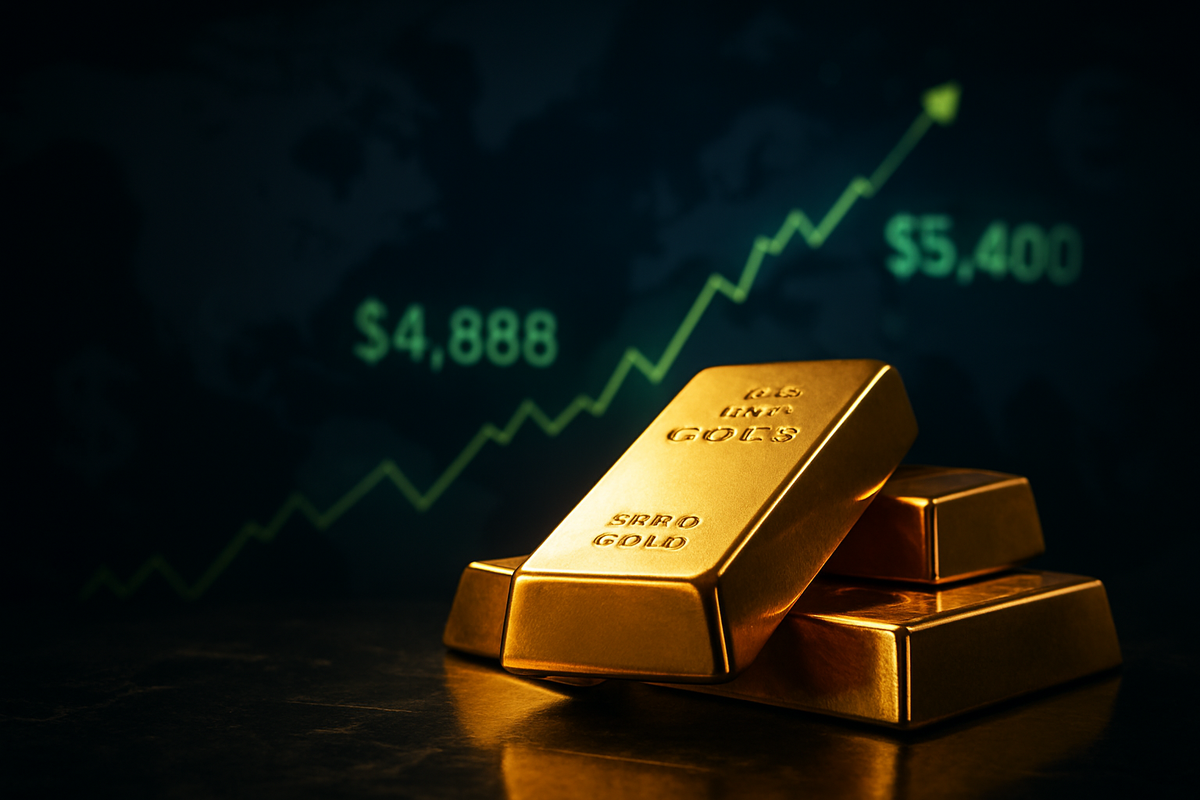
The global gold market reached a historic fever pitch this week as spot prices shattered all previous records, testing the $4,888 per ounce level during intraday trading on Wednesday, January 21, 2026. The surge marks a definitive escalation in what analysts are calling a "structural bull market," driven by a relentless combination of geopolitical instability and a fundamental shift in how both nations and private investors perceive the safety of the U.S. dollar. As the dust settles on this new price floor, the immediate implications suggest a reordering of global reserve assets, with gold increasingly viewed not just as a hedge, but as a primary pillar of fiscal stability.
Following this historic milestone, Goldman Sachs (GS:NYSE) issued a high-conviction research note on January 22, 2026, significantly revising its price targets. The bank now projects gold will reach $5,400 per ounce by the end of 2026, up from its previous forecast of $4,900. This 10% upward revision signals institutional confidence that the current rally is far from over. For the broader market, the crossing of the $4,888 threshold represents a psychological and technical breakout that has forced a massive recalculation of risk across the commodities, currency, and sovereign debt markets.
Record-Breaking Momentum: The Road to $4,888
The ascent to $4,888 per ounce was catalyzed by a "perfect storm" of macro-economic and geopolitical triggers that intensified throughout late 2025 and into the first weeks of 2026. While gold saw a staggering 65-70% gain throughout 2025, the recent push past $4,800 was specifically ignited by sudden diplomatic friction regarding the "Greenland framework" and mounting civil unrest in the Middle East. These events served as the immediate sparks, but the underlying timeline reveals a market that has been building pressure for eighteen months as central banks and private wealth offices aggressively pivoted away from traditional paper assets.
Key stakeholders, including institutional desk heads and sovereign wealth fund managers, have noted that this rally differs from the speculative bubbles of the past. Unlike the short-lived spikes of the early 2020s, the current price action is backed by massive physical demand and record inflows into gold-backed ETFs such as the SPDR Gold Shares (GLD:NYSE). Initial market reactions to the $4,888 breach saw a flurry of activity in the options market, where call options for the $5,000 and $5,500 levels saw record volume, indicating that professional traders are positioning for a sustained climb rather than a sharp reversal.
Winners and Losers in the New Gold Era
The most direct beneficiaries of this price explosion are the world’s major gold producers, who are seeing their profit margins expand at an unprecedented rate. Newmont Corporation (NEM:NYSE), the world's largest gold miner, has seen its stock price soar as its massive reserve base is revalued under the $4,800+ regime. Similarly, Barrick Gold (GOLD:NYSE) and Agnico Eagle Mines (AEM:NYSE) have reported record quarterly free cash flows, allowing them to accelerate dividend payouts and new exploration projects in low-risk jurisdictions. These companies are now operating with "all-in sustaining costs" that are significantly below half of the current spot price, creating a level of profitability rarely seen in the materials sector.
However, the "Gold Rush of 2026" creates significant challenges for other sectors. Large-scale financial institutions with heavy exposure to long-dated U.S. Treasuries, such as J.P. Morgan (JPM:NYSE), are navigating a complex landscape where the rising gold price is often a mirror reflection of declining confidence in sovereign debt. Furthermore, consumer-facing industries that rely on gold for manufacturing—ranging from high-end electronics to luxury jewelry—are facing intense margin pressure. Publicly traded retailers in the luxury space are being forced to choose between massive price hikes that could alienate consumers or absorbing the highest input costs in the history of the industry.
The Structural Shift: De-Dollarization and Fiscal Dominance
The wider significance of gold’s rise to $4,888 lies in the accelerating trend of "de-dollarization." Central banks across the globe, led by emerging economies like Poland, Brazil, and Uzbekistan, have transitioned gold from a secondary reserve to the second-most important reserve asset globally, recently over-taking the Euro. This shift is driven by a desire for "sanction-proof" assets and a growing wariness of the U.S. dollar’s long-term dominance. As the dollar’s share of global reserves slipped to 57% in early 2026, gold has filled the vacuum, acting as an insurance policy against a volatile and increasingly fragmented global financial order.
Moreover, the market is currently grappling with "fiscal dominance"—a scenario where government debt levels and fiscal spending are so high that they dictate monetary policy. With the U.S. federal debt continuing its upward trajectory, private sector investors are using gold to hedge against the potential "debasement" of the currency. Historical precedents, such as the inflationary cycles of the 1970s, are being studied with renewed fervor, but analysts note that the current environment is unique due to the speed of information and the sheer scale of global debt. This has led to a return of Western investor demand, which had remained largely sidelined during the 2024 rally but has now returned with a vengeance, providing a new, sticky layer of support for prices.
Looking Ahead: The Path to $5,400
In the short term, the market expects gold to consolidate its gains, perhaps retracing slightly to the $4,820 range as traders take profits. However, the long-term outlook remains bullish as the Federal Reserve is widely expected to implement at least 50 basis points of rate cuts later in 2026. Lower interest rates traditionally reduce the opportunity cost of holding non-yielding gold, providing yet another tailwind for the metal. Goldman Sachs’ target of $5,400 assumes that these rate cuts will coincide with continued "sticky" demand from private wealth offices that are increasingly worried about the independence of the Federal Reserve and potential executive branch interference in monetary policy.
The potential for "Black Swan" events remains high, with sovereign debt crises in smaller economies potentially acting as further catalysts for gold. Market participants should watch for any signals of a "strategic pivot" from major central banks regarding their gold acquisition rates. If the current monthly average of 60 tonnes of gold purchases by central banks holds or increases, the $5,400 target might even prove conservative. The primary challenge for the market will be the availability of physical supply, as mines struggle to ramp up production quickly enough to meet this structural shift in demand.
Conclusion: A New Paradigm for Investors
The breach of $4,888 per ounce is more than a numerical milestone; it is a signal that the global financial system is entering a new paradigm. The combination of central bank diversification and aggressive private-sector hedging has transformed gold from a "relic of the past" into a central instrument of 21st-century risk management. Goldman Sachs' revised $5,400 target reflects a growing consensus that the traditional "60/40" portfolio may be evolving to include a permanent, significant allocation to physical bullion and mining equities.
Moving forward, the market will remain sensitive to geopolitical headlines and U.S. fiscal policy announcements. For investors, the takeaway is clear: the forces driving gold are structural, not cyclical. While volatility is inevitable, the trend suggests that gold has re-established itself as the ultimate arbiter of value in an era of unprecedented policy uncertainty. Investors should closely monitor ETF inflow data and central bank reserve reports in the coming months for confirmation that this historic bull run has the legs to reach, and perhaps exceed, the mid-$5,000 range.
This content is intended for informational purposes only and is not financial advice.