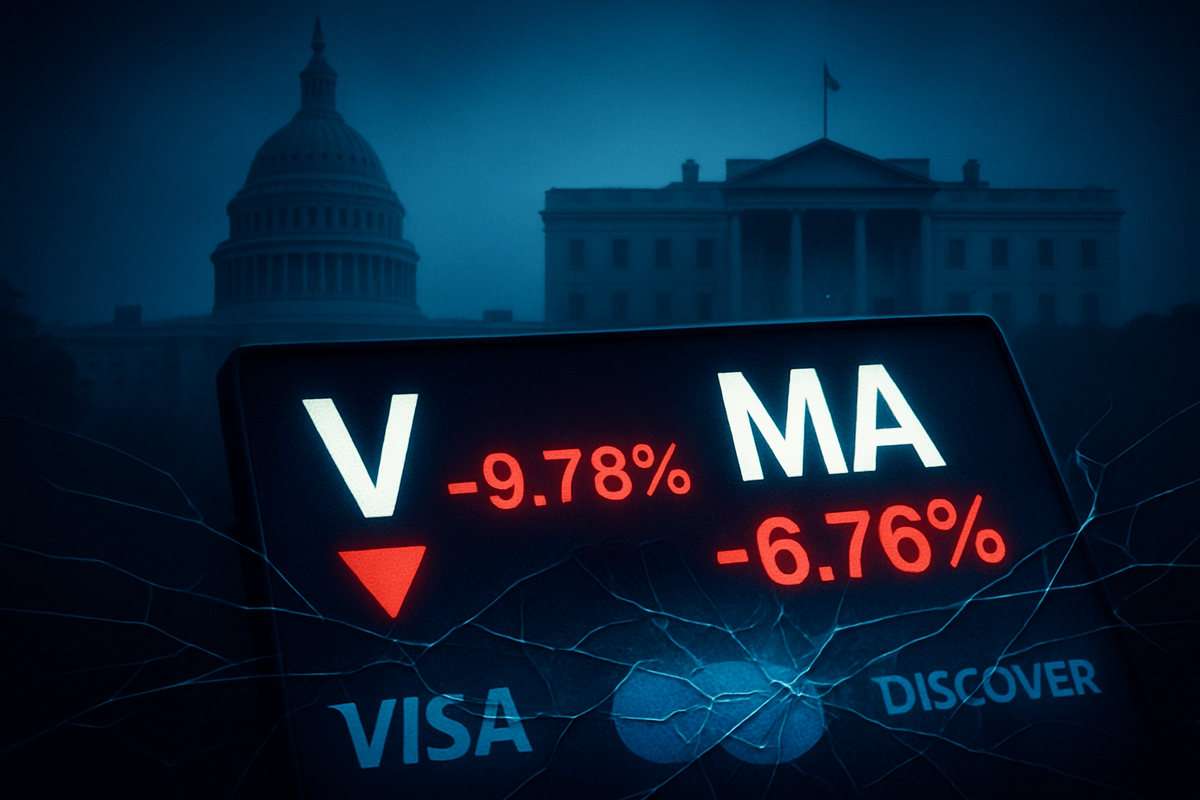
In a move that has sent shockwaves through the financial services sector, shares of payment processing titans Visa and Mastercard plummeted on Tuesday following a surprise endorsement from President Donald Trump for the Credit Card Competition Act (CCCA). The legislative push, which aims to dismantle what critics call a "duopoly" in the credit card routing market, saw Visa (NYSE: V) and Mastercard (NYSE: MA) shares both slide approximately 3.7% in intraday trading as investors braced for a fundamental shift in how transactions are processed in the United States.
The President’s backing, delivered via a series of social media posts, has breathed new life into a bipartisan bill that had previously struggled to gain traction. By framing the reduction of "swipe fees" as a core component of his administration’s "affordability agenda," Trump has effectively aligned the populist wing of the Republican party with long-standing efforts by Democratic lawmakers to lower operating costs for small businesses. The immediate market reaction underscores deep-seated fears that the high-margin interchange fee model, which has fueled the growth of the payment giants for decades, may finally be facing a credible regulatory threat.
A Decisive Shift in the Legislative Landscape
The catalyst for the market sell-off was a Tuesday morning post from President Trump on Truth Social, where he explicitly called for the passage of the CCCA. "Everyone should support great Republican Senator Roger Marshall's Credit Card Competition Act, in order to stop the out of control Swipe Fee ripoff," the President wrote. This endorsement coincided with the formal reintroduction of the bill in both the House and Senate on January 13, 2026. Led by a bipartisan coalition including Senator Dick Durbin (D-IL) and Senator Roger Marshall (R-KS), the bill targets financial institutions with over $100 billion in assets, requiring them to offer at least two unaffiliated networks for routing credit card transactions.
The timeline of this escalation is rapid. Following a January 9 proposal to cap credit card interest rates at 10%, the Trump administration signaled it was looking for further ways to squeeze the financial sector in the name of consumer relief. By the time markets opened on January 13, the reintroduction of the CCCA was already expected, but the explicit presidential blessing served as the "smoking gun" for institutional investors. Within hours, Visa’s stock saw its worst intraday performance in months, eventually closing down 4.5%, while Mastercard followed suit with a 3.8% decline.
Key stakeholders have been quick to react. While the White House portrays the move as a win for "Main Street," the banking lobby has entered a state of high alert. Senate Majority Leader John Thune (R-SD) has already indicated that the bill will be fast-tracked for a floor vote, marking a significant departure from previous years where the legislation was often stalled in committee. The convergence of Trump’s populist rhetoric and Durbin’s long-term regulatory goals has created a rare "perfect storm" in Washington that the payment industry appears ill-prepared to weather.
Winners and Losers: The Merchant-Bank Divide
The primary beneficiaries of the CCCA are undoubtedly the nation’s retailers. Merchant advocacy groups, such as the National Retail Federation (NRF) and the Merchant Payments Coalition (MPC), have long argued that swipe fees—which typically range from 2% to 3% per transaction—are the second-largest operating expense for small businesses after labor. If the bill passes, merchants would have the option to route transactions through lower-cost independent networks like NYCE, Star, or Shazam, potentially saving billions of dollars annually. Large-scale retailers like Walmart (NYSE: WMT) and Target (NYSE: TGT) stand to gain significantly from these reduced overhead costs, which they claim will eventually be passed on to consumers in the form of lower prices.
Conversely, the "losers" in this scenario extend beyond just the card networks. While Visa and Mastercard lose their exclusive grip on routing, the large issuing banks such as JPMorgan Chase (NYSE: JPM), Citigroup (NYSE: C), and Bank of America (NYSE: BAC) face a substantial threat to their revenue streams. These banks rely on interchange fees to fund popular credit card rewards programs. If the fees are compressed by competition, the "points and miles" economy that many American consumers have grown accustomed to could be severely curtailed. Smaller networks like Discover Financial Services (NYSE: DFS) and American Express (NYSE: AXP) face a more nuanced future; while they could theoretically be chosen as the "second network" on cards, the overall downward pressure on fees may offset any gains in volume.
The banking lobby, led by the American Bankers Association (ABA), has already launched a counter-offensive, labeling the bill a "Big Box Bailout." They argue that by forcing competition onto a system optimized for security and reliability, the CCCA could compromise transaction safety and leave low-income consumers with fewer credit options as banks pull back on card offerings that are no longer profitable.
Broader Implications and Historical Precedents
The current situation bears a striking resemblance to the 2010 Durbin Amendment, which placed a cap on debit card interchange fees. That move successfully lowered costs for merchants but led to the near-extinction of free checking accounts and debit rewards. Analysts see the CCCA as "Durbin 2.0," but for the much larger and more lucrative credit card market. The wider significance lies in the potential "commoditization" of the payment network. For decades, Visa and Mastercard have operated as premium utility providers; the CCCA threatens to turn credit routing into a price-war-driven service where the lowest bidder wins.
This event also signals a major shift in the Republican party’s relationship with "Big Finance." Under the Trump administration’s current direction, the traditional GOP alliance with large banks is being tested by a populist mandate to lower the cost of living. This "regulatory populism" could set a precedent for future interventions in other sectors of the economy, from insurance to healthcare, where "middleman" fees are perceived as a burden on the average voter. The ripple effects are already being felt in the fintech space, as startups specializing in alternative payment methods see a potential opening to compete directly with the established giants.
The Road Ahead: Strategic Pivots and Market Volatility
In the short term, investors should expect continued volatility in the payments sector as the bill moves through Congress. Visa and Mastercard are likely to increase their lobbying expenditures and may attempt to negotiate "carve-outs" or safety provisions to blunt the bill’s impact. Strategic pivots are already being discussed behind closed doors, with rumors suggesting that the major networks may look to diversify even further into data analytics, identity verification, and cross-border B2B payments to decouple their stock prices from domestic swipe fee revenue.
Long-term, the industry may see a "bifurcation" of the credit card market. We could see the emergence of "premium" cards that maintain high fees and high rewards by utilizing proprietary networks, while "standard" cards become lower-cost, no-frills tools for basic transactions. The potential for a legal challenge to the CCCA on constitutional grounds—specifically regarding government interference in private contracts—remains a distinct possibility if the bill is signed into law.
Final Assessment: A New Era for Payments
The endorsement of the Credit Card Competition Act by President Trump marks a definitive end to the era of unchecked dominance for the Visa-Mastercard duopoly. The 3.7% drop in share prices is more than just a momentary blip; it is a recognition by the market that the political consensus has shifted against the status quo of the payment industry. As the bill moves toward a likely vote in early 2026, the battle lines are clearly drawn between a populist-led government and the traditional pillars of the American financial system.
Moving forward, the market will be watching for any signs of fracture in the bipartisan support for the bill. If the banking lobby can successfully convince the public that their beloved travel rewards are at risk, the legislative momentum may slow. However, with the full weight of the presidency and the leadership of both parties currently behind the measure, the odds of a major structural change in the payments industry have never been higher. Investors should keep a close eye on retail earnings reports and banking sector guidance in the coming months for early indications of how these players are pricing in a post-CCCA world.
This content is intended for informational purposes only and is not financial advice.