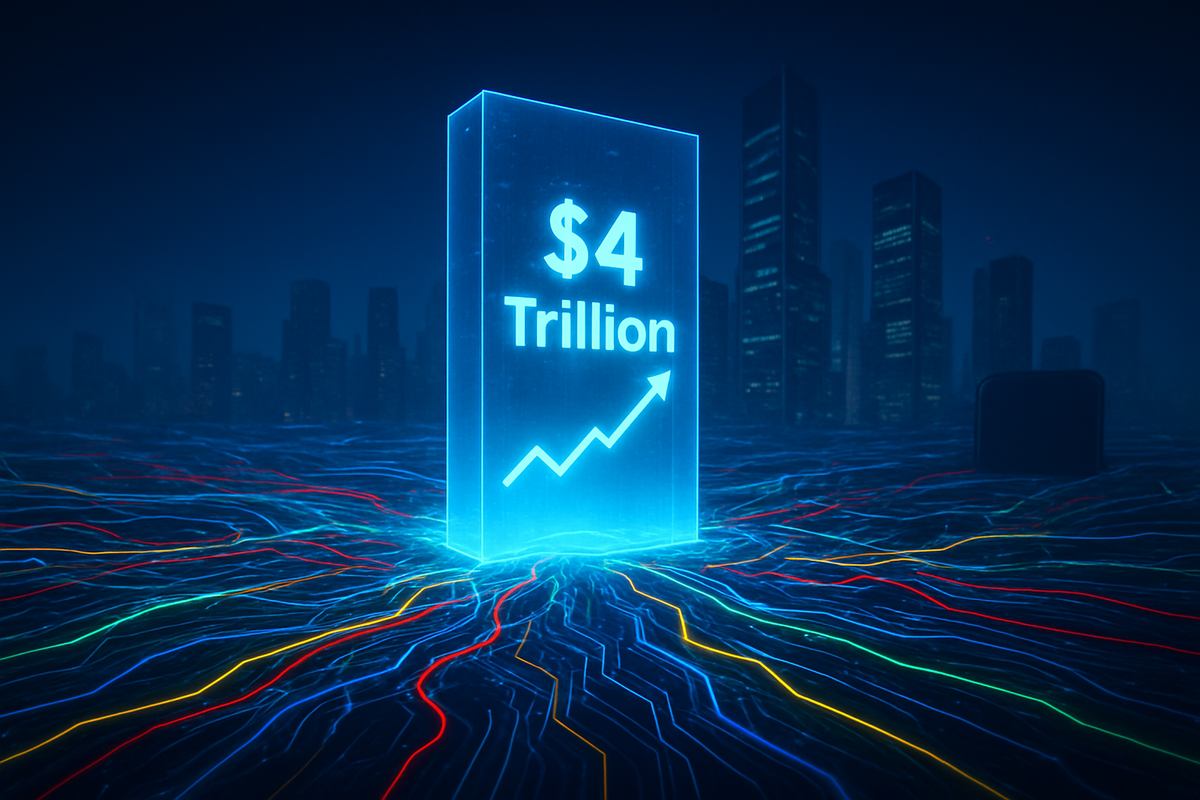
In a historic realignment of the global financial order, Alphabet Inc. (NASDAQ: GOOGL) reached a monumental $4.01 trillion market capitalization on January 13, 2026. This milestone marks the first time since 2019 that the search giant has surpassed Apple (NASDAQ: AAPL) in total market value, signaling a definitive shift in investor sentiment away from consumer hardware and toward vertically integrated artificial intelligence. As of midday trading, Alphabet’s stock surged 4.2%, buoyed by record-breaking cloud margins and the widespread adoption of its latest generative AI models.
The ascension of Alphabet to the $4 trillion club places it in an elite tier previously occupied only by Nvidia (NASDAQ: NVDA), which remains the world’s most valuable entity. For Alphabet, the achievement represents a triumphant "Code Red" recovery—a three-year strategic pivot that began in late 2022 and culminated in the total transformation of its core Search and Cloud businesses into AI-native powerhouses.
The Path to $4 Trillion: From "Code Red" to AI Dominance
The journey to this historic valuation was catalyzed by a series of aggressive technological leaps throughout 2024 and 2025. The most significant of these was the late-2025 launch of Gemini 3 and its "Deep Think" reasoning engine. Unlike previous iterations, Gemini 3 introduced advanced iterative planning capabilities that allowed the model to solve complex scientific and mathematical problems with human-like precision. This breakthrough effectively neutralized the competitive threat from specialized AI startups and solidified Alphabet’s lead in the generative AI race.
Furthermore, Alphabet’s mid-2025 overhaul of Google Search—rebranded simply as "AI Mode"—successfully transitioned the world’s most popular website from a list of blue links to a predictive engine that provides multi-step, synthesized answers. Despite early industry fears that AI would cannibalize search advertising, Alphabet’s integration of dynamic ads into its "AI Overviews" proved highly lucrative, driving a 16.5% increase in search revenue in the fourth quarter of 2025.
Key players in this transformation include CEO Sundar Pichai, whose "AI-first" mandate faced immense scrutiny during the 2023 rollout of Bard. However, by leveraging Alphabet’s proprietary "Ironwood" 7th Generation TPUs (Tensor Processing Units), the company was able to scale its models at a fraction of the cost of its competitors. This hardware advantage allowed Alphabet to offer superior performance while maintaining operating margins that reached 38% in its core services.
Winners and Losers in the New Valuation Hierarchy
The primary winner in this shift is undeniably Alphabet and its vast ecosystem of developers and enterprise clients. Google Cloud, now projected to reach $90 billion in revenue for 2026, has become the preferred platform for "AI-native" startups. Another major beneficiary is Nvidia (NASDAQ: NVDA), whose high-end H300 chips remain the backbone of Alphabet’s training clusters, even as Google scales its internal silicon efforts. Additionally, institutional investors who bet on Alphabet’s recovery have seen massive gains; Berkshire Hathaway (NYSE: BRK.B) notably disclosed a $4.9 billion stake in the company in late 2025, providing a crucial "stamp of approval" for conservative funds.
On the other side of the ledger, Apple (NASDAQ: AAPL) currently finds itself in an uncharacteristic position of trailing its peer. With a market cap of $3.84 trillion, Apple has struggled to match the velocity of Alphabet’s AI innovation. The delay of the "More Personal Siri" into late 2026 and a reported licensing agreement to use Alphabet’s Gemini models to power iPhone features have led many analysts to view Apple as "behind the curve" in the generative AI era. While iPhone revenue remains robust, its 7% growth rate pales in comparison to the 65% surge seen in Alphabet’s AI-driven segments.
Other potential "losers" include traditional digital marketing firms that failed to adapt to the "AI Mode" search interface. Companies that relied on legacy SEO tactics have found their traffic plummeting as Google’s AI now provides answers directly on the search page, forcing a radical rethink of how brands interact with the digital world.
Broader Significance: A Paradigm Shift in Big Tech
Alphabet’s rise to $4 trillion reflects a broader industry trend where valuation is increasingly decoupled from hardware sales and tied directly to "compute dominance." We are witnessing the end of the "Mobile Era"—defined by the hardware dominance of the iPhone—and the beginning of the "Intelligence Era," where the ability to synthesize data at scale is the primary driver of wealth. This shift mirrors the historical transition from the PC era (led by Microsoft) to the Mobile era (led by Apple), with Alphabet now reclaiming the mantle of innovation.
However, this dominance does not come without risks. Regulatory scrutiny remains a persistent shadow over Alphabet’s success. The U.S. Department of Justice (DOJ) continues to monitor Alphabet’s integration of AI into its search monopoly, and the $4 trillion milestone is likely to intensify calls for antitrust intervention. Globally, the European Union’s AI Act has already begun to impact how Gemini is deployed, potentially creating a "splinternet" where certain features are unavailable in high-regulation jurisdictions.
The event also sets a new precedent for "Big Tech" competition. For the first time, the "Magnificent Seven" is being narrowed down to a "Terrific Three"—Nvidia, Alphabet, and Microsoft (NASDAQ: MSFT)—who control the essential layers of the AI stack: hardware, models, and cloud infrastructure.
What’s Next: Sustaining the $4 Trillion Crown
In the short term, the market will be laser-focused on Alphabet’s upcoming Q1 2026 earnings report to see if the AI monetization continues to outpace its massive capital expenditure. Alphabet is projected to spend over $110 billion on data center expansions in 2026 alone, a staggering figure that requires continued double-digit growth to justify. Investors will also be watching for the official launch of "Gemini 4" and the rumored integration of quantum computing capabilities into the Google Cloud platform by late 2026.
Long-term, Alphabet faces the challenge of "platform fatigue." As AI-generated content becomes ubiquitous, the company must ensure that its search results remain trustworthy and free from the "hallucinations" that plagued early models. Furthermore, as competitors like Microsoft and OpenAI continue to iterate, Alphabet must avoid the complacency that led to its "Code Red" moment in 2023. Strategic pivots toward autonomous systems via Waymo and humanoid robotics could be the next frontier to push Alphabet toward the $5 trillion mark.
Summary and Market Outlook
Alphabet’s achievement of a $4 trillion market cap is more than just a numerical milestone; it is a validation of the company's aggressive and often controversial pivot to artificial intelligence. By successfully integrating AI into its core search business and scaling its cloud infrastructure with proprietary silicon, Alphabet has redefined what it means to be a modern tech conglomerate.
Key Takeaways for Investors:
- AI Monetization is Real: Alphabet has proven that generative AI can drive significant revenue growth in both search advertising and cloud services.
- Vertical Integration Wins: Owning the chip (TPU), the model (Gemini), and the distribution (Search/YouTube) provides a margin moat that competitors find difficult to breach.
- Watch the Capex: The $110 billion spending plan is the biggest risk factor; any slowdown in AI demand could lead to a significant valuation correction.
As we move through 2026, the tech landscape will continue to be defined by this "AI arms race." For now, Alphabet has claimed the high ground, leaving its rivals to recalibrate their strategies in the wake of this $4 trillion earthquake.
This content is intended for informational purposes only and is not financial advice.