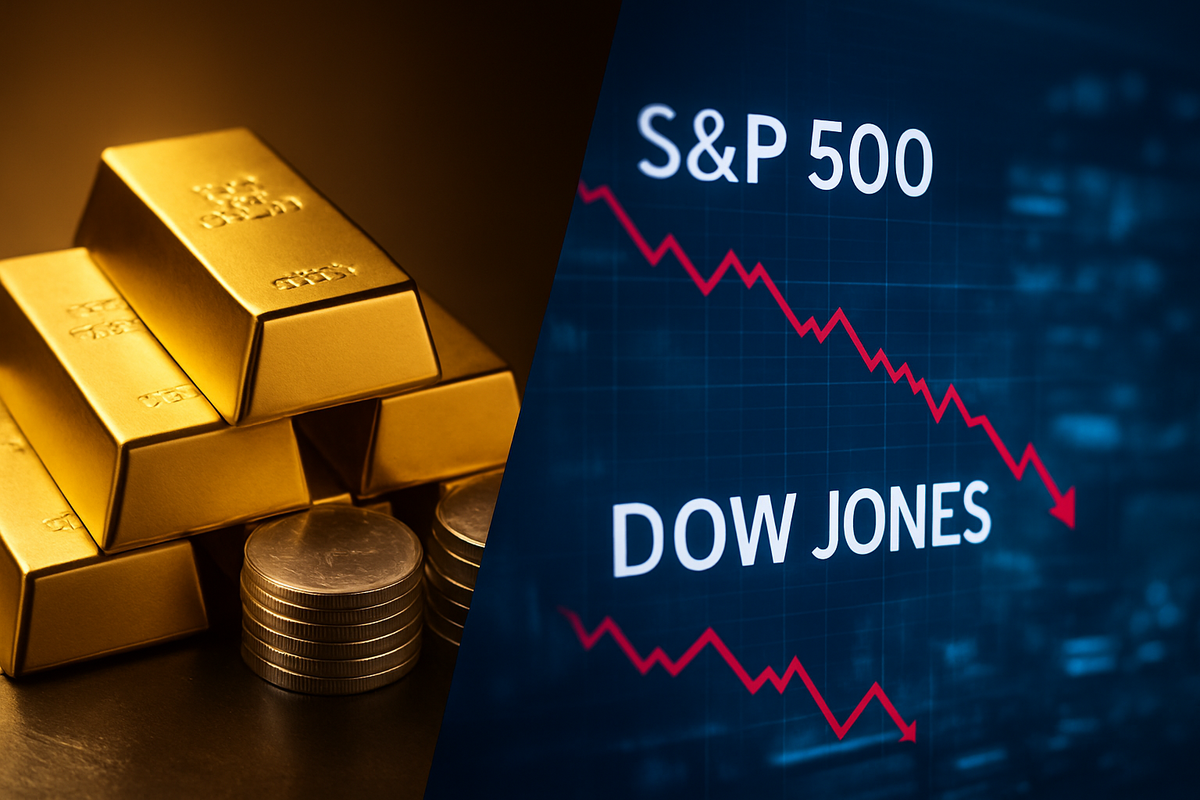
As the final trading days of 2025 unfold, a stark divergence has emerged on Wall Street, signaling a potential paradigm shift in investor sentiment. While the traditional "Santa Claus Rally" appears to have stalled for major equity benchmarks, precious metals are staging a ferocious comeback. On Tuesday, December 30, 2025, gold and silver prices rebounded sharply from a brief but intense "flash crash," even as the S&P 500 and the Dow Jones Industrial Average slipped for their second consecutive session.
This market decoupling highlights a growing "flight to quality" as investors grapple with a cocktail of geopolitical instability, a record-breaking $38 trillion U.S. national debt, and a cooling of the artificial intelligence euphoria that dominated the first half of the decade. As the SPDR S&P 500 ETF Trust (NYSEARCA:SPY) and the SPDR Dow Jones Industrial Average ETF Trust (NYSEARCA:DIA) showed signs of fatigue, the safe-haven rotation into hard assets accelerated, marking one of the most significant year-end shifts in recent financial history.
The Rebound of the "Metals of the Year"
The volatility witnessed in the final week of 2025 has been nothing short of extraordinary. On Monday, December 29, the precious metals market experienced a "corrective flush" that sent shockwaves through the trading pits. Gold, which had reached a record high of $4,585 per ounce just days prior, plummeted 4.4% in a single session. Silver, the undisputed "metal of the year" with year-to-date gains exceeding 150%, suffered an even more violent 9% crash, briefly dipping toward $72.15 per ounce.
The catalyst for Monday's carnage was largely technical. The CME Group, the world’s largest derivatives exchange, implemented a series of margin requirement hikes for gold and silver contracts, forcing over-leveraged traders to liquidate positions. However, the "dip-buyers" were waiting in the wings. By the morning of December 30, gold had reclaimed the $4,400 level, rising 1.7%, while silver staged a massive 7.7% recovery to trade near $75.50 per ounce.
This resurgence was fueled by a deteriorating geopolitical backdrop. News of renewed tensions between Russia and Ukraine, coupled with a U.S. naval blockade of Venezuelan oil tankers, sent investors scrambling for the perceived safety of the SPDR Gold Shares (NYSEARCA:GLD) and the iShares Silver Trust (NYSEARCA:SLV). Furthermore, a lingering 43-day U.S. government shutdown earlier in the quarter has left a "data blackout" in its wake, making the intrinsic value of gold more appealing than the uncertainty of corporate earnings reports.
Winners and Losers: Miners Rise as Tech Titans Retreat
The divergence between sectors has created a clear divide between the winners of the "tangible economy" and the losers of the "valuation correction." Leading the charge on the upside were the major mining houses, which acted as high-beta plays on the rebounding metal prices. Newmont Corporation (NYSE: NEM), the world’s largest gold miner, saw its shares rise 2.0% on Tuesday, recovering from a 6% drop the previous day. Similarly, Barrick Gold (NYSE: GOLD) gained 2.8%, buoyed by reports of record-breaking free cash flow generated during gold's historic 2025 run.
In the silver space, the recovery was even more pronounced. Pan American Silver (NYSE: PAAS) and Agnico Eagle Mines (NYSE: AEM) saw gains of 3.2% and 6.5% respectively, as industrial demand for silver—driven by the global AI-solar nexus—showed no signs of abating despite the temporary price volatility. Sibanye Stillwater (NYSE: SBSW) also emerged as a top performer, surging over 6% in early trading.
Conversely, the "Magnificent Seven" and other high-growth technology stocks continued to weigh on the broader indices. Tesla (NASDAQ: TSLA) led the decline, falling nearly 4.5% over the two-session slip as reports surfaced of a contraction in annual deliveries. Nvidia (NASDAQ: NVDA), the cornerstone of the AI revolution, dropped 2.5% as investors questioned whether the massive capital expenditures in AI infrastructure were beginning to yield diminishing returns. Other notable decliners included Palantir Technologies (NASDAQ: PLTR) and Meta Platforms (NASDAQ: META), both of which faced profit-taking after a year of stellar performance.
A Structural Shift in Global Finance
The current market divergence is more than just a year-end anomaly; it is the culmination of several long-term trends that have reached a boiling point in late 2025. The most prominent of these is the accelerating trend of "de-dollarization." With the U.S. national debt crossing the $38 trillion threshold this year, global central banks have been rotating out of U.S. Treasuries at a record pace, opting instead for gold as a politically neutral reserve asset.
Historically, such a rotation occurs when the market perceives that the Federal Reserve is "behind the curve" or when fiscal stability is in question. Despite the Fed delivering three rate cuts in late 2025, bringing the benchmark rate to a range of 3.50%–3.75%, the internal divisions revealed in the FOMC minutes have left investors uneasy about the 2026 path. The government shutdown earlier this year only added to the narrative of institutional instability, further legitimizing the pivot toward hard assets.
Furthermore, the "AI fatigue" currently hitting the S&P 500 mirrors the dot-com era's transition from speculative growth to value-oriented stability. While companies like Oracle (NYSE: ORCL) continue to build massive data centers, the rising cost of debt and the sheer scale of investment required are beginning to strain balance sheets. In this environment, the simplicity and "zero-counterparty risk" of precious metals have become increasingly attractive to institutional fund managers.
The Road Ahead: Support Levels and Policy Pivots
As we move into 2026, the immediate focus for traders will be whether gold can maintain its foothold above the $4,400 psychological support level. Technical analysts suggest that if the current rebound holds, the next target for gold could be the $5,000 mark by mid-2026, provided that geopolitical tensions do not subside. For silver, the volatility is expected to remain high, but the underlying industrial shortage remains a potent long-term catalyst.
In the short term, the market is bracing for the release of the final FOMC meeting minutes of the year. If the minutes suggest a more hawkish stance for 2026 to combat the inflationary pressures of a devalued dollar, equities could face further downward pressure. Conversely, any hint of a "pause" in rate adjustments could provide a temporary floor for tech stocks, though the momentum clearly favors the metals sector at this juncture.
Strategic pivots are already underway at major hedge funds. We are seeing a move away from the "60/40" portfolio toward a more "commodity-heavy" allocation. Investors should watch for potential regulatory changes as well; if the volatility in silver continues to disrupt industrial supply chains, there may be calls for increased oversight of commodity derivatives and margin requirements.
Closing Thoughts: A New Era for Investors
The events of December 30, 2025, serve as a potent reminder that market leadership is never permanent. The era of "easy money" and tech-driven dominance is being challenged by the cold reality of fiscal deficits and geopolitical friction. The rebound in gold and silver, occurring simultaneously with a slip in the S&P 500 and Dow, suggests that the market is re-pricing risk in a fundamental way.
For investors, the key takeaway is the importance of diversification into non-correlated assets. While the tech giants of the Nasdaq remain formidable, the "Great Rotation" into precious metals provides a necessary hedge against the systemic risks that have characterized the latter half of 2025. Moving forward, the relationship between the U.S. dollar, the national debt, and the performance of the mining sector will be the most critical metrics to watch.
As the curtain closes on 2025, the "Santa Claus Rally" may be missing from Wall Street, but for those holding gold and silver, the year is ending on a high note. The market is no longer just betting on growth; it is now betting on resilience.
This content is intended for informational purposes only and is not financial advice.