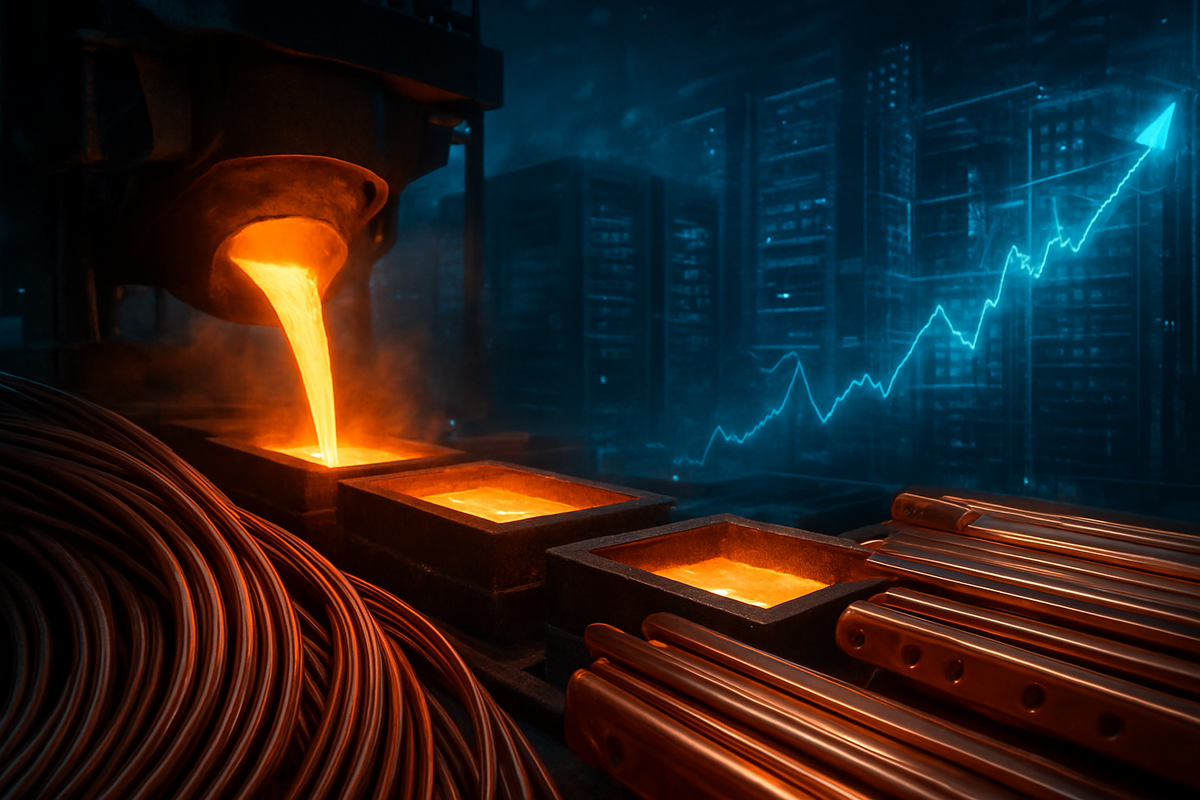
As 2025 draws to a close, the global commodities market is grappling with a historic transformation in the copper sector. The "red metal," long considered a barometer for global economic health, has shattered all previous price records, peaking at an extraordinary $12,960 per metric ton on the London Metal Exchange (LME) this week. This 40% annual surge represents the strongest performance for the metal in over fifteen years, driven by a convergence of technological shifts and geopolitical volatility that few analysts fully anticipated at the start of the year.
The immediate implications of this rally are being felt across the globe, from the boardrooms of Silicon Valley to the industrial hubs of East Asia. As copper futures on the COMEX hit a record $5.964 per pound earlier this summer, the cost of the energy transition and the build-out of artificial intelligence infrastructure has skyrocketed. For the broader market, this "super-squeeze" has signaled the end of cheap industrial inputs, forcing a massive strategic realignment among manufacturers and energy providers who now face a structural deficit that could last well into the next decade.
A Year of Unprecedented Volatility and Record Peaks
The 2025 copper rally was not a linear ascent but rather a series of explosive surges punctuated by dramatic policy shifts. The timeline of the "Perfect Storm" began in the first half of the year as the global AI boom transitioned from software hype to hardware reality. By mid-2025, it became clear that the massive data centers required to power generative AI were significantly more copper-intensive than traditional facilities. Analysts found that modern AI hubs require between 0.9 and 1.3 tons of copper per megawatt of capacity—nearly ten times the intensity of older data centers. This "generational" demand driver added an estimated 110,000 metric tons of consumption to the market in 2025 alone.
However, the defining moment of the year occurred on July 30, 2025, when a chaotic policy shift in the United States sent shockwaves through the futures markets. Following the implementation of a 50% tariff on semi-finished copper products, a sudden clarification that refined copper cathodes would remain exempt triggered a record 18% single-day plunge in COMEX prices. This "tariff-beating" arbitrage trade caused a massive influx of metal into U.S. warehouses, leading to a historic 31% price spread between New York and London prices. By October, nearly 830,000 tons of copper were "economically trapped" in the U.S. as traders front-ran potential future levies.
The supply side provided no relief. Throughout 2025, a "barrage" of unplanned outages crippled global production. In Chile, the world's top producer, a deadly collapse and subsequent earthquake at the El Teniente mine, operated by state-owned Codelco, forced a drastic reduction in output. Simultaneously, the world’s second-largest copper mine, Grasberg in Indonesia—majority-owned by Freeport-McMoRan (NYSE: FCX)—declared force majeure in September following a catastrophic mudslide. These events, combined with persistent labor blockades at the Las Bambas mine in Peru, resulted in a 7% decline in global mined output for the year.
Winners and Losers in the New Copper Economy
The primary beneficiaries of the 2025 rally have been the "mega-miners" with diversified portfolios and low-cost operations. Freeport-McMoRan (NYSE: FCX) has seen its valuation surge despite the disruptions at Grasberg, as the high price environment more than compensated for volume losses. Similarly, BHP Group (NYSE: BHP) and Rio Tinto (NYSE: RIO) have reported record-breaking free cash flows, driven by their massive Australian and Chilean operations. Southern Copper Corporation (NYSE: SCCO) has also emerged as a winner, leveraging its vast reserves in Peru and Mexico to capture the record premiums in the North American market.
Conversely, the year has been disastrous for copper smelters, particularly in China. As mine supply tightened, the Treatment and Refining Charges (TC/RCs)—the fees miners pay smelters to process ore—plummeted to zero dollars per ton for 2026 benchmark contracts. This unprecedented collapse in margins has forced major Chinese processing hubs to announce 10% output cuts, further tightening the supply of refined metal. Antofagasta (LSE:ANTO) and Glencore (LSE:GLEN) have had to navigate a complex landscape of rising operational costs and geopolitical friction, with Glencore’s massive trading arm benefiting from the volatility while its mining margins faced pressure from inflationary headwinds in diesel and labor.
On the consuming end, the "losers" include mid-tier renewable energy developers and electrical grid contractors. Companies like Teck Resources (NYSE: TECK), which had been banking on a smooth ramp-up of its Quebrada Blanca project, faced operational delays that prevented them from fully capitalizing on the July price peaks. Meanwhile, tech giants and automotive manufacturers have seen their input costs for wiring and power distribution components rise by double digits, threatening the profit margins of the next generation of electric vehicles and AI hardware.
Wider Significance: A Fractured Global Market
The events of 2025 represent a fundamental shift in how industrial commodities are traded and valued. For decades, the copper market operated on a globalized, "just-in-time" model. That model has now been replaced by a "just-in-case" strategy defined by resource nationalism and trade barriers. The 50% U.S. tariff on copper products has effectively bifurcated the market, creating a "Fortress America" for copper where prices remain permanently higher than the rest of the world. This fits into a broader trend of "de-globalization" where critical minerals are treated as matters of national security rather than mere commodities.
Historically, the 2025 rally draws comparisons to the 2004-2006 "China Boom," but with a critical difference: the current surge is driven by a supply deficit that cannot be easily fixed by opening new mines. The regulatory environment has become significantly more stringent, with the "green-tape" of environmental permits extending the lead time for new mines to over 15 years. This has created a "regulatory bottleneck" that ensures supply will lag behind demand for the foreseeable future, a realization that has fundamentally changed the risk assessment for long-term investors in the sector.
Furthermore, the integration of AI into the demand equation has decoupled copper from traditional industrial cycles. In the past, a slowdown in global construction would have cooled copper prices. In 2025, however, even as some sectors of the economy softened, the relentless expansion of AI data centers provided a "floor" for demand. This suggests that copper has evolved into a "tech-commodity," its value tied as much to the digital revolution as to physical infrastructure.
The Road Ahead: 2026 and Beyond
Looking into 2026, the market is bracing for continued scarcity. With TC/RC fees at zero, the smelting industry is in a state of crisis that could lead to a permanent reduction in refined copper capacity in Asia. Short-term, we may see strategic pivots as manufacturers attempt to substitute copper with aluminum in certain applications, such as high-voltage transmission lines. However, for the high-density requirements of AI data centers and EV motors, copper remains irreplaceable, suggesting that the "substitution trade" will have a limited impact on overall demand.
Market opportunities are likely to emerge in the recycling and "urban mining" sectors. As the price of virgin copper remains above $12,000 per ton, the economics of recovering copper from old electronics and demolished infrastructure have become highly attractive. We expect to see major miners and tech firms forming strategic partnerships to secure "circular" supply chains, potentially leading to a new wave of M&A activity in the recycling space.
The potential for further geopolitical volatility remains the "wild card." If trade tensions between the U.S. and China escalate further, we could see retaliatory export quotas on refined metal, which would send prices into a vertical "blow-off top" scenario. Conversely, a resolution to the labor and social unrest in Peru could provide a temporary relief valve for supply, though it is unlikely to bridge the massive structural gap identified this year.
Summary of the 2025 Copper Super-Squeeze
The 2025 copper rally has been a landmark event in financial history, driven by the "perfect storm" of AI infrastructure needs, a 7% contraction in global mined supply, and aggressive trade tariffs. With record highs of $12,960 per ton on the LME, the red metal has cemented its status as the most critical material of the 21st-century economy. The year has seen massive windfalls for major producers like Freeport-McMoRan and BHP, while forcing a painful restructuring of the global smelting industry and increasing costs for the tech and energy sectors.
Moving forward, the market is no longer a single global entity but a fractured landscape of regional premiums and strategic stockpiles. Investors should watch closely for the 2026 production guidance from major miners and any further shifts in U.S. trade policy regarding refined metal. The "Copper Era" is firmly upon us, and the lessons of 2025 suggest that the volatility—and the record prices—may only be the beginning of a much longer structural shift in the commodities landscape.
This content is intended for informational purposes only and is not financial advice.