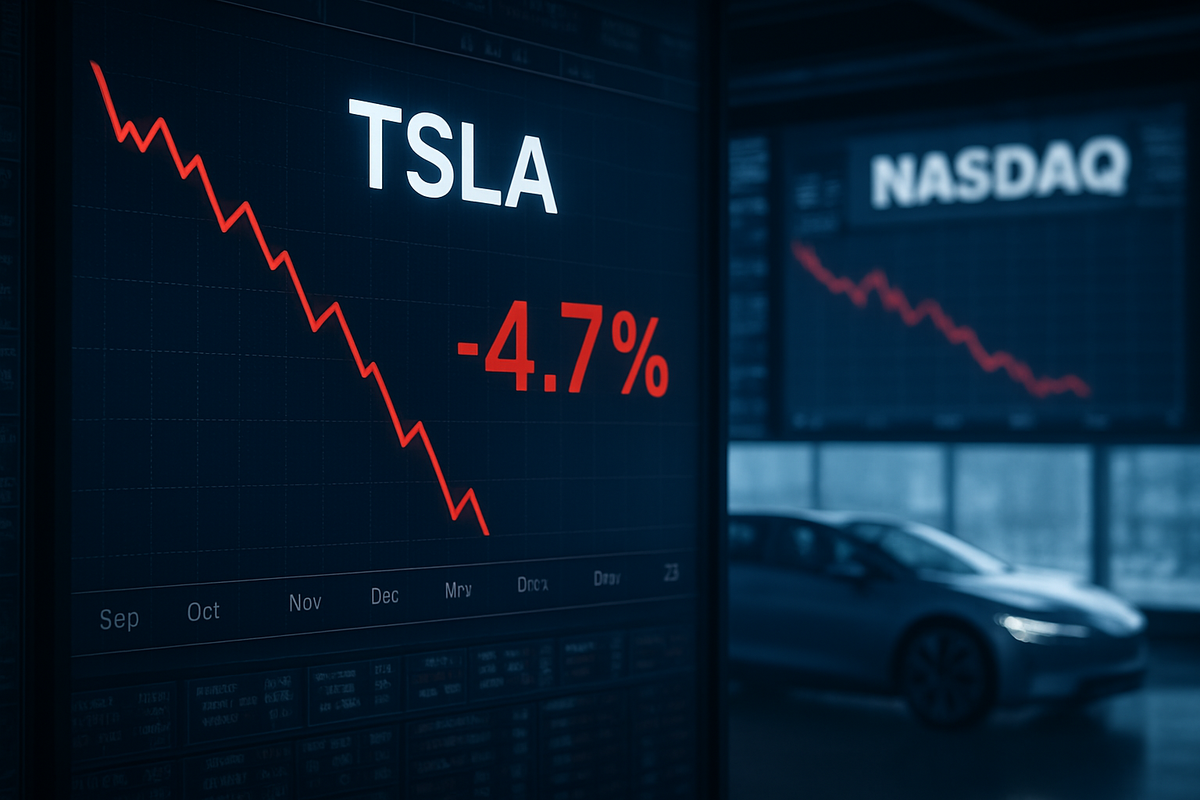
AUSTIN, Texas — In a sharp reversal of its recent record-breaking rally, Tesla (NASDAQ: TSLA) saw its shares slide nearly 4.5% in morning trading on Monday, December 29, 2025. The decline comes as investors grapple with a "perfect storm" of cooling demand following the expiration of federal tax credits and a looming delivery report that many analysts expect will show the company’s first significant year-over-year volume contraction.
The morning sell-off in Tesla has sent ripples through the broader tech sector, weighing heavily on the Nasdaq 100 (INDEXNASDAQ: NDX), which fell 1.2% in early trading. As the final week of 2025 commences, the market’s darling of the fourth quarter is facing a reality check, with the stock retreating from its December 22 all-time high of $498.83 to trade in the $470 range. The sudden volatility underscores a fragile year-end sentiment as the industry shifts its focus from hardware sales to the long-promised era of autonomous software and robotics.
The Post-Credit Cliff and a Soft Q4 Outlook
The immediate catalyst for Monday's downward pressure appears to be a combination of "tax credit exhaustion" and leaked internal delivery targets. Following the legislative repeal of the $7,500 federal EV tax credit in September 2025, Tesla experienced a massive "pull-forward" of sales into the third quarter. This has left the final quarter of the year significantly hollowed out. Analysts now project Q4 deliveries to land between 405,000 and 449,000 units—a figure that would cement a 7.7% annual decline in total vehicle deliveries for 2025, totaling roughly 1.65 million units.
This timeline of events marks a sobering end to a year that began with high hopes for "Project Redwood," Tesla’s affordable $25,000 vehicle. While pilot production for the next-gen model officially began at Giga Texas in June 2025, management recently signaled that volume production has been pushed to the second half of 2026. This delay, coupled with the "tax credit cliff," has shifted investor focus away from immediate growth and toward the company's narrowing margins. Furthermore, the market is reacting to the formal crowning of BYD (OTC: BYDDY) as the world’s largest BEV manufacturer, with the Chinese giant expected to end 2025 with over 2.1 million pure electric sales, officially surpassing Tesla on the global stage.
Winners and Losers in the Year-End Shift
The primary loser in this morning’s session is undoubtedly Tesla (NASDAQ: TSLA) and its retail-heavy investor base, which had been riding a wave of euphoria following the successful deployment of Full Self-Driving (FSD) v14 earlier this month. The retreat has wiped out billions in market capitalization in a matter of hours. Similarly, the Nasdaq 100 is feeling the burn; given Tesla’s heavy weighting in the index, the stock’s 4% drop is a primary driver behind the index’s lackluster start to the week.
Conversely, the "winners" in this environment appear to be diversified tech giants and international competitors who are less reliant on the U.S. consumer EV subsidy. BYD (OTC: BYDDY) continues to gain institutional favor as it demonstrates an ability to scale profitably without the same level of regulatory tailwinds required in the North American market. In the broader tech space, companies focused on "Agentic AI"—such as Microsoft (NASDAQ: MSFT) and Alphabet (NASDAQ: GOOGL)—are seeing a rotation of capital as investors move away from capital-intensive hardware like EVs and toward high-margin software ecosystems. Rivian (NASDAQ: RIVN) has also seen a minor uptick in relative strength, as investors bet that its R2 platform might capture the "premium-adventure" niche that Tesla’s aging Model 3 and Model Y lineup is currently struggling to defend.
The Death of the "Hardware Era" and the Rise of Autonomy
Tesla’s current struggle fits into a much broader industry trend: the saturation of the first-adopter EV market and the painful transition to mass-market adoption. The historical precedent of 2025 will likely be remembered as the year the "EV hardware" narrative died, replaced by a cutthroat price war and a pivot toward software-defined vehicles. The expiration of U.S. subsidies has leveled the playing field, forcing manufacturers to compete on raw cost efficiency—an area where Tesla still leads in the West but faces existential threats from Chinese manufacturers.
The ripple effects are also being felt in the regulatory sphere. While Tesla has made technical leaps with FSD v14, achieving a 6-fold improvement in miles between interventions using the "Cortex" supercomputer, regulatory bodies like the Dutch RDW in Europe have remained cautious. The lack of a "green light" for unsupervised driving in major markets by the end of 2025 has dampened the "Robotaxi" hype that sustained Tesla's valuation through the summer. Additionally, the aggressive tariff policies implemented throughout 2025 on imported components have increased the bill of materials for all U.S. automakers, creating a persistent inflationary headwind that even the Federal Reserve’s recent rate cuts have yet to fully offset.
What Lies Ahead: The 2026 Pivot
As we look toward 2026, Tesla is entering a critical "bridge year." The short-term challenge will be managing the narrative through a likely lackluster Q4 earnings call in January. To regain its momentum, the company must prove that the "Cybercab" pilot currently running in Austin can be scaled into a revenue-generating service by its April 2026 target. Any further delays in the $25,000 "Model 2" or Project Redwood will likely lead to further downward revisions from institutional heavyweights like JPMorgan (NYSE: JPM), who have already maintained a cautious stance on the stock's "growth without growth" fundamentals.
Market opportunities may emerge if Tesla can successfully transition its "Optimus" robot from the lab to the factory floor. Strategic pivots toward becoming an AI-licensing powerhouse—similar to how Nvidia (NASDAQ: NVDA) dominates the chip space—could decouple the stock price from its vehicle delivery numbers. However, the immediate hurdle remains the cooling labor market and the 4.6% unemployment rate, which may further dampen consumer appetite for big-ticket automotive purchases in the coming months.
Final Assessment for the 2026 Horizon
The final week of 2025 serves as a stark reminder that even the most dominant market leaders are not immune to macroeconomic shifts and the end of government largesse. The key takeaway for investors is that Tesla is no longer just a car company, but it is being priced like a software company while still carrying the heavy baggage of a manufacturing giant. The market is currently in a "show me" phase, demanding proof that FSD and robotics can translate into bottom-line profits to justify a near-$500 share price.
Moving forward, the Nasdaq's performance will likely remain tethered to the "Magnificent Seven's" ability to monetize AI. Investors should keep a close eye on the January delivery report and any commentary regarding the 2026 production ramp-of the next-gen platform. While the long-term vision of a robotic, autonomous future remains intact, the path to getting there is proving to be more volatile than many anticipated as we close the books on 2025.
This content is intended for informational purposes only and is not financial advice.