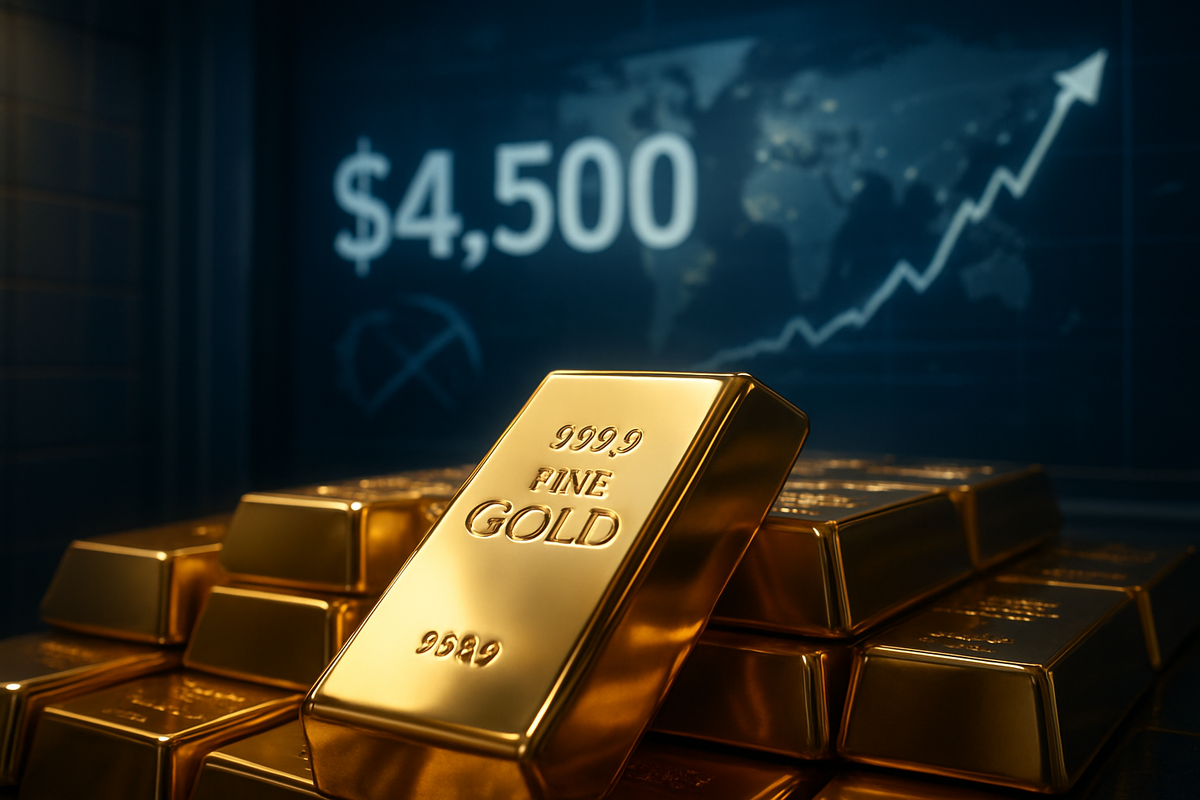
In a historic session that has fundamentally redefined the global commodities landscape, gold prices officially breached the $4,500-an-ounce mark on December 24, 2025. This unprecedented milestone represents the culmination of a vertical ascent that saw the precious metal gain approximately 70% in value over the course of the year. As of this morning, spot gold peaked at $4,525.19 per ounce, while February 2026 futures on the COMEX exchange reached as high as $4,555.10, signaling a profound shift in investor sentiment toward the world’s oldest safe-haven asset.
The immediate implications of this rally are being felt across global financial centers. The surge reflects a growing lack of confidence in traditional fiat currencies and "risk-free" government debt, as investors scramble to hedge against a unique combination of loosening U.S. monetary policy and a deteriorating geopolitical environment. This milestone is not merely a psychological victory for gold bugs but a structural realignment of the global financial order, where gold is increasingly being treated as a "sanctions-resistant" pillar of monetary sovereignty.
The Road to $4,500: A Timeline of Volatility and Policy Pivots
The journey to $4,500 began in earnest during the first half of 2025, when gold broke through the long-standing $3,000 resistance level. However, the true acceleration occurred in the final quarter of the year. A critical catalyst arrived in mid-December when the Federal Reserve implemented a 25-basis-point interest rate cut—its third reduction of 2025. This move brought interest rates to their lowest levels in three years, significantly reducing the opportunity cost of holding non-yielding assets like gold. Simultaneously, the U.S. Dollar Index (DXY) slipped to multi-year lows, further propelling the dollar-denominated price of bullion.
Beyond interest rates, institutional instability within the United States played a pivotal role. The U.S. national debt crossing the $38 trillion mark, coupled with a 22-day federal government shutdown in October 2025, eroded market trust in U.S. Treasuries. This "fiscal fatigue" drove a massive rotation out of bonds and into precious metals. Geopolitical tensions provided the final push; a U.S. naval blockade of oil tankers from Venezuela in December sparked fears of a wider regional conflict and energy supply disruptions, forcing institutional desks to increase their gold allocations almost overnight.
Key stakeholders in this rally include emerging market central banks, which have been purchasing gold at a record pace of over 1,000 tonnes annually. In 2025, Poland, Brazil, and India emerged as the most aggressive buyers. These institutions are increasingly viewing gold as a neutral intermediary asset that carries no sovereign risk—a vital characteristic in an era of "deglobalization" and weaponized finance.
Mining Giants and the Beneficiaries of the Bull Run
The meteoric rise in gold prices has transformed the balance sheets of the world’s largest mining companies, turning the sector into a top performer for 2025. Newmont Corporation (NYSE: NEM) has seen its stock price surge by over 170% year-to-date, trading near $104.88. Following its strategic merger with Newcrest, Newmont reported a record free cash flow of $4.5 billion in the first three quarters of 2025 alone. The company has leveraged these windfall profits to announce aggressive dividend hikes and share buyback programs, making it a primary vehicle for investors looking to gain leveraged exposure to the gold price.
Similarly, Barrick Gold Corporation (NYSE: GOLD) has seen its valuation jump by 181% this year. Barrick’s ability to resolve long-standing disputes in regions like Mali, combined with its expanding copper portfolio, has allowed it to capitalize on the high-price environment more effectively than in previous cycles. Meanwhile, Agnico Eagle Mines Limited (NYSE: AEM) has outperformed many of its peers in cost efficiency. Trading at roughly $179.89, Agnico Eagle has maintained industry-leading All-In Sustaining Costs (AISC), allowing it to post record quarterly earnings of $815 million by tapping into high-grade assets in Canada and Finland.
Conversely, the "losers" in this scenario include sectors sensitive to rising raw material costs, such as the high-end jewelry industry and certain electronics manufacturers. Central banks in developed nations that did not diversify into gold early enough are also facing a relative decline in the value of their foreign exchange reserves compared to their emerging-market counterparts.
A New Era of De-dollarization and Monetary Sovereignty
The significance of gold hitting $4,500 extends far beyond the trading floor; it fits into a broader industry trend of "de-dollarization." As the U.S. continues to use the dollar as a tool of foreign policy, nations are looking for alternatives that cannot be frozen or seized. Gold, which has no counterparty risk, has become the ultimate sanctuary. This trend is causing ripple effects among U.S. allies and competitors alike, as countries reconsider the composition of their national reserves.
Historically, this rally draws comparisons to the late 1970s, when high inflation and geopolitical instability led to a massive spike in gold prices. However, the 2025 rally is distinct because it is driven by structural debt concerns rather than just temporary inflation. Regulatory bodies are now facing pressure to re-evaluate the role of gold in the banking system, with some analysts suggesting that gold could eventually be reintegrated into a more formal role within global trade settlements to provide stability against fluctuating fiat values.
The Path Forward: $5,000 in Sight or a Technical Correction?
As the market looks toward 2026, the primary question is whether this momentum can be sustained. Major investment banks, including Goldman Sachs and JPMorgan, have already revised their 2026 targets upward, with several prominent analysts predicting a move toward $5,000 per ounce. Short-term, the market remains highly sensitive to the Federal Reserve's "dot plot" and the potential for further rate cuts. If the Fed continues its easing cycle as expected, the floor for gold prices is likely to remain high.
However, a rally of 70% in a single year often precedes a technical correction. Strategic pivots may be required if geopolitical tensions—specifically the Venezuelan blockade—de-escalate, which could remove some of the "risk premium" currently baked into the price. Market participants should also watch for any potential regulatory shifts regarding digital gold or central bank digital currencies (CBDCs), which may attempt to compete with physical bullion as a reserve asset.
Conclusion: A Milestone for the Ages
The breach of the $4,500 mark is a watershed moment for the precious metals market, marking the end of the "low-volatility" era for gold. The key takeaways from this event are clear: the combination of aggressive monetary easing, unsustainable national debt levels, and a fractured geopolitical landscape has restored gold to its status as the ultimate arbiter of value.
Moving forward, the market is expected to remain in a "buy-on-dip" regime as long as real interest rates stay low and global tensions remain high. Investors should closely monitor the Fed’s 2026 policy path and the ongoing shifts in central bank reserve strategies. While the $4,500 milestone is a historic peak, it may also be the foundation for a new, higher baseline in a world that is increasingly wary of traditional financial systems.
This content is intended for informational purposes only and is not financial advice.