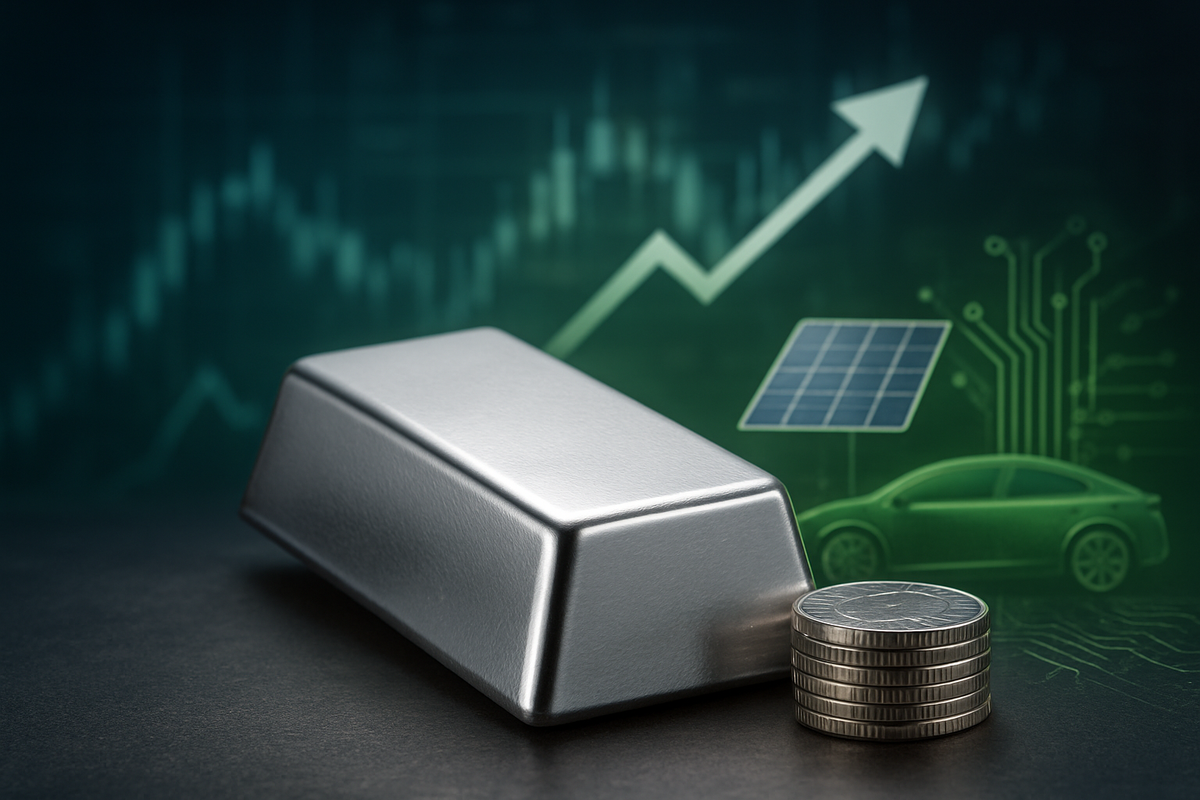
As of December 17, 2025, the price of silver has reached unprecedented levels, trading firmly between $65.76 and $66.03 per troy ounce, marking a new all-time high. This remarkable surge, reflecting a staggering 120% year-to-date increase and approximately 30% in the past month alone, underscores silver's escalating importance as a dual-faceted asset: a robust hedge against inflation and an indispensable industrial commodity driving the global green energy transition. In an economic climate fraught with uncertainty, investors are increasingly turning to the gleaming metal to preserve purchasing power, while its critical role in solar panels, electric vehicles, and advanced electronics solidifies its fundamental demand.
The current economic landscape, characterized by persistent inflationary pressures and accommodative monetary policies, has significantly bolstered silver's appeal. Its tangible nature offers a safeguard against the depreciation of fiat currencies, a historical strength that is now amplified by a structural supply deficit and booming industrial consumption. This unique combination of monetary and industrial utility positions silver as a compelling asset for both institutional and retail investors seeking stability and growth in volatile markets.
Unpacking the Silver Surge: A Confluence of Factors
The dramatic ascent of silver prices to over $66 per ounce by December 17, 2025, is not a singular event but the culmination of several powerful, interconnected forces. The market has been grappling with a structural supply deficit for five consecutive years, accumulating approximately 800 million ounces since 2021 – nearly a full year of global production. Inventories on major exchanges like the London Metal Exchange and COMEX have plummeted to historic lows, creating a physical market squeeze that has exacerbated price pressures.
Adding fuel to this fire is exploding industrial demand, particularly from the burgeoning green technology sectors. Industrial fabrication of silver reached a record high in 2025, with the solar photovoltaic (PV) industry, electric vehicle (EV) manufacturing, and data center infrastructure proving to be insatiable consumers. Modern EVs, for instance, incorporate three times the silver content of conventional vehicles, while solar panels remain highly reliant on silver paste for efficiency. Silver's unique properties—superior electrical conductivity and corrosion resistance—make it exceedingly difficult to substitute in these high-performance applications, ensuring sustained and growing demand.
Furthermore, accommodative monetary policies have provided a significant tailwind. A mixed US jobs report, indicating rising unemployment alongside increased payrolls, led to expectations of the Federal Reserve either holding steady or implementing rate cuts. In December 2025, the Fed indeed cut interest rates by 25 basis points and initiated $40 billion in monthly Treasury bill purchases, a move characterized by some as "mini-quantitative easing." Such policies tend to reduce the opportunity cost of holding non-yielding assets like precious metals and can weaken the US dollar, making dollar-denominated commodities more attractive to international buyers. This environment has intensified investor participation, leading to substantial positive ETF inflows and silver outperforming gold, nearly doubling year-to-date.
Corporate Fortunes: Winners and Challengers in the Silver Boom
The unprecedented surge in silver prices to over $66 per ounce is creating a clear divide between beneficiaries and those facing significant cost pressures across various public companies.
Silver mining companies are unequivocally positioned as the primary winners. Higher silver prices directly translate into substantially increased revenues and expanded profit margins, leveraging their relatively stable fixed costs. This financial boon allows miners to reduce debt, fund crucial exploration and development projects, and potentially return capital to shareholders. Major players poised for significant gains include Pan American Silver Corp. (NASDAQ: PAAS, TSX: PAAS), one of the world's largest primary silver producers with extensive operations across the Americas. Similarly, First Majestic Silver Corp. (NYSE: AG, TSX: AG), focused on Mexican silver mines, and Hecla Mining Company (NYSE: HL), the largest primary silver producer in the US and Canada, will see substantial uplifts in their financial performance. Precious metals streaming companies like Wheaton Precious Metals Corp. (NYSE: WPM) are also major beneficiaries, as their business model involves purchasing silver at fixed, low costs and selling it at prevailing market rates, leading to exceptionally high profit margins in the current environment. Other notable winners include Fresnillo PLC (LSE: FRES), Coeur Mining, Inc. (NYSE: CDE), Endeavour Silver Corporation (NYSE: EXK, TSX: EDR), and Silvercorp Metals Inc. (TSX: SVM).
Conversely, silver-consuming industries face considerable challenges due to elevated material costs, which could squeeze profit margins or necessitate higher product prices. The solar industry, with major manufacturers like First Solar, Inc. (NASDAQ: FSLR) and JinkoSolar Holding Co., Ltd. (NYSE: JKS), relies heavily on silver paste. With silver at over $66 per ounce, silver can account for a significant portion of solar module production costs, exacerbating financial pressures. While "thrifting" efforts aim to reduce silver content, the sheer volume of global solar installations means overall consumption continues to rise, forcing manufacturers to absorb costs or pass them on.
The electric vehicle (EV) industry, including giants like Tesla, Inc. (NASDAQ: TSLA), General Motors Company (NYSE: GM), and Ford Motor Company (NYSE: F), also faces headwinds. EVs use substantially more silver (25-50 grams per vehicle) than traditional internal combustion engine vehicles (15-28 grams), primarily in battery management systems and power electronics. The rapid expansion of the EV market means higher silver prices translate directly into increased material costs, potentially impacting vehicle affordability and adoption rates or reducing profitability for manufacturers. Similarly, the broader electronics industry, which utilizes silver in printed circuit boards, connectors, and semiconductors for 5G infrastructure and data centers, will experience rising production costs. While silver's superior conductivity makes substitution difficult, these companies may need to strategically reprice products or invest heavily in R&D for alternatives, though with potential performance trade-offs.
Wider Significance: A Critical Mineral in a Shifting Global Economy
The ascent of silver past the $66 mark by December 17, 2025, carries profound wider significance, signaling fundamental shifts in global economic trends, energy policies, and commodity markets. This event underscores silver's evolving role beyond a mere precious metal, solidifying its status as a critical industrial input for the 21st century.
This price surge is deeply intertwined with broader industry trends, particularly the accelerating global transition to green technologies. The relentless push for renewable energy, spearheaded by massive solar photovoltaic installations, and the rapid electrification of transportation through electric vehicles, are creating an unprecedented, and largely price-inelastic, demand for silver. Silver's designation as a "critical material" by the U.S. government earlier in 2025 further highlights its strategic importance, indicating potential future policies aimed at securing domestic supply and enhancing supply chain resilience. This critical status places silver alongside other strategically vital minerals, underscoring its role in national security and economic stability.
The potential ripple effects extend across numerous sectors. For silver mining companies, the high prices incentivize increased exploration and development, though the predominantly byproduct nature of silver production (70-72% from other metal mines) limits rapid supply responses. This inelasticity means that even with soaring prices, supply expansion will be slow, prolonging the market deficit. For silver-consuming industries, the cost pressures are accelerating innovation in "thrifting" (reducing silver content) and the search for alternative materials. While copper and nickel are being explored, silver's unique properties often make direct substitution challenging without compromising performance, forcing difficult strategic decisions for manufacturers.
Regulatory and policy implications are also emerging. The "critical material" designation could lead to government support for domestic mining, recycling initiatives, or even strategic stockpiling. Furthermore, global green energy mandates and subsidies continue to underpin industrial silver demand, ensuring that policy decisions around renewable energy and electrification will have a direct impact on silver's market dynamics. Trade policies and tariffs on silver-intensive products could also introduce volatility and affect manufacturing output.
Historically, silver has demonstrated its prowess as an inflation hedge during periods of economic turmoil. During the 1970s stagflation, silver surged by 1,546%. More recently, it gained 70% during the 2020-2021 inflationary cycle. The current rally draws parallels with the 2008-2011 financial crisis, when silver prices soared from approximately $10/oz to nearly $50/oz by 2011, driven by fears of inflation and unprecedented quantitative easing. However, the current scenario is unique due to the added dimension of structurally embedded industrial demand from green technologies, suggesting a more fundamental and sustained upward pressure on prices, rather than purely speculative forces.
What Comes Next: Navigating a Bullish Silver Market
The future outlook for silver, with prices firmly above $66 per ounce as of December 17, 2025, points towards a sustained bullish trend in both the short and long term. This trajectory is underpinned by the enduring trifecta of robust industrial demand, persistent supply deficits, and its established role as an inflation hedge.
In the short-term (2025-2026), analysts project continued upside for silver, with price targets generally ranging from the mid-$50s to mid-$60s, and some more aggressive forecasts seeing it touch $70 or even $100 per ounce by late 2026. The ongoing supply deficits, fueled by the insatiable demand from solar, EVs, 5G, and AI data centers, will continue to exert upward pressure. Investment demand, driven by macroeconomic uncertainty and expectations of further accommodative monetary policies, will also remain strong.
The long-term (2027-2035) outlook is even more optimistic, with some predictions for silver reaching $133-$143 per ounce by 2027-2030, and even exceeding $200-$300 per ounce within the next 5-10 years. This long-term appreciation is rooted in deepening structural deficits, the accelerating global green energy transition (particularly solar PV, with projections of a 170% increase in demand from solar by 2030), and the continued expansion of advanced technologies.
Strategic pivots and adaptations will be crucial for companies. Silver mining firms will focus on capitalizing on record profits by reducing debt, increasing dividends, and funding new exploration. Given the long lead times for new mines, expanding existing operations and reassessing previously uneconomic deposits will be key. For silver-consuming industries, managing costs and securing supply chains are paramount. This involves aggressive "thrifting" (reducing silver content), exploring recycling innovations, and strategically repricing products. While finding cost-effective substitutes for silver's unique properties remains challenging, R&D in this area will intensify.
Market opportunities are abundant for investors in physical silver, silver-backed ETFs like iShares Silver Trust (NYSEARCA: SLV) and Global X Silver Miners ETF (NYSEARCA: SIL), and silver mining stocks. The current gold-to-silver ratio, historically high, suggests silver may still be undervalued compared to gold, presenting a significant buying opportunity. The green technology sector's growth guarantees a strong fundamental base for silver consumption, creating a robust market for producers and innovators. However, market challenges include silver's inherent price volatility, supply inelasticity, geopolitical risks affecting mining operations, and the long-term risk of demand destruction if prices become prohibitively high, although this is less likely for critical applications.
Potential scenarios range from a "Silver Supercycle," driven by sustained industrial demand and deficits, pushing prices significantly higher, to a short-term correction followed by a renewed rally. A "Silver Squeeze" scenario, where depleting physical inventories lead to extremely sharp price spikes, remains a possibility. Ultimately, while technological innovation and increased recycling could eventually temper long-term price appreciation, the fundamental drivers suggest a strong upward trajectory, necessitating agile strategic adaptations across both silver mining and consuming industries.
A Glimmering Future: Silver's Enduring Significance
The current rally in silver prices, pushing the metal past $66 per ounce as of December 17, 2025, represents a pivotal moment in the financial markets. The key takeaway is silver's undeniable dual role: a vital inflation hedge in an era of economic uncertainty and an indispensable industrial commodity fueling the global green energy revolution. This unique combination provides a robust foundation for its value, distinguishing it from other precious metals.
Moving forward, the market will be characterized by a persistent structural supply deficit, driven by flat mine production and exploding demand from solar, electric vehicles, and advanced electronics. This fundamental imbalance, coupled with supportive monetary policies and ongoing investor interest in tangible assets, suggests a sustained bullish trajectory for silver prices. While volatility is inherent to the commodity, the underlying demand drivers are strong and long-term.
Investors should closely watch several factors in the coming months. These include further developments in central bank monetary policies, particularly any indications of future interest rate adjustments or quantitative easing measures. The pace of green technology adoption and innovation in silver "thrifting" within industrial applications will also be critical. Geopolitical events and their potential impact on supply chains from major silver-producing regions will continue to influence market dynamics. Finally, the evolving gold-to-silver ratio could offer insights into relative value and potential buying opportunities. Silver, with its glimmering future, is set to remain a significant and strategic asset in the global economy for years to come.
This content is intended for informational purposes only and is not financial advice