Date: March 3, 2026
Introduction
Target Corporation (NYSE: TGT) has long held a unique position in the American retail landscape, bridging the gap between the utilitarian bulk of big-box discounters and the aspirational curation of specialty boutiques. Often referred to by its affectionate nickname "Tar-zhay," the company has built a brand identity centered on "cheap-chic"—high-design products at accessible price points. However, as of early 2026, Target finds itself at a critical juncture. After navigating the volatile "homebody economy" of the early 2020s and a subsequent period of inventory and margin contraction, the company is now undergoing a significant leadership transition. With a new CEO at the helm and a shifting macroeconomic backdrop, investors are closely watching whether Target can reclaim its premium valuation or if it will remain shadowed by the logistical dominance of larger rivals.
Historical Background
Target’s roots trace back to 1902 when George Dayton founded Goodfellow Dry Goods in Minneapolis. The company evolved into the Dayton-Hudson Corporation, a department store powerhouse. It wasn't until 1962—the same year Walmart and Kmart were founded—that the first Target store opened in Roseville, Minnesota, as a discount offshoot.
Throughout the 1980s and 90s, Target distinguished itself through "design for all" partnerships with high-end designers like Michael Graves, which cemented its reputation for style. The 2000s saw the company divest its department store assets (Marshall Field’s and Mervyn’s) to focus entirely on the Target brand. A pivotal moment came in 2014 when Brian Cornell took the CEO role following a massive data breach and a failed expansion into Canada. Under Cornell’s "stores-as-hubs" strategy, Target successfully integrated its physical footprint with its digital platform, a move that proved visionary during the 2020-2021 pandemic boom.
Business Model
Target operates as a general merchandise retailer through more than 1,900 stores across the United States. Its revenue model is diversified across five core categories: Beauty & Household Essentials, Food & Beverage, Home Furnishings & Decor, Hardlines (electronics, toys), and Apparel & Accessories.
A cornerstone of Target’s business model is its "Owned Brands" portfolio. Brands like Good & Gather, Cat & Jack, and Threshold generate approximately 30% of total sales. These private labels offer higher margins than national brands and foster intense customer loyalty. Furthermore, Target has pioneered the "store-within-a-store" concept, partnering with premium brands like Ulta Beauty, Starbucks, and Disney to drive foot traffic and basket size.
Stock Performance Overview
As of March 2, 2026, Target’s stock was trading at approximately $113.17. The performance history reflects a roller-coaster decade for shareholders:
- 1-Year Performance: Down roughly 9%. The stock has been weighed down by sluggish comparable sales and the costs associated with upgrading store security and supply chain automation.
- 5-Year Performance: Down nearly 35%. This steep decline highlights the "hangover" effect from the stock’s all-time high of over $232 in late 2021. The market has repriced TGT as growth in discretionary spending cooled.
- 10-Year Performance: Up 83.6%. Investors who held through the decade have seen nearly a doubling of value, largely driven by the company’s digital transformation and the success of its omnichannel fulfillment (Drive Up, Shipt).
Financial Performance
Fiscal Year 2025 was a year of stabilization for Target. The company reported total revenue of $104.8 billion, a slight year-over-year decrease of 1.7%. Comparable sales dipped 2.6%, reflecting a consumer base that remains cautious about non-essential purchases.
Despite the top-line pressure, Target maintained a healthy gross margin rate of 27.9%. While merchandising markdowns to clear excess seasonal inventory pressured margins, these were partially offset by the high-margin growth of its advertising arm. Net income for 2025 stood at $4.091 billion, with GAAP Earnings Per Share (EPS) of $8.13. The company enters 2026 with a sharpened focus on cost discipline and inventory management to protect the bottom line.
Leadership and Management
A new era began on February 1, 2026, as Michael Fiddelke stepped into the CEO role. Fiddelke, a 20-year Target veteran and former COO/CFO, succeeded Brian Cornell, who transitioned to the role of Executive Chair of the Board.
Cornell is credited with saving Target from obsolescence during the mid-2010s, but the market is now looking to Fiddelke to navigate a more complex era defined by AI integration and rising "retail shrink." Fiddelke is viewed as a disciplined operational leader. His strategy for 2026, described as "back-to-basics," emphasizes merchandising authority and leveraging technology to reduce friction in the guest experience.
Products, Services, and Innovations
Target continues to innovate in the "Retail Media" space. Its advertising division, Roundel, has become a major profit engine, generating nearly $2 billion in annual value by 2026. This allows Target to monetize its vast first-party shopper data, selling targeted ad placements to consumer-packaged goods (CPG) companies.
In terms of services, Target Circle 360—the company’s revamped loyalty and subscription program—has seen steady adoption. It competes directly with Amazon Prime and Walmart+, offering unlimited same-day delivery via Shipt. On the product front, the company continues to refresh its grocery offerings, adding over 600 new items to its Good & Gather label in 2025 to capture more "frequent trip" shoppers.
Competitive Landscape
Target occupies a precarious middle ground in a retail world dominated by scale:
- Walmart (WMT): The undisputed price leader. With over $675 billion in domestic sales, Walmart has successfully attracted higher-income shoppers who are "trading down," putting pressure on Target’s core demographic.
- Amazon (AMZN): The logistics titan. While Target’s e-commerce is robust (~1.9% US market share), it pales in comparison to Amazon’s 37.6%. Amazon’s speed remains the gold standard.
- Costco (COST): A major rival for high-income suburban families. Costco’s membership model provides a level of recurring revenue and loyalty that Target is still trying to replicate with its loyalty tiers.
Industry and Market Trends
In 2026, the retail sector is defined by two major shifts: Retail Media and Omnichannel 2.0. Retailers are no longer just selling products; they are becoming media platforms. Target’s ability to grow Roundel is essential for offsetting the thin margins of grocery and essentials.
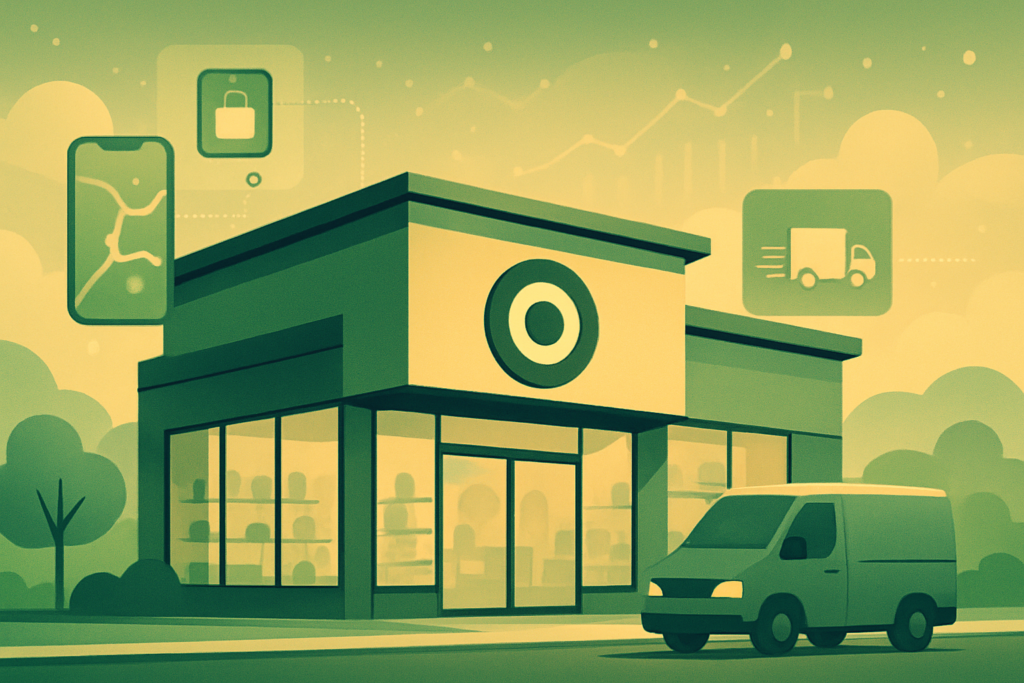
Additionally, the "Stores-as-Hubs" model has matured. Nearly 97% of Target’s online orders are fulfilled by its physical stores. This reduces shipping costs and delivery times, but it requires a sophisticated labor and tech stack to manage inventory in real-time across thousands of locations.
Risks and Challenges
The most prominent operational risk for Target is Inventory Shrink. In 2025, the company reported losses of approximately $500 million due to organized retail crime and shoplifting. This has led to controversial but necessary measures, such as limiting self-checkout to 10 items or fewer and locking up high-theft categories like beauty products.
Furthermore, Target is highly sensitive to discretionary spending. Unlike Walmart, which derives more than half of its sales from groceries, Target leans heavily on home decor, apparel, and electronics. If the US economy experiences a cooling period in mid-2026, Target’s "cheap-chic" items are often the first to be cut from consumer budgets.
Opportunities and Catalysts
- Operational Efficiency: Under CEO Michael Fiddelke, Target is investing heavily in AI-driven supply chain tools to predict demand more accurately and reduce the need for margin-killing markdowns.
- Grocery Expansion: By expanding its owned-brand food labels, Target aims to move from a "discretionary destination" to a weekly necessity, increasing the frequency of store visits.
- Market Share Recovery: If inflation continues to stabilize, the "aspirational" shopper—who may have traded down to dollar stores or Walmart in 2024—may return to Target for the curated experience they prefer.
Investor Sentiment and Analyst Coverage
Wall Street sentiment on Target is currently Neutral/Hold. Analysts have a median price target of $105.00–$107.00, suggesting the stock may be slightly overextended at its current $113 level. While institutional investors appreciate Target’s dividend history and Roundel’s growth, there is a "wait and see" attitude regarding the leadership transition and the company's ability to stem the tide of inventory shrink.
Regulatory, Policy, and Geopolitical Factors
The regulatory environment in 2026 presents several hurdles. The "One Big Beautiful Bill Act" (OBBBA), signed in late 2025, has introduced changes to tax structures for hourly workers ("No Tax on Tips/Overtime"), which may help Target’s labor retention but also complicates payroll compliance.
More concerning are the new trade tariffs enacted in early 2026. Because Target imports a significant portion of its apparel and electronics, these tariffs could force the company to either raise prices (risking customer loss) or absorb the costs (hurting margins). Additionally, the FTC is increasing scrutiny on subscription models like Target Circle 360, requiring more transparent "easy-to-cancel" features.
Conclusion
Target Corporation enters the mid-2020s as a leaner, more technologically integrated version of its former self, yet it faces an uphill battle against the sheer scale of Walmart and Amazon. The success of the "Fiddelke era" will depend on the company’s ability to balance its "cheap-chic" identity with the cold realities of retail security and macro-inflationary pressures.
For investors, Target remains a high-quality retail play with a formidable private-label engine and a burgeoning media business. However, the stock’s performance in 2026 will likely hinge on whether it can prove that its stores are safe, its inventory is protected, and its "Owned Brands" can keep the American consumer coming back even when their wallets are tight.
This content is intended for informational purposes only and is not financial advice.