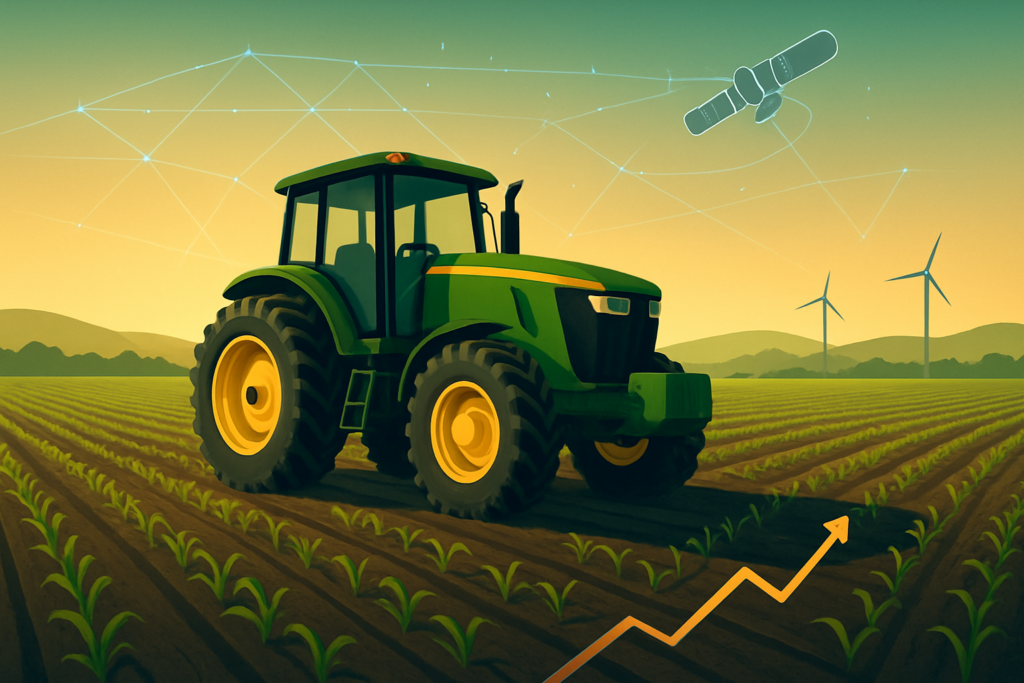
As of March 17, 2026, Deere & Company (NYSE: DE) stands at a pivotal crossroads between its 189-year heritage as a blacksmith-founded manufacturer and its future as a global technology powerhouse. Often synonymous with the rugged "green and yellow" tractors seen across the American heartland, the company has spent the last decade aggressively re-engineering its identity. Today, Deere is less about the "iron" and more about the "silicon." In an era defined by labor shortages, climate volatility, and thinning farm margins, Deere’s evolution into a "Smart Industrial" leader is no longer a strategic choice—it is the central pillar of its survival and growth. This deep-dive explores how the world’s largest agricultural machinery company is navigating a cyclical downturn by betting on autonomous systems, satellite connectivity, and high-margin recurring software revenue.
Historical Background
The story of Deere & Company began in 1837 when John Deere, a blacksmith in Grand Detour, Illinois, noticed that local farmers were struggling to plow the thick, sticky Midwestern soil with traditional iron plows. His invention of the self-scouring steel plow revolutionized American agriculture and laid the foundation for an industrial empire. Incorporated in 1868, the company survived the Great Depression and multiple world wars by consistently innovating.
The 20th century was marked by the 1918 acquisition of the Waterloo Boy tractor company, which transitioned Deere from an implement maker to a power-machinery leader. By the 1950s, the company expanded into construction and forestry, creating a diversified industrial base. However, the most significant transformation began in 2017 with the acquisition of Blue River Technology. This $305 million deal signaled to the market that Deere’s future would be built on computer vision, machine learning, and artificial intelligence, rather than just horsepower and steel.
Business Model
Deere & Company operates through four primary business segments, each integrated into a centralized "Smart Industrial" operating model:
- Production & Precision Ag: The flagship segment, focusing on large-scale grain, cotton, and sugar production. It delivers high-horsepower tractors and combines integrated with precision technology.
- Small Ag & Turf: Serves mid-sized farms, livestock producers, and the professional landscaping/turf market. This segment is increasingly focused on electrification and smaller autonomous units.
- Construction & Forestry: Provides a broad range of earthmoving and timber-harvesting equipment. This segment has benefited significantly from global infrastructure tailwinds in 2025 and 2026.
- Financial Services: Primarily finances sales and leases of new and used equipment. It remains a critical profit driver, managing a multi-billion dollar portfolio of retail notes and revolving credit.
Stock Performance Overview
Over the last decade, Deere has transitioned from being valued as a cyclical industrial stock to receiving a valuation premium more typical of a technology company.
- 10-Year Performance: As of March 2026, the stock has delivered a staggering 733.4% return, vastly outperforming the broader S&P 500. This reflects the market’s realization of the "Tech-as-a-Service" potential in agriculture.
- 5-Year Performance: The stock is up approximately 64.7%. This period saw the 2021–2023 "super-cycle" in farm equipment, followed by a necessary correction in 2024.
- 1-Year Performance: A robust 25.3% recovery. After bottoming out in late 2024 due to high interest rates and lower commodity prices, the stock has rallied in early 2026 as investors anticipate the next technology-led replacement cycle.
Financial Performance
The fiscal year 2025 was a "reset year" for Deere. After record-breaking profits in 2023, the company saw net income pull back to $5.027 billion on total revenue of $45.68 billion. This decline of nearly 29% from peak levels was widely expected by analysts as the post-pandemic equipment boom normalized.
However, the Q1 2026 results released recently have changed the narrative. Deere reported a "beat-and-raise" quarter, with earnings per share (EPS) of $2.42, surpassing the consensus estimate of $2.02. This was driven by surprising resilience in the Construction & Forestry segment and higher-than-expected take-rates for its "See & Spray" technology. For the full year 2026, management has raised its net income guidance to between $4.5 billion and $5.0 billion, suggesting the cyclical trough is firmly in the rearview mirror.
Leadership and Management
Under the leadership of CEO John May, who took the helm in 2019, Deere has doubled down on its "Leap Ambitions." These are a set of aggressive operational and sustainability goals for 2026 and 2030. May is widely respected for his ability to bridge the gap between traditional manufacturing and high-tech software development.
Key pillars of May’s strategy include:
- Recurring Revenue: Aiming for 10% of total revenue to come from software and subscription fees by 2030.
- Connectivity: Reaching 500 million "engaged acres" connected to the John Deere Operations Center by late 2026.
- Autonomy: Launching fully autonomous production systems for major row crops by the end of the decade.
Products, Services, and Innovations
Deere’s R&D pipeline is currently the most advanced in the heavy machinery industry. Key innovations include:
- Autonomous 8R Tractor: A fully driverless tractor that utilizes six pairs of stereo cameras and AI to navigate fields, detect obstacles, and process data without an operator in the cab.
- See & Spray
 Ultimate: A computer-vision system that distinguishes between weeds and crops in real-time, applying herbicide only where needed. This can reduce chemical usage by up to 67%, providing an immediate ROI for farmers.
 - Starlink Partnership: In 2024, Deere signed a landmark deal with SpaceX to equip machinery with Starlink satellite terminals. This solves the "connectivity gap" in rural areas, allowing tractors to upload and download massive datasets in real-time even in the most remote corners of the globe.
Competitive Landscape
While Deere remains the dominant force in North America, the competitive landscape is intensifying in the race for autonomy:
- CNH Industrial (NYSE: CNHI): Following its acquisition of Raven Industries, CNHI has become Deere’s most direct rival in precision technology. They focus on "open" platforms that can work across different brands.
- AGCO Corporation (NYSE: AGCO): AGCO is pursuing a "retrofit" strategy through its Precision Planting brand, allowing farmers to add advanced technology to older machines at a lower entry price.
- Caterpillar (NYSE: CAT): In the construction sector, Caterpillar remains the gold standard. While Deere is a strong secondary player, Caterpillar’s massive $51 billion backlog in early 2026 highlights the intense competition for global infrastructure projects.
Industry and Market Trends
The "Smart Industrial" shift is occurring against a complex macro backdrop. In March 2026, corn and soybean prices have stabilized (around $4.31 and $11.33 per bushel, respectively), but they remain well below the peaks of 2022. This "tight margin" environment actually favors Deere’s technology; when farmers can’t rely on high crop prices, they must rely on efficiency.
Additionally, labor shortages in rural areas are reaching a crisis point. This has turned autonomous machinery from a "luxury" into a "necessity" for many large-scale operations. Meanwhile, high interest rates, though moderating, continue to pressure equipment financing, favoring Deere’s robust Financial Services arm which can offer flexible lending terms to maintain market share.
Risks and Challenges
Despite its technological lead, Deere faces several headwinds:
- Right to Repair: The company continues to face legal and regulatory pressure regarding its proprietary diagnostic software. Critics argue that Deere’s restrictions force farmers into expensive dealership repairs. Recent 2026 EPA and FTC guidance may eventually force a more open software ecosystem, potentially impacting service margins.
- Cyclicality: Deere cannot fully escape the 5–7 year agricultural cycle. A prolonged global recession or a collapse in grain demand would severely impact the Production & Precision Ag segment.
- Geopolitics and Tariffs: As a global exporter, Deere is highly sensitive to trade tensions. The company has estimated that steel and aluminum tariffs could add up to $1.2 billion in pre-tax costs in 2026 if current trade disputes are not resolved.
Opportunities and Catalysts
- The "SaaS" Pivot: If Deere successfully reaches its goal of 10% recurring revenue from software, it will fundamentally change its valuation multiple, moving it closer to a "tech" P/E ratio.
- Emerging Markets: Precision agriculture is still in its infancy in South America and parts of Asia. Deere’s Starlink partnership is a key catalyst for growth in these regions where cellular infrastructure is lacking.
- Infrastructure Spend: Continued government spending on green energy and infrastructure in the U.S. and Europe provides a solid floor for the Construction & Forestry division.
Investor Sentiment and Analyst Coverage
Wall Street sentiment as of March 2026 remains a "Moderate Buy." Most analysts are encouraged by Deere’s ability to maintain operating margins in the 18–19% range even during a cyclical trough—a feat that was unheard of in previous decades.
The average price target among major firms like Goldman Sachs and Morgan Stanley sits at approximately $645.00, representing significant upside from current levels. Institutional ownership remains high, with major funds viewing Deere as a core "quality" industrial play that offers exposure to the unavoidable trend of agricultural automation.
Regulatory, Policy, and Geopolitical Factors
The regulatory environment is a double-edged sword for Deere. On one hand, government incentives for "climate-smart" agriculture—such as carbon credits and subsidies for precision spraying—directly drive demand for Deere’s high-tech implements.
On the other hand, the company must navigate increasingly strict emissions regulations and the aforementioned "Right to Repair" legislation. Furthermore, as a major consumer of high-grade steel and a manufacturer with a global footprint, Deere remains a bellwether for the impact of deglobalization and regional trade blocs on industrial profit margins.
Conclusion
Deere & Company is no longer a simple equipment manufacturer; it is a data and robotics company that happens to build very large machines. As of March 2026, the company has successfully navigated the post-pandemic "hangover" and is emerging with a leaner, more tech-centric business model.
For investors, the key will be watching the adoption rates of the Autonomous 8R and the growth of software subscriptions. If Deere can prove that its "Leap Ambitions" are more than just marketing jargon, the stock’s decade of outperformance may only be the beginning. However, the path is fraught with cyclical risks and regulatory hurdles that require a disciplined, long-term perspective. In the high-stakes game of global food security, Deere has positioned itself as the indispensable platform upon which the future of farming will be built.
This content is intended for informational purposes only and is not financial advice.