As of February 27, 2026, Baidu, Inc. (Nasdaq: BIDU; HKEX: 9888) stands at a critical crossroads in its quarter-century history. Long pigeonholed as the "Google of China," the Beijing-based tech giant is aggressively shedding its reputation as a mere search engine provider to emerge as a global leader in autonomous driving and generative artificial intelligence (AI).
Baidu has recently captured significant market attention following a "mixed" Q4 2025 earnings report that highlighted the friction of this transition: a contraction in legacy advertising offset by explosive growth in AI Cloud and its Apollo Go robotaxi business. For the first time in its history, the company has pivoted toward a shareholder-friendly capital allocation strategy, announcing its inaugural dividend policy alongside a massive $5 billion share buyback program. This move signals a new era of maturity and management confidence, even as the company navigates a complex geopolitical landscape and intensifying domestic competition.
Historical Background
Founded in January 2000 by Robin Li and Eric Xu, Baidu was born out of Li’s pioneering work on RankDex, a search engine algorithm that predated Google’s PageRank. Throughout the 2000s, Baidu successfully fended off international competitors to become the dominant portal for the Chinese internet, commanding over 70% of the country’s search market.
The company’s trajectory shifted significantly in 2010 when Google exited mainland China, leaving Baidu with an effective monopoly on search advertising. However, the rise of the mobile internet and "walled garden" ecosystems like Tencent’s WeChat and ByteDance’s Douyin eventually eroded Baidu's gatekeeper status. Recognizing this shift, Baidu began a "pivot to AI" as early as 2013, investing billions into deep learning, natural language processing, and autonomous driving. This decade-long R&D marathon culminated in the 2023 launch of "Ernie Bot," China’s first major answer to ChatGPT, and the rapid commercialization of the Apollo autonomous driving platform.
Business Model
Baidu’s business model is currently bifurcated into "Baidu Core" and its majority stake in the streaming service iQIYI.
- Baidu Core – Online Marketing: This remains the company’s primary cash cow, generating revenue through P4P (pay-for-performance) search ads and feed-based advertising. While stable, this segment has faced structural headwinds from short-video platforms.
- Baidu Core – AI Cloud: This is the company’s primary growth engine. Unlike traditional commodity cloud providers, Baidu Cloud differentiates itself through "AI-as-a-Service," offering proprietary Model-as-a-Service (MaaS) tools built on the Ernie LLM.
- Intelligent Driving (Apollo): This segment includes the Apollo Go robotaxi service, intelligent vehicle solutions for automakers, and the development of self-driving hardware.
- iQIYI: A leading long-form video platform in China (often called the "Netflix of China"), which operates as an independent subsidiary with its own subscription-based and advertising revenue streams.
Stock Performance Overview
Baidu’s stock performance over the last decade has been a study in volatility and investor skepticism regarding China’s tech sector.
- 10-Year Horizon: Since 2016, the stock has undergone multiple boom-and-bust cycles. It struggled during the 2018 trade war, surged to an all-time high near $350 in early 2021 driven by the "ARK Invest" hype, and subsequently plummeted during the 2021-2022 Chinese regulatory crackdown.
- 5-Year Horizon: Investors who entered five years ago have largely seen flat or negative returns as the company transitioned its revenue base. The stock has spent much of the last two years trading at a significant "China discount" relative to its U.S. peers.
- 1-Year Horizon: Over the past 12 months, the stock has shown signs of a "U-shaped" recovery. The market’s initial skepticism toward Ernie Bot has turned into cautious optimism as Baidu demonstrated real-world monetization of AI through its Cloud division.
Financial Performance
Baidu’s Q4 2025 results, released yesterday, paint a picture of a company in mid-transformation. Quarterly revenue reached RMB 32.7 billion ($4.68 billion), a 5% sequential increase, though it slightly missed analysts' aggressive top-line estimates.
Full-year 2025 revenue stood at RMB 129.1 billion, a 3% year-over-year decline attributed to the shrinking of the legacy ad business. However, the quality of earnings is improving. Non-GAAP net income for Q4 was RMB 3.9 billion, with margins holding steady despite heavy R&D spending. Crucially, the company’s cash position remains robust, allowing for the newly announced $5 billion share buyback and the first-ever dividend policy, intended to return value to shareholders while the market waits for the AI segments to reach full scale.
Leadership and Management
Robin Li remains the driving force as Chairman and CEO. His tenure has been marked by a relentless focus on engineering and R&D, often at the expense of short-term marketing or consumer-facing polish. While Li has been criticized in the past for being slow to react to the mobile transition, he is now widely seen as a visionary who "placed the right bet" on AI long before it became a global trend.
The management team has stabilized following several high-profile departures in the early 2020s. The current leadership has successfully executed a cost-optimization strategy, focusing the company’s "war chest" on two specific frontiers: Generative AI and Autonomous Driving.
Products, Services, and Innovations
Baidu is currently moving from being a search-centric company to an AI-native ecosystem:
- Ernie Bot (Wenxin Yiyan): Now boasting over 200 million Monthly Active Users (MAUs), Ernie Bot is deeply integrated into Baidu’s search engine and enterprise tools. It currently handles over 200 million queries daily.
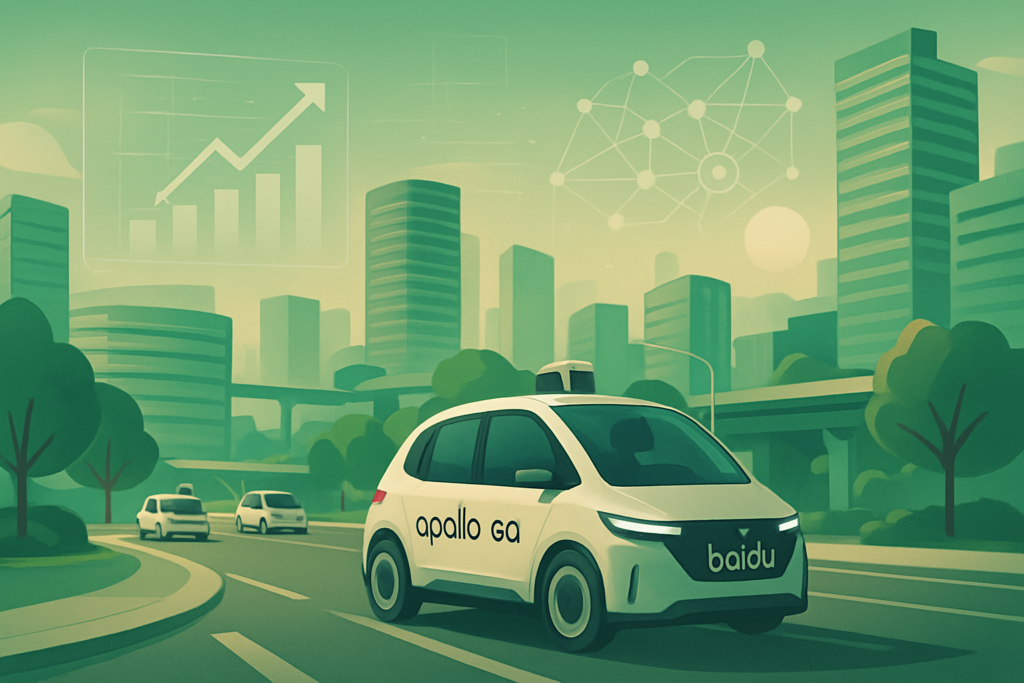
- Apollo Go: The world’s largest robotaxi service. By February 2026, Apollo Go has delivered over 20 million cumulative rides. The introduction of the RT6 robotaxi, which features a steering-wheel-free design and significantly lower production costs, has allowed the business to approach unit-economic profitability in cities like Wuhan and Beijing.
- Kunlunxin AI Chips: Baidu’s in-house AI chip subsidiary is a critical hedge against U.S. export restrictions. Management recently announced plans to spin off this unit to unlock its valuation as a standalone semiconductor leader.
Competitive Landscape
Baidu operates in one of the world’s most cutthroat tech environments.
- In AI and Cloud: Baidu faces fierce competition from Alibaba Group (BABA) and Tencent (TCEHY), as well as Huawei. While Alibaba has a larger cloud market share, Baidu claims the lead in "AI-native" cloud services.
- In Advertising: ByteDance remains the primary threat, capturing the "attention economy" through Douyin. However, Baidu’s pivot to AI-driven search results has helped it regain some ground in high-intent intent-based queries.
- In Autonomous Driving: While Tesla’s FSD (Full Self-Driving) is a global benchmark, Baidu’s Apollo Go is the leader in the service (robotaxi) model within China, currently holding a significant lead over local rivals like Pony.ai and AutoX in terms of total driverless miles.
Industry and Market Trends
Two macro trends are currently defining Baidu’s future:
- The Generative AI Arms Race: China’s enterprise sector is undergoing a massive digital transformation, with companies shifting from traditional software to AI-integrated agents. Baidu is the primary beneficiary of this "SaaS-to-MaaS" shift in the Chinese market.
- Autonomous Mobility: Regulatory support for driverless cars in China is accelerating. Local governments are increasingly viewing robotaxis as a solution to urban congestion and an aging workforce, providing a favorable tailwind for Apollo Go’s expansion.
Risks and Challenges
Despite its technological lead, Baidu faces significant risks:
- Geopolitical and Supply Chain Risks: U.S. restrictions on high-end NVIDIA GPUs remain a significant hurdle. While Baidu’s Kunlunxin chips offer a domestic alternative, they still lag behind the top-tier global hardware required for the most advanced LLM training.
- Regulatory Scrutiny: The Cyberspace Administration of China (CAC) maintains strict control over AI content. Maintaining compliance while ensuring Ernie Bot remains competitive with global peers like OpenAI’s models is a delicate balancing act.
- Macroeconomic Pressure: China’s broader economic recovery remains uneven, impacting the discretionary advertising budgets of the SMEs (Small and Medium Enterprises) that form the core of Baidu’s legacy revenue.
Opportunities and Catalysts
- Global Expansion of Apollo Go: The recent launch of operations in Abu Dhabi and partnerships in South Korea suggest that Baidu’s autonomous driving tech is exportable. Success in international markets could significantly re-rate the stock.
- Monetization of Ernie Bot: The transition of Ernie Bot from a free consumer tool to a paid enterprise API is in its early stages. High-margin recurring revenue from AI Cloud could lead to significant earnings surprises in late 2026.
- Kunlunxin Spin-off: A potential IPO or independent funding round for its chip unit could provide a massive one-time valuation boost.
Investor Sentiment and Analyst Coverage
Investor sentiment remains cautious but is beginning to thaw. Institutional investors have praised the new dividend and buyback policy as a sign that Baidu is no longer a "black box" of R&D spending. Wall Street ratings are currently leaning "Buy," with many analysts noting that Baidu’s current P/E ratio of approximately 15.9x (as of early 2026) does not reflect the potential of its robotaxi business, which some value as a "free call option" on the future of transportation.
Regulatory, Policy, and Geopolitical Factors
The "Holding Foreign Companies Accountable Act" (HFCAA) in the U.S. remains a background noise issue, though Baidu’s dual-primary listing in Hong Kong provides a safe haven for investors concerned about potential ADR delistings. Domestically, Baidu benefits from the Chinese government’s "New Infrastructure" policy, which subsidizes AI and smart-city initiatives. However, the company must continue to navigate the complex interplay of data security laws and cross-border data transfer regulations.
Conclusion
Baidu in 2026 is no longer the search company of 2016. It is a high-stakes bet on the convergence of two of the most transformative technologies of our time: Generative AI and Autonomous Driving. The mixed Q4 2025 results highlight the pain of letting go of the past, but the $5 billion buyback and inaugural dividend signal that the company has reached a level of financial stability to weather the storm.
For investors, Baidu represents a unique value proposition: a legacy business priced like a utility, but with the growth optionality of a Silicon Valley disruptor. While geopolitical risks and domestic competition are ever-present, Baidu's dominant position in the "AI-native" era of the Chinese internet makes it an unavoidable ticker for anyone tracking the future of the global digital economy.
This content is intended for informational purposes only and is not financial advice.