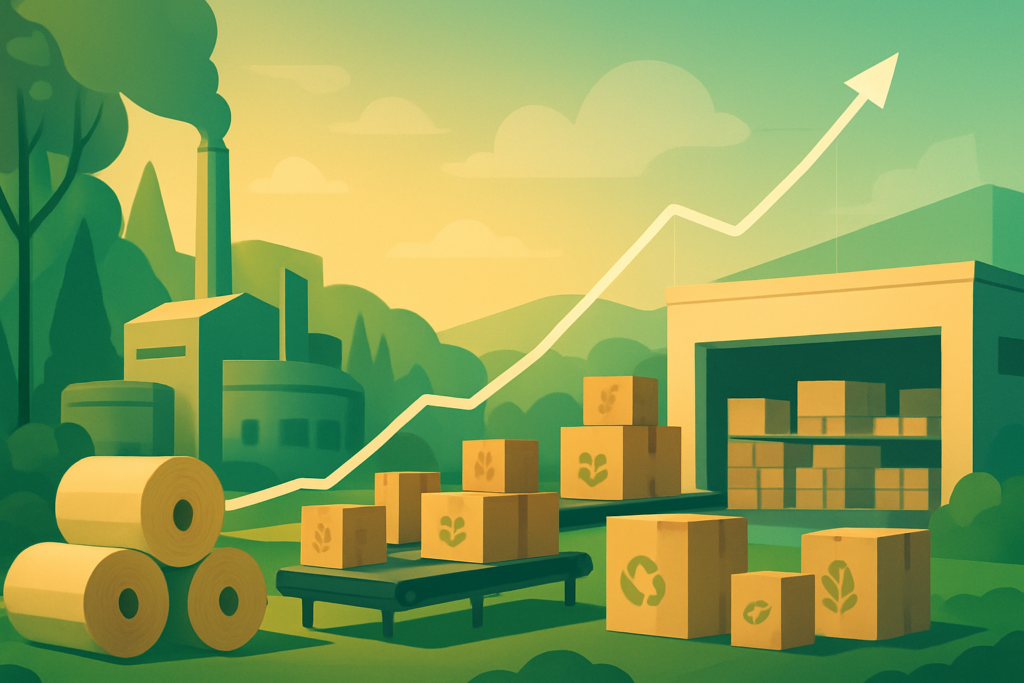
In the high-stakes world of industrial materials, few companies have demonstrated the consistent operational excellence of Packaging Corporation of America (NYSE: PKG). As of early 2026, the company has once again captured Wall Street’s attention following a series of positive earnings surprises and a bold strategic expansion. While competitors grapple with the complexities of global mergers and shifting consumer demand, PKG has carved out a high-margin niche, combining the scale of a major producer with the agility of a specialized service provider. With the global shift toward sustainable, paper-based packaging accelerating, PKG stands at a pivotal junction, leveraging its recent acquisition of Greif’s containerboard assets and a significant industry-leading price increase to solidify its market position.
Historical Background
Packaging Corporation of America's journey began in 1959 through the merger of three established firms: Central Fibre Products Company, American Box Board Company, and Ohio Boxboard Company. For decades, it operated as a subsidiary of various conglomerates, most notably Tenneco. However, the modern iteration of PKG was born in 1999 when Madison Dearborn Partners acquired the containerboard business from Tenneco, restoring the legendary name.
Following its initial public offering in 2000, PKG embarked on a disciplined growth path. Unlike its peers who often chased massive global footprints, PKG focused on the North American market, prioritizing vertical integration and customer service. Key milestones include the transformative $2 billion acquisition of Boise Inc. in 2013 and the late-2025 acquisition of Greif's containerboard operations, which added nearly half a million tons of annual capacity and significantly expanded the company's footprint in the Eastern United States.
Business Model
PKG operates a highly efficient, vertically integrated business model. The company's primary objective is to produce containerboard at its mills and "pull" that production through its own network of corrugated products plants. Currently, PKG consumes approximately 85% of its own mill production internally, a strategy that insulates it from the volatility of the open containerboard market.
The company is organized into two primary segments:
- Packaging Segment: This core engine accounts for over 90% of total revenue. It produces a wide array of corrugated packaging, from standard brown boxes for shipping to high-end, multi-color displays used in retail environments.
- Paper Segment: Accounting for roughly 7% of revenue, this segment focuses on uncoated freesheet (UFS) and specialty papers. While smaller, it provides diversified cash flow and high-quality paper products for commercial and office use.
Stock Performance Overview
PKG has been a standout performer in the materials sector. Over the 10-year horizon, the stock has delivered a staggering total return of approximately 510%, far outpacing the S&P 500 and its direct peers.
- 1-Year Performance: The stock has risen roughly 32% over the past twelve months, driven by the successful integration of the Greif assets and stronger-than-expected demand in the consumer staples sector.
- 5-Year Performance: Shares have grown over 85% since 2021, reflecting a doubling of value as the company benefited from the pandemic-induced e-commerce boom and subsequent pricing power.
- 10-Year Performance: Investors who held PKG for a decade have seen nearly 20% annualized returns, bolstered by a consistently growing dividend.
Financial Performance
In its most recent earnings release for the fourth quarter of 2025 (reported in late January 2026), PKG delivered a robust adjusted EPS of $2.32, surpassing internal expectations and showing a 10% year-over-year increase in net sales to $2.4 billion.
The "positive surprise" primarily stemmed from two factors:
- Volume Growth: Total corrugated shipments surged 17% year-over-year, largely due to the new capacity from the Greif acquisition.
- Operational Efficiency: Despite wage and energy inflation, packaging segment margins remained healthy at 21.7%.
The company’s balance sheet remains a focus for analysts. While the Debt-to-Equity ratio climbed to 91.6% following the recent $1.2 billion acquisition, PKG’s management has signaled a commitment to aggressive debt pay-down in 2026, supported by projected record operating cash flow.
Leadership and Management
At the helm is CEO Mark Kowlzan, who has led the company since 2010. Kowlzan is widely regarded as one of the most disciplined operators in the industry, credited with maintaining PKG’s "agility-first" culture even as the company grew into the third-largest producer in North America.
Recent leadership transitions have also occurred to support the next phase of growth. Tom Hassfurther was elevated to the role of President in 2025, and Kent Pflederer took over as CFO, bringing a focus on capital allocation and margin expansion through digital transformation of the mill network.
Products, Services, and Innovations
PKG differentiates itself through "Design for Performance." Rather than just selling boxes, the company employs hundreds of designers who work with customers to optimize packaging for the "unboxing experience"—a critical component for e-commerce brands.
Recent innovations include:
- Wallula Mill Reconfiguration: A massive capital project in Washington State that transitioned older machines to produce high-performance, lightweight recycled linerboard, reducing production costs by an estimated $125 per ton.
- Sustainable Barrier Coatings: R&D efforts have yielded new, recyclable coatings that allow paper packaging to replace single-use plastics in the food and beverage industry.
Competitive Landscape
The North American containerboard market is dominated by three major players. PKG sits as the third largest, behind International Paper (NYSE: IP) and the newly formed Smurfit WestRock (NYSE: SW).
- Competitive Strength: PKG’s "secret sauce" is its focus on small-to-medium-sized customers. While IP and Smurfit WestRock often prioritize massive, high-volume contracts with global retailers, PKG provides customized, just-in-time service to thousands of localized businesses. This "boutique at scale" approach allows PKG to command premium pricing.
- Competitive Weakness: PKG’s lack of a significant international footprint makes it more vulnerable to North American economic cycles compared to the more globally diversified Smurfit WestRock.
Industry and Market Trends
Two macro trends are currently defining the industry in 2026:
- E-Commerce Maturity: While the "gold rush" era of e-commerce has stabilized, the intensity of packaging per item remains high as brands prioritize damage prevention and brand aesthetics.
- The Circular Economy: Brands are under immense pressure to eliminate plastic. This has led to a massive shift toward corrugated solutions for everything from produce trays to electronics housing.
Risks and Challenges
Despite its strong performance, PKG faces several hurdles:
- Leverage: The Greif acquisition was necessary for growth but has left the company with a higher debt load than historically preferred.
- Input Costs: While PKG produces its own board, it is still subject to fluctuating prices for recycled fiber (OCC), chemicals, and electricity.
- Cyclicality: A significant downturn in North American consumer spending would directly impact box demand, as packaging is often a "leading indicator" for the broader economy.
Opportunities and Catalysts
The most immediate catalyst is the $70 per ton price increase for containerboard, which PKG successfully implemented effective March 1, 2026. This move, which led the industry, is expected to flow through to earnings in the second and third quarters of 2026, significantly boosting margins. Furthermore, the full realization of synergies from the Greif acquisition—estimated at $50 million annually—remains a major tailwind for the next 18 months.
Investor Sentiment and Analyst Coverage
Wall Street sentiment toward PKG remains overwhelmingly positive. Analysts frequently cite the company’s 22 consecutive years of dividend payments as a sign of financial maturity. Institutional ownership is high, with major funds viewing PKG as a "quality" play within the cyclical materials sector. Recent upgrades have highlighted the company’s ability to take market share during industry consolidation phases.
Regulatory, Policy, and Geopolitical Factors
Regulatory scrutiny is intensifying around "forever chemicals" (PFAS) in food packaging. With an August 12, 2026, deadline looming for PFAS-free food-contact materials in several major jurisdictions, PKG’s proactive R&D into natural barrier coatings has positioned it ahead of the compliance curve. Additionally, the EPA is increasing oversight of "green" claims, requiring companies to provide more rigorous data on the actual recyclability and carbon footprint of their products—an area where PKG’s modern, recycled-focused mills provide a competitive edge.
Conclusion
Packaging Corporation of America enters the middle of 2026 as an operational titan. Its ability to consistently deliver positive earnings surprises is no accident; it is the result of a disciplined strategy that prioritizes customer service over sheer volume and vertical integration over market speculation. While the debt from its recent expansion requires careful management, the combination of industry-leading price increases and a structural shift toward sustainable packaging provides a compelling narrative for the future. For investors, PKG remains a benchmark of how a legacy industrial company can thrive in the modern, e-commerce-driven economy.
This content is intended for informational purposes only and is not financial advice.