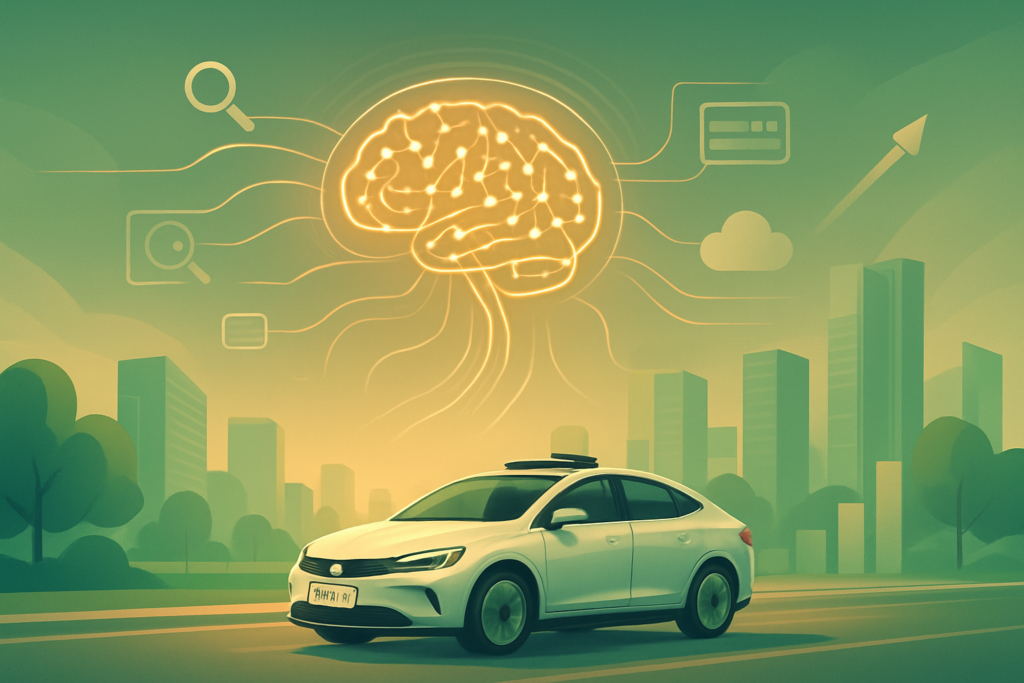
As of today, February 26, 2026, Baidu, Inc. (NASDAQ: BIDU; HKEX: 9888) finds itself at a historic crossroads. Long labeled the "Google of China," the Beijing-based tech giant has spent the last decade aggressively attempting to shed its reputation as a legacy search engine provider to become a global leader in artificial intelligence (AI) and autonomous driving. Following the release of its Q4 2025 financial results earlier today, the company’s "AI-first" transformation is no longer a roadmap—it is the operational reality. With the successful scaling of its ERNIE LLM (Large Language Model) ecosystem and the international expansion of its Apollo Go robotaxi fleet, Baidu is positioning itself as the primary beneficiary of China’s "New Quality Productive Forces" economic mandate.
Historical Background
Founded in 2000 by Robin Li and Eric Xu, Baidu rose to dominance by mastering the complexities of the Chinese language in web search. After its 2005 IPO on the NASDAQ, it became one of the "BAT" trio (Baidu, Alibaba, Tencent) that defined the first two decades of the Chinese internet. However, the rise of mobile-first ecosystems like ByteDance’s Douyin and Tencent’s (OTC: TCEHY) WeChat created "walled gardens" that challenged Baidu’s search dominance. In response, Robin Li pivoted the company toward deep tech in the mid-2010s, investing billions into the PaddlePaddle deep learning framework, the Kunlun AI chip series, and the Apollo autonomous driving platform. This long-term bet, often criticized by investors during periods of stock stagnation, has finally begun to yield high-margin fruit in the current 2025-2026 cycle.
Business Model
Baidu operates through two primary segments: Baidu Core and iQIYI (NASDAQ: IQ).
- Baidu Core: This is the engine of the company, comprising "Baidu Mobile Ecosystem" (Search, Feed, and the Baidu App), "Baidu AI Cloud," and "Intelligent Driving & Other Growth Initiatives." While search advertising still provides the majority of the company's cash flow, AI Cloud and autonomous driving now represent the primary growth drivers.
- iQIYI: Often called the "Netflix of China," this subsidiary focuses on long-form video streaming. While it operates with its own management team, it synergizes with Baidu’s AI for content recommendation and advertising efficiency.
- Customer Base: Baidu serves a dual market: hundreds of millions of retail users who use its search and ERNIE interfaces, and a rapidly growing B2B sector that relies on its AI Cloud for digital transformation and specialized LLM deployment.
Stock Performance Overview
Baidu’s stock performance has historically been a story of extreme volatility and "China discount" headwinds.
- 1-Year Performance: 2025 was a standout year for BIDU, with shares rallying nearly 60% as the market re-rated the company from a "legacy search" firm to an "AI infrastructure" leader.
- 5-Year Performance: Over the five-year horizon, the stock has struggled with regulatory crackdowns (2021-2022) and the post-pandemic economic slowdown in China. However, as of early 2026, it has recovered a significant portion of its 2021 highs.
- 10-Year Performance: Long-term shareholders have experienced a "lost decade" in terms of capital gains compared to US peers, largely due to geopolitical tensions and the transition from PC to mobile. However, the current valuation reflects a much leaner, more technologically advanced company than the one seen in 2016.
Financial Performance
In the Q4 2025 results released today (Feb 26, 2026), Baidu reported a nuanced financial picture:
- Revenue: Total revenue reached RMB 32.74 billion (~$4.68 billion). This was a modest 5% year-over-year increase, reflecting a "K-shaped" recovery where legacy search ads remained flat while AI Cloud and Apollo Go surged.
- Profitability: The company delivered a significant bottom-line beat, with adjusted net income of RMB 10.62 per ADS. This was driven by aggressive cost optimization and the improving unit economics of its GenAI services.
- Cash Flow & Capital Allocation: Operating cash flow turned strongly positive in the second half of 2025. In a move that surprised the market, Baidu announced its first-ever dividend policy and a $5 billion share repurchase program, signaling management's confidence in its long-term cash generation.
Leadership and Management
Robin Li remains the singular visionary at the helm, serving as Chairman and CEO. His tenure is marked by a refusal to chase short-term trends, instead focusing on "hard tech." Under his leadership, the management team has been restructured to prioritize AI integration across all product lines. The board has also seen an influx of members with deep expertise in semiconductors and global logistics, reflecting the company’s shift toward hardware (chips) and physical services (robotaxis).
Products, Services, and Innovations
Innovation is currently centered on two pillars:
- ERNIE 5.0: Unveiled in late 2025, this "omni-modal" model has 2.4 trillion parameters and competes directly with the best Western models. It has achieved massive adoption, with daily API calls surpassing 1.6 billion.
- Kunlunxin Chips: Baidu’s in-house AI chip unit is a critical component of its vertical integration. By designing its own silicon, Baidu has partially insulated itself from US export restrictions on high-end GPUs. The upcoming confidential IPO of Kunlunxin in Hong Kong is expected to unlock significant shareholder value.
- Apollo Go: The world's largest autonomous ride-hailing service has now surpassed 20 million cumulative rides, with its 6th-generation RT6 vehicle reducing hardware costs to under $30,000 per unit.
Competitive Landscape
Baidu faces a multi-front war:
- AI Models: It competes with Alibaba (NYSE: BABA) and its "Tongyi Qianwen" model, as well as several high-value Chinese startups like Moonshot AI.
- Cloud: Alibaba Cloud and Tencent Cloud remain formidable rivals, though Baidu’s focus on "AI-native" cloud has allowed it to gain market share in the enterprise GenAI sector.
- Autonomous Driving: Globally, Tesla (NASDAQ: TSLA) and Alphabet’s (NASDAQ: GOOGL) Waymo are the primary benchmarks. In China, local EV makers like XPeng (NYSE: XPEV) are also pushing into the autonomous space, though Baidu’s Apollo Go remains the leader in the specific robotaxi (Level 4) niche.
Industry and Market Trends
The "democratization of AI" is the defining trend of 2026. As LLM costs fall, Chinese enterprises are moving from experimentation to full-scale deployment. Furthermore, the Chinese government’s 15th Five-Year Plan has placed an unprecedented emphasis on "Digital China," providing subsidies and favorable policies for companies that can localize the AI supply chain. This macro environment acts as a massive tailwind for Baidu’s B2B and Cloud segments.
Risks and Challenges
Despite the technological progress, several risks loom:
- Geopolitical Friction: Continued US restrictions on advanced semiconductor manufacturing equipment could eventually hamper Baidu’s ability to scale its internal chip production.
- Ad Revenue Saturation: The Chinese consumer market remains cautious. If legacy advertising revenue continues to decline faster than AI revenue grows, it could lead to "valuation traps."
- Regulatory Scrutiny: China’s domestic AI regulations regarding content safety and data privacy are among the strictest in the world, requiring constant compliance overhead.
Opportunities and Catalysts
- Kunlunxin Spin-off: The potential IPO of the AI chip unit could provide a massive one-time valuation boost.
- Global Expansion: Apollo Go’s pilots in the Middle East and Europe (specifically London) represent the first major export of Chinese autonomous technology to the West.
- Dividend Growth: If the dividend policy is sustained, it may attract a new class of "value" and "income" investors who previously avoided the volatile tech stock.
Investor Sentiment and Analyst Coverage
Wall Street currently holds a "Moderate Buy" consensus on BIDU. While many analysts praise the technical leadership, some remain skeptical of the "sum-of-the-parts" valuation. Institutional ownership has stabilized in 2026, with major hedge funds moving back into the name as a "play on the Chinese AI recovery." However, the 2.6% pre-market dip following today's earnings suggests that "perfection" is now priced in, and the company must continue to deliver high-margin growth to maintain its momentum.
Regulatory, Policy, and Geopolitical Factors
Baidu is perhaps the most "policy-aligned" of the major Chinese tech firms. Its focus on autonomous transport and domestic chips aligns perfectly with Beijing's self-reliance goals. However, the company remains caught in the crossfire of the US-China tech war. The 2026 landscape is defined by "dual-track" development: building a domestic-only supply chain for the China market while attempting to navigate Western safety standards for its international robotaxi ambitions.
Conclusion
Baidu’s Q4 2025 performance confirms that the company has successfully survived its transition period. It is no longer a search company with an AI hobby; it is an AI infrastructure powerhouse with a legacy search business that funds its R&D. For investors, the "Baidu of 2026" offers a unique proposition: a deep-value entry into the most advanced AI and autonomous driving ecosystem in Asia. While geopolitical risks and legacy ad-revenue pressures remain, the combination of a new dividend, a multi-billion dollar buyback, and the impending Kunlunxin IPO makes BIDU one of the most compelling, albeit complex, stories in the global technology sector.
This content is intended for informational purposes only and is not financial advice.