As of February 24, 2026, DoorDash (NYSE: DASH) has transitioned from a Silicon Valley delivery darling into a global titan of local commerce. While its origins are rooted in the simple delivery of restaurant meals, the DoorDash of 2026 is a multi-faceted logistics and advertising powerhouse. However, this evolution faces a new and formidable challenge: the "Global Tariff Shock" of 2025-2026. With trade tensions reshaping the cost of hardware and consumer goods, DoorDash finds itself at a crossroads—balancing record profitability with a macro-economic environment that threatens the discretionary spending of its core user base.
Historical Background
Founded in 2013 by Stanford students Tony Xu, Stanley Tang, Andy Fang, and Evan Moore, DoorDash began as "PaloAltoDelivery.com." The founders personally delivered the first orders to understand the friction points of the merchant-dasher-consumer triad. By 2018, DoorDash had overtaken Grubhub (NASDAQ: JET) in US market share, a lead it never relinquished.
The company’s 2020 IPO marked a turning point, providing the capital necessary to expand beyond food. Key milestones include the 2022 acquisition of Finnish delivery firm Wolt, which opened the doors to Europe and Central Asia, and the blockbuster 2025 acquisition of Deliveroo. These moves transformed DoorDash into a truly international platform, setting the stage for the unified global tech stack initiative currently underway in 2026.
Business Model
DoorDash operates a high-velocity, three-sided marketplace:
- Marketplace: The core platform connecting consumers with over 600,000 merchants. Revenue is generated via commissions from merchants and service fees from consumers.
- DashPass: A subscription service that provides $0 delivery fees. By 2026, DashPass has become the company's primary retention engine, with members spending significantly more than non-members.
- Advertising & Retail Media: DoorDash now allows brands to purchase "sponsored listings" and display ads. This high-margin segment is a critical driver of the company’s recent shift toward GAAP profitability.
- New Verticals (Grocery & Retail): Expanding into non-restaurant categories like alcohol, flowers, and beauty products.
- Drive: A white-label fulfillment service where merchants use DoorDash’s logistics network for orders placed on their own websites.
Stock Performance Overview
Over the past year, DASH has outperformed the broader S&P 500, buoyed by the 2025 realization of GAAP net income. However, the five-year horizon tells a story of significant volatility, including the "post-pandemic hangover" of 2022 and the subsequent recovery driven by disciplined cost management.
While the stock reached all-time highs in late 2025 following the Deliveroo acquisition, early 2026 has seen a slight pullback. Investors are currently weighing the company's "investment year" guidance—meant to unify its global tech platforms—against the backdrop of rising global tariffs which have introduced uncertainty into the consumer tech sector.
Financial Performance
DoorDash reported a stellar fiscal year 2025, with revenue reaching $13.7 billion, a substantial increase from $10.7 billion in 2024. For Q4 2025, the company posted:
- Revenue: $4.0 billion (up 38% YoY).
- GAAP Net Income: $935 million for the full year, a massive swing from the $123 million reported in 2024.
- Adjusted EBITDA: $780 million in Q4, representing 2.6% of Gross Order Value (GOV).
- Free Cash Flow: DoorDash continues to generate robust cash flow, ending 2025 with a healthy balance sheet that includes over $4 billion in cash and short-term investments.
The 2026 outlook is more cautious, with Q1 Adjusted EBITDA projected between $675M and $775M as the company reinvests heavily in international integration.
Leadership and Management
CEO Tony Xu remains the architect of DoorDash’s "relentless execution" culture. Under his leadership, the company has maintained a flat organizational structure and a unique "Dash" requirement, where corporate employees must complete one delivery per month.
The management team, including CFO Ravi Inukonda, has been praised by Wall Street for their "under-promise and over-deliver" approach to financial guidance. The board’s strategy in 2026 focuses on "System-Building for Local Commerce," aiming to make DoorDash the default infrastructure for any item moving within a city.
Products, Services, and Innovations
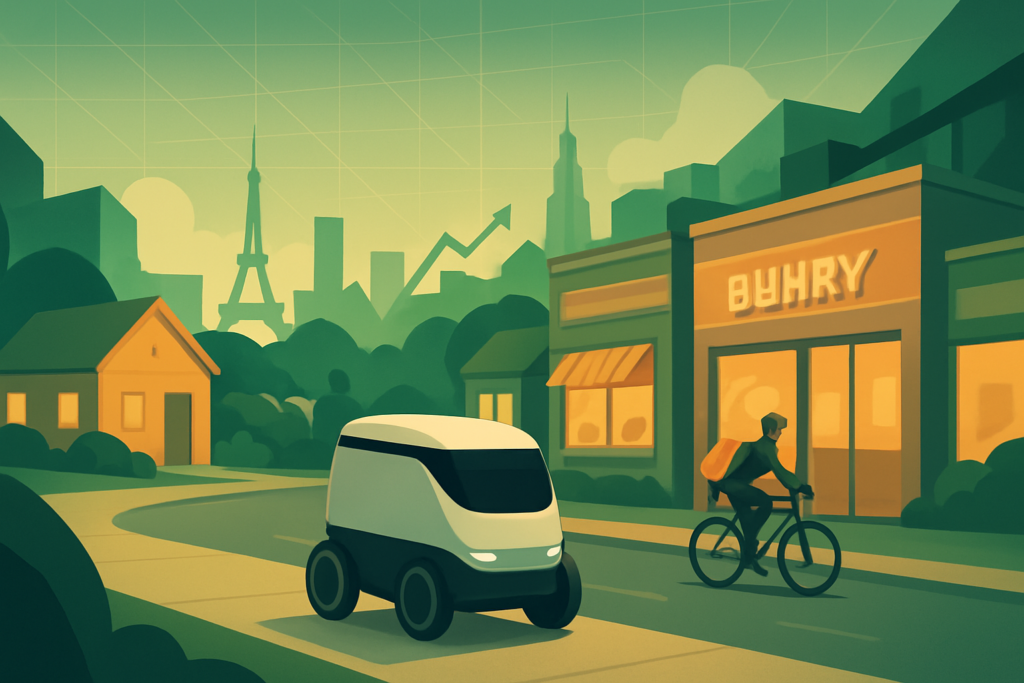
The most significant innovation in 2026 is the "DoorDash Dot," an autonomous sidewalk robot designed for short-distance, small-basket deliveries. This technology aims to solve the "unit economics" problem of delivering a single coffee or convenience item.
Additionally, the company is rolling out its Unified Global Tech Stack, which merges the back-end systems of DoorDash, Wolt, and Deliveroo. This will allow for seamless cross-border logistics and a centralized advertising platform that can reach consumers in London, Helsinki, and New York with a single campaign.
Competitive Landscape
DoorDash maintains a dominant position in the US, holding an estimated 57% to 67% market share. Its primary rival, Uber (NYSE: UBER), holds 23-25% through Uber Eats.
The competitive battleground has shifted to "New Verticals." While DoorDash leads in suburban food delivery, Uber Eats is leveraging its cross-platform "Uber One" membership to gain ground in urban grocery segments. Meanwhile, Grubhub has retreated to a niche focus on campus dining after its acquisition by Wonder Foods. In Europe, DoorDash faces fierce competition from local champions like Just Eat Takeaway and Delivery Hero, though the Deliveroo acquisition has given DASH a formidable lead in the UK and Middle East.
Industry and Market Trends
The "Anywhere Economy" is the defining trend of 2026. Consumers now expect every local merchant—from boutiques to hardware stores—to offer same-day delivery. This has forced a consolidation of logistics providers, as only the largest players have the density to make the economics work.
Furthermore, the rise of Retail Media Networks (RMNs) has turned delivery apps into search engines. DoorDash is capitalizing on this by transforming its app into a high-intent shopping destination, competing directly with Amazon (NASDAQ: AMZN) for local search dominance.
Risks and Challenges: The Tariff Shock
The primary headwind in 2026 is the impact of global tariffs. With effective US tariff rates reaching 13-17% following recent trade disputes, the "discretionary dollar" is under pressure.
- Consumer Inflation: Tariffs have added an estimated $1,300 to $2,400 in annual costs for the average US household. This "ancillary inflation" reduces the frequency of luxury services like food delivery.
- Hardware Costs: The rollout of "DoorDash Dot" robots and merchant tablets is becoming more expensive due to tariffs on imported electronics, aluminum, and steel.
- Operational Pressure: Rising costs for vehicle parts and fuel—exacerbated by trade-related energy disruptions—increase the "Dasher pay" required to keep the fleet active, squeezing the company's take rate.
Opportunities and Catalysts
Despite the macro challenges, several catalysts remain:
- Grocery Profitability: Management expects the grocery and retail segments to turn profit-positive by the second half of 2026.
- Advertising Scale: DoorDash is on track to hit $2.6 billion in high-margin advertising revenue by 2027.
- Autonomous Efficiency: If the "DoorDash Dot" rollout is successful, it could significantly lower the cost-per-delivery in high-density urban areas, insulating the company from rising labor costs.
Investor Sentiment and Analyst Coverage
Wall Street remains generally bullish on DASH, viewing it as the "best-in-class" operator in local logistics. However, institutional investors are closely monitoring the 2026 "investment cycle." Analysts from major banks have expressed concern that the unification of the global tech stack might distract management from domestic competition with Uber. Retail sentiment remains positive, though there is "chatter" regarding the potential impact of labor regulation in the European markets acquired via Deliveroo.
Regulatory, Policy, and Geopolitical Factors
DoorDash faces a complex regulatory map in 2026. In the US, the debate over "worker classification" (Independent Contractor vs. Employee) continues at the state level. In the EU, the Platform Work Directive poses a structural risk to margins if Deliveroo and Wolt are forced to reclassify their couriers.
Geopolitically, the company is navigating a world of "fragmented trade." The focus on supply chain resilience has forced DoorDash to seek domestic or "friend-shored" alternatives for its hardware needs, a move that is strategically sound but operationally expensive in the short term.
Conclusion
As of February 2026, DoorDash stands as a titan of the local commerce industry, having successfully navigated the transition to profitability. Its market share in the US is commanding, and its international expansion has provided it with a massive total addressable market.
However, the "Global Tariff Shock" represents a significant test of the company's resilience. Investors should watch closely to see if DoorDash can maintain its delivery frequency in a higher-inflation environment and if its autonomous delivery investments can offset the rising costs of traditional logistics. While the 2026 "investment year" may lead to short-term margin pressure, the long-term vision of a unified, ad-supported, global delivery platform remains a compelling narrative for the "anywhere economy."
This content is intended for informational purposes only and is not financial advice.