Advanced Micro Devices (AMD) may rank among the top semiconductor companies in the age of artificial intelligence, with AMD stock having more than doubled in value over the past 52 weeks. However, the security has gotten off to an uncharacteristically poor start to the new year, losing roughly 7%. Adding to some of the skepticism, the Barchart Technical Opinion indicator rates AMD as a 24% Weak Sell.
Fundamentally, much of the concern appears tied to growing anxieties of an AI bubble. Further, while machine learning has accelerated productivity across the board, there are also worries that most of the recent economic gains have been concentrated within a few elite tech companies. With such an unbalanced mix of sectors participating in the wealth creation story, the threat of a bubble bursting looms larger.
It may be no coincidence, then, that the options market has been lighting up, especially for hot names like AMD stock. One noteworthy stat to consider is options flow, which focuses exclusively on big block transactions likely placed by institutional investors.
In the back half of February, options flow has noticeably turned pessimistic, with several transactions showcasing potential downward intent. For example, on Feb. 19, net trade sentiment slipped to almost $160 million below parity, with total gross bearish volume reaching $201.83 million in the red. Further, the last four business days of February saw net negative trades, with most transactions representing debit-based put options.
With debits, a trader is paying that premium, which gives them the right to speculate on a directional outcome. For the puts to be profitable, then, AMD stock must fall to a defined threshold; otherwise, the debit is likely to be lost.
Unless the smart money is in the business of throwing capital away, the negative options flow appear to represent a subtle signal that the pros are becoming more cautious about AMD stock.
Using the Volatility Skew as a Directional Guide for AMD Stock
Perhaps the most important clue about Advanced Micro Devices stock comes from volatility skew. Definitionally, the skew identifies implied volatility (IV) — or a stock’s potential range of motion — across the strike price spectrum of a given options chain. Colloquially, the skew provides a visual representation of the surface-area distortion of volatility space, allowing retail traders to understand how the smart money is structured against risk.
In the case of the March 20 expiration date, the skew near the spot price is relatively flat, suggesting a lack of urgency to protect against the everyday rumblings that may occur for a security like AMD stock. However, toward the left-hand boundaries (that is, toward lower strikes), the skew noticeably angles upward.
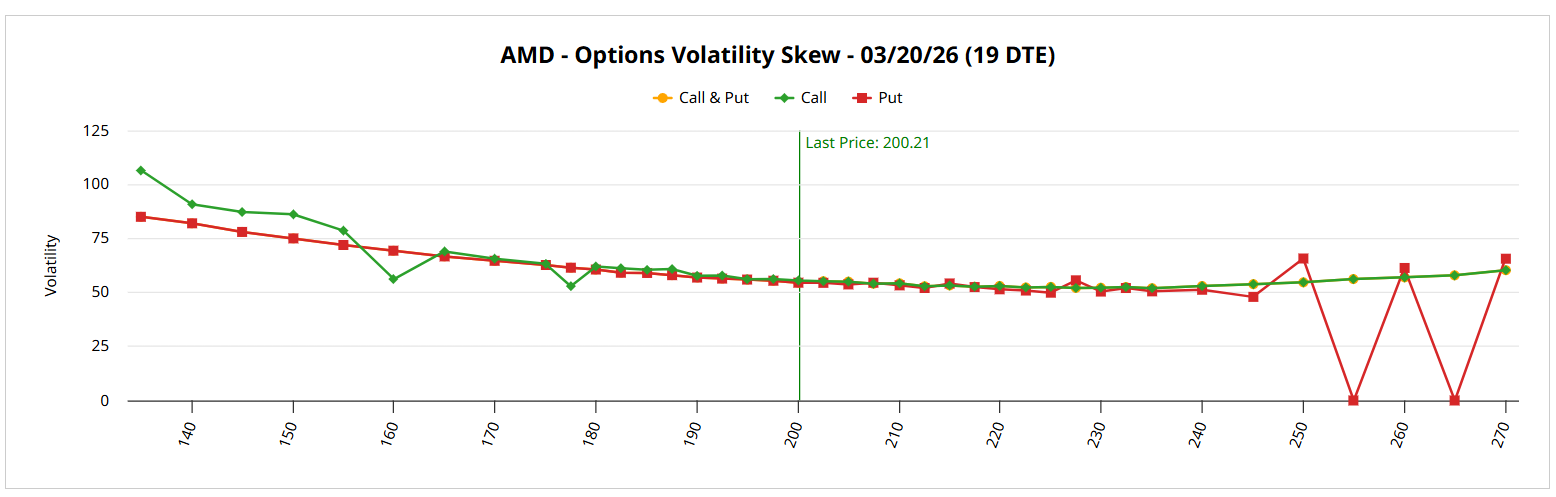
This setup suggests that, in a controlled sense, traders recognize the non-triviality of downside tail risk and are thus willing to pay a little extra premium for protection.
Now, let’s be clear: no one appears to be panic-hedging AMD stock. If so, the skew would show much sharper kinks higher due to the higher demand for protection. But what’s really significant is the skew on the right-hand boundaries (toward higher strikes). You’ll notice that neither put nor call IV rises much beyond the current spot price.
In my opinion, this circumstance represents information by omission. While there’s modest protection being paid for against downside tail risk, the equivalent cannot be said about upside risk. Stated differently, from the smart money’s perspective, the magnitude of risk in failing to protect against volatility is perceived to be greater than the magnitude of reward in not positioning for upside convexity.
That sounded a lot smoother in my head than when I actually wrote those words. In the simplest sense, options traders are more focused on not losing than they are on directly winning. It’s this subtle pensiveness that makes me think that a bear put spread might be in order.
A Final Wrinkle to Consider
I’m not going to say that Advanced Micro Devices stock is a long-term bearish trade. If you look at the following monthly options chain (the one expiring on April 17), volatility skew shows a rising upward curve on the right-hand boundaries (particularly for call IV). Over the longer term, the smart money seems to believe that the semiconductor company will work its way out of its funk.
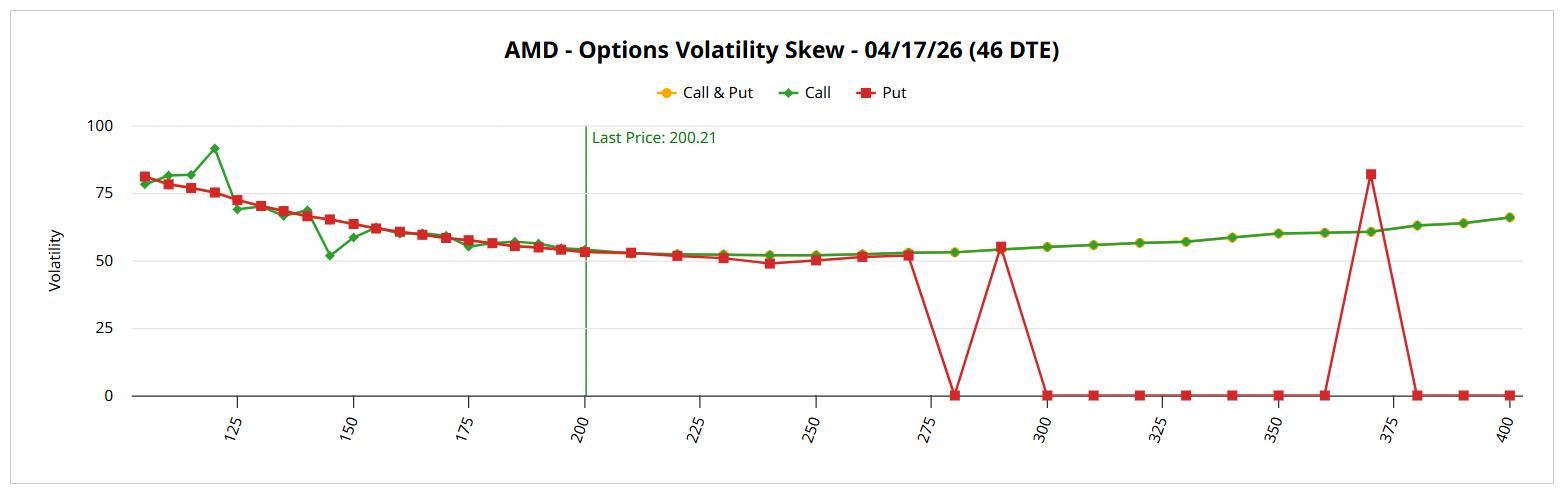
In the immediate term, though, there could be some turbulence. For those who really want to take a bold bet, the 200/195 bear put spread expiring March 20 could be interesting. Basically, you’d be looking for AMD stock to fall through the $195 strike at expiration. If so, the maximum payout would be slightly over 104%.
Based on IV and days to expiration, the Expected Move calculator anticipates a dispersion between $182.57 and $217.85. From this framework, the $195 target theoretically sits within a realistic range. Most significantly, the smart money appears to be hedging their bets, making a bear put strategy potentially relevant.
On the date of publication, Josh Enomoto did not have (either directly or indirectly) positions in any of the securities mentioned in this article. All information and data in this article is solely for informational purposes. For more information please view the Barchart Disclosure Policy here.
More news from Barchart