With a market cap of $118.2 billion, Palo Alto Networks, Inc. (PANW) provides cybersecurity solutions worldwide. The Santa Clara, California-based cybersecurity titan offers firewall appliances and software, and Panorama, a security management solution for the global control of network security platforms.
Companies valued at $10 billion or more are generally classified as “large-cap” stocks, and Palo Alto Networks fits this criterion perfectly. Palo Alto Networks’ core competencies lie in delivering an integrated, AI-driven cybersecurity platform that spans network, cloud, endpoint, and security operations. Through its Strata, Prisma, and Cortex suites, the company extends next-generation firewall leadership into cloud security, SASE/Zero-Trust access, and automated SecOps, enabling enterprises to consolidate multiple point tools into a unified architecture.
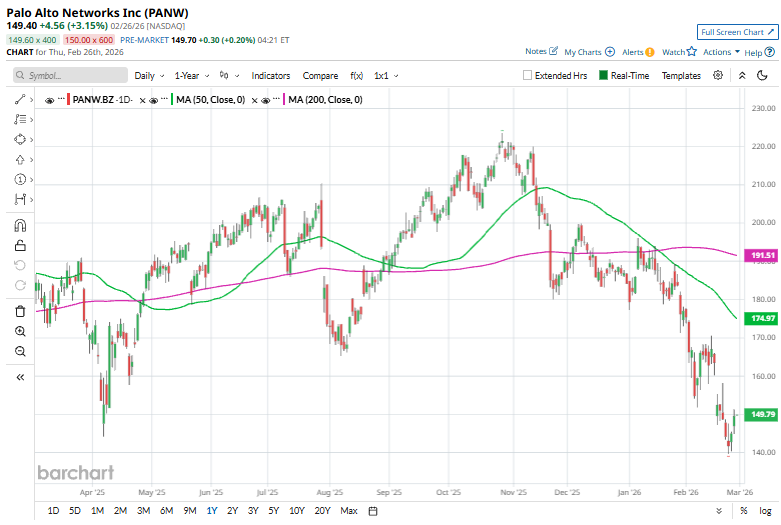
However, the cybersecurity titan has faced challenges over the past year, and its shares have fallen 33.2% from their 52-week high of $223.61. Over the past three months, its shares have plunged 19.4%, underperforming the broader State Street Technology Select Sector SPDR Fund’s (XLK) marginal decline during the same period.
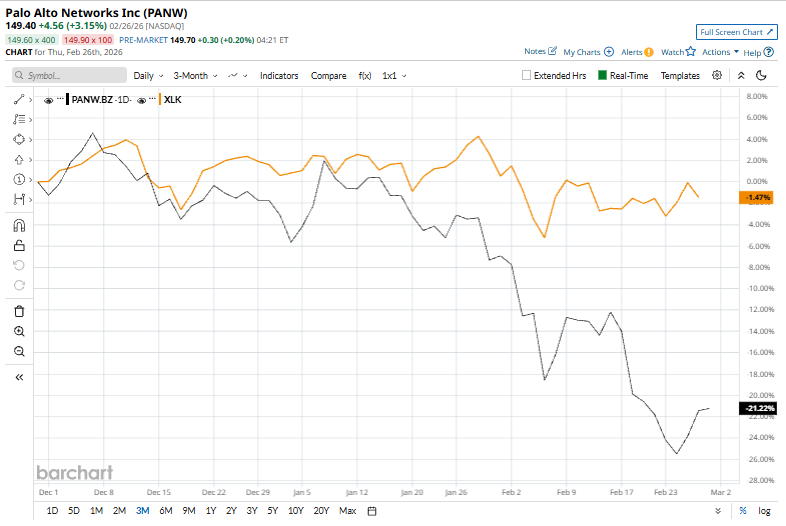
PANW stock is down 18.9% over the past six months, lagging behind XLK’s 7.2% gain. Moreover, shares of the security software maker have dipped 21.2% over the past 52 weeks, compared to XLK’s 22.1% rise over the same time frame.
The stock has been trading below its 50-day moving average since mid-November and under its 200-day moving average since early December, reinforcing a bearish trend.
On Feb. 17, Palo Alto released its FY2026 Q2 earnings, and its shares dropped 2.1% before tanking 6.8% in the next trading session. Its revenue rose 15% year over year to $2.6 billion and adjusted EPS grew 27% year over year to $$1.03, both topping the market expectations. Growth was driven by continued platform adoption, with Next-Gen Security ARR reaching $6.3 billion, up 33% from the year-ago quarter and non-GAAP operating margin of 30.3%.
Despite the earnings beat, the stock declined as investors focused on softer near-term profitability due to heavy spending on acquisitions and platformization initiatives. The company raised full-year revenue guidance to $11.28–$11.31 billion but lowered FY2026 EPS guidance to $3.65–$3.70, reflecting integration costs and ongoing investment in its AI-security platform strategy.
In comparison, rival Broadcom Inc. (AVGO) has outpaced PANW stock. AVGO stock has climbed 78% over the past six months and 51.1% over the past 52 weeks.
PANW stock has a consensus rating of “Strong Buy” from 51 analysts in coverage, and the mean price target of $208.87 is a premium of 39.8% to current levels.
On the date of publication, Kritika Sarmah did not have (either directly or indirectly) positions in any of the securities mentioned in this article. All information and data in this article is solely for informational purposes. For more information please view the Barchart Disclosure Policy here.
More news from Barchart