The software trade has not just cooled – it has been aggressively repriced. The artificial intelligence (AI) excitement has turned into AI anxiety, with investors questioning which business models will remain strong and which will be disrupted. Consequently, the sector has undergone a meaningful markdown worldwide. Sector P/E premiums have compressed, well below the historical average, although earnings momentum still ranks among the stronger pockets of the market.
According to UBS analyst Andrew Garthwaite, software is now “6.1 standard deviations oversold,” pointing to a rare disconnect between stock prices, earnings trends, and macro variables. UBS’s Market Narrative model suggests U.S. software screens nearly 40% undervalued, though Garthwaite cautions that a weaker dollar clouds the outlook for European peers. Historically, when valuations have compressed this much, the sector has outperformed mostly over a one-year horizon. Nevertheless, free cash flow yields are not broadly attractive.
The analyst is not calling for a blanket buy. He recommends being selective and focusing on fundamentally strong U.S.-based companies. Against that backdrop, let’s examine three beaten-down yet resilient players. Microsoft Corporation (MSFT), design software maker Autodesk (ADSK), and customer platform provider HubSpot (HUBS) are all nursing year-to-date (YTD) losses. But for investors, they could be solid buy-the-dip portfolio additions.
Software Stock #1: Microsoft
Microsoft is one of those companies that quietly powers everyday life. Founded as a software maker, it has grown into a global tech giant with a market capitalization of $2.85 trillion. Windows still runs the majority of the world’s PCs, but Microsoft today is much more than an operating system company.
Its Azure cloud platform supports businesses worldwide, while Microsoft 365 keeps offices, schools, and teams connected. The company also operates in developer tools, enterprise software, and gaming. Over the years, Microsoft has shifted from selling boxed software to building subscription and AI-driven cloud ecosystems, constantly adapting to stay ahead in a fast-changing tech landscape.
If we take a step back, Microsoft still looks like a long-term winner. The multi-year chart tells a story of steady gains, powered by cloud leadership and the AI wave. That run firmly positioned it as a mega-cap anchor in tech portfolios. But zoom into the past year, and the story appears to look different.
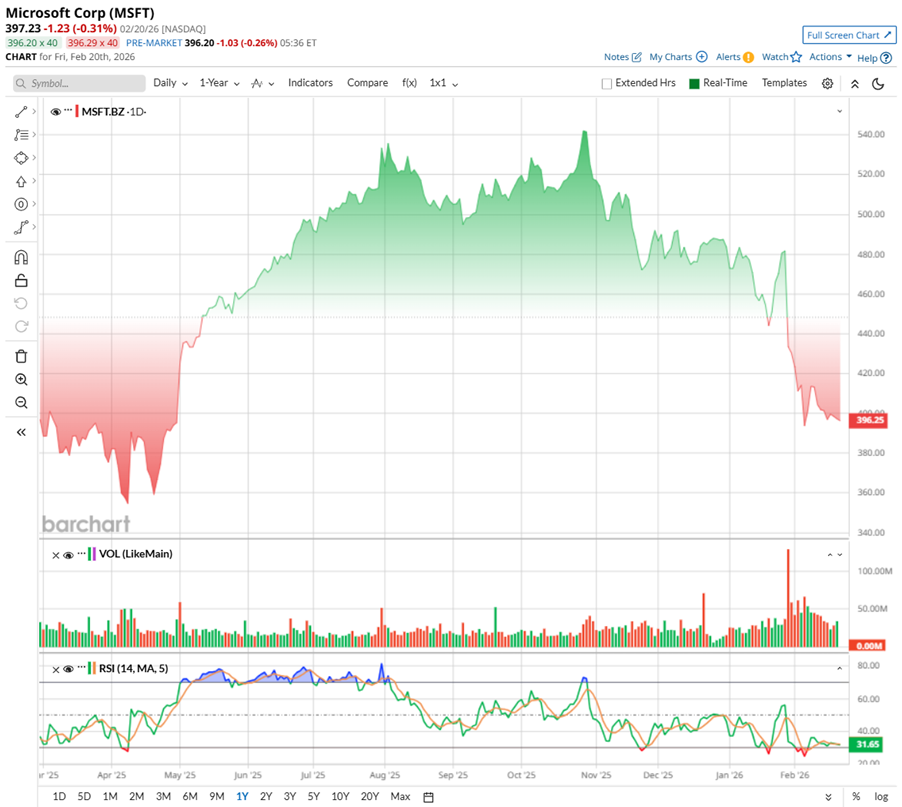
MSFT is down about 4% over the past 52 weeks. The past six months have been more challenging, with shares sliding nearly 24%. In 2026, the stock is already down roughly 20% YTD. Investor concerns around elevated AI-related capital spending, rising competition, and a more measured near-term outlook have pressured sentiment. After its Q2 earnings report in January, shares fell 10% in a single session, and that was the sharpest drop since March 2020. The stock now trades near a 10-month low after four straight monthly declines.
Technically, volumes have increased, signaling active repositioning, while the 14-day RSI has dipped into oversold territory, suggesting short-term pressure may be stretched.
When we look at valuation, Microsoft is not exactly a bargain bin stock. It trades around 23.8 times forward adjusted earnings and about 9 times forward sales, which is higher than the broader tech sector. But compared to its own history, the stock is actually a bit cheaper than usual. So the premium feels more like a reflection of quality than overpricing, especially with revenue, margins, and cash flow still trending higher.
Plus, Microsoft has remained consistently loyal to shareholders. Since starting dividends in 2003, the company has raised its payout consistently, now paying $3.64 per-share annualized dividend with a low 22.6% payout ratio that leaves room for steady future growth.
Microsoft released its earnings report for the second quarter of fiscal 2026 on Jan. 28. Revenue jumped 17% year-over-year (YOY) to $81.3 billion, while non-GAAP EPS climbed 24% to $4.14. Both exceeded Wall Street’s projections, reflecting continued strength across Azure, productivity software, and AI-driven services.
A notable swing factor was Microsoft’s stake in OpenAI. The company recorded a $7.6 billion net gain tied to that investment, reversing prior-year losses. Still, management focused attention on core operating performance, emphasizing non-GAAP results that exclude investment volatility.
Margins held up impressively. Operating margin reached 47%, even as Microsoft continues pouring capital into AI infrastructure. Cloud revenue crossed $50 billion in a single quarter for the first time, up 26%. Commercial bookings climbed 23%, and remaining performance obligations surged to $625 billion – a massive contracted revenue pipeline, with roughly 45% tied to OpenAI-related commitments.
Yet despite the strength, shares fell 10% the next day. The market reaction wasn’t about weakness – it was about expectations. Investors wanted even faster cloud acceleration and grew cautious about AI-related capital expenditures, which reached $29.9 billion in the quarter. Plus, Microsoft is spending aggressively, with the tech giant adding roughly one gigawatt of data center capacity in just three months, introducing custom silicon like Maya 200 and Cobalt 200, and expanding AI-optimized facilities globally.
Financially, the balance sheet remains solid. Microsoft ended Q2 with $89.5 billion in cash and investments against $40.3 billion in long-term debt. Operating cash flow reached $35.8 billion. The company returned $12.7 billion to shareholders through dividends and buybacks.
Looking ahead, Q3 revenue is guided between $80.65 billion and $81.75 billion, implying mid-teens growth. Azure is expected to accelerate to 37% to 38% growth range, though demand continues to outpace supply. Management sees margins dipping slightly in the near term due to AI investments, but expects full-year margins to edge higher as spending normalizes – balancing scale with profitability.
When it comes to outlook, Microsoft still has Wall Street firmly on its side. For fiscal Q3 2026, analysts expect about $4.05 per share profit, up 17.1% YOY. Revenue is projected to be around $81.4 billion, signaling that growth across cloud and AI remains steady. Looking at the full year, confidence builds further. EPS is estimated at $16.37 for fiscal 2026, marking roughly 20% annual growth, with projections climbing another 14% annually to $18.72 in fiscal 2027. That kind of steady expansion keeps the long-term story intact.
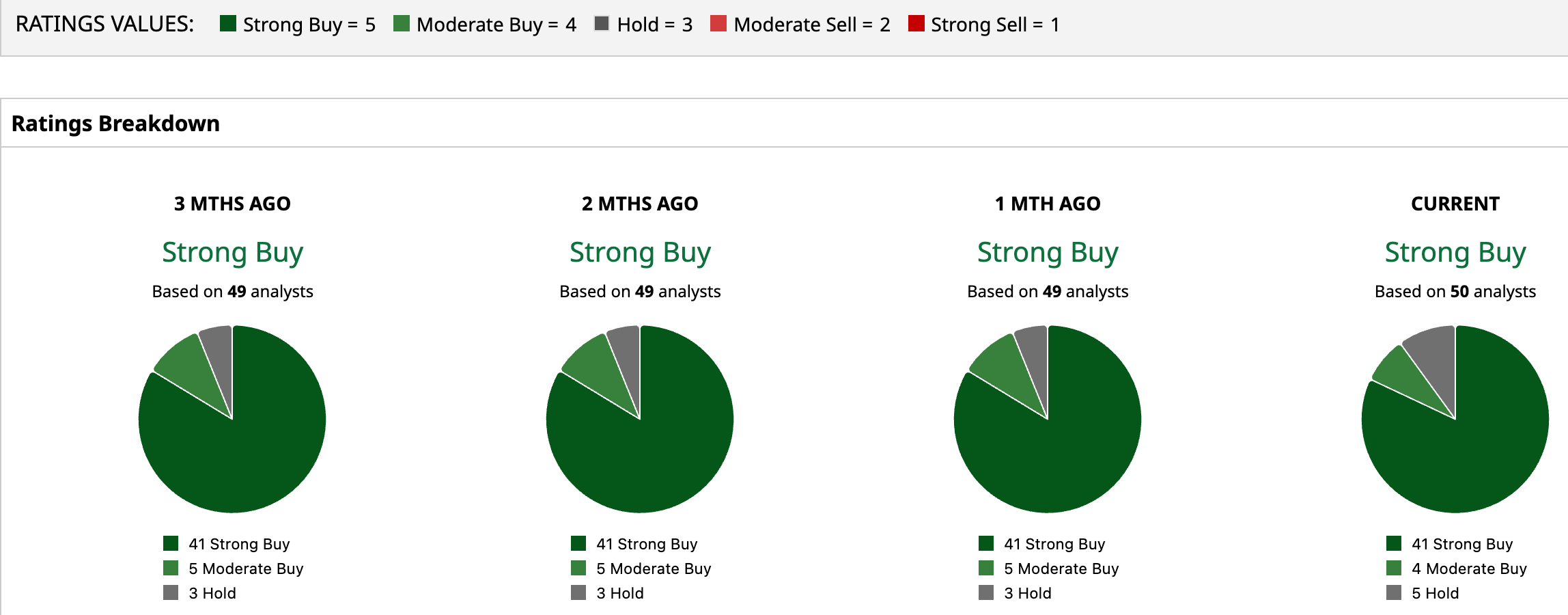
Analysts are upbeat on MSFT, with an overall “Strong Buy” consensus. Of the 50 analysts tracking the stock, 41 have a “Strong Buy,” four advise a “Moderate Buy,” and the remaining five are on the sidelines with a “Hold” rating.
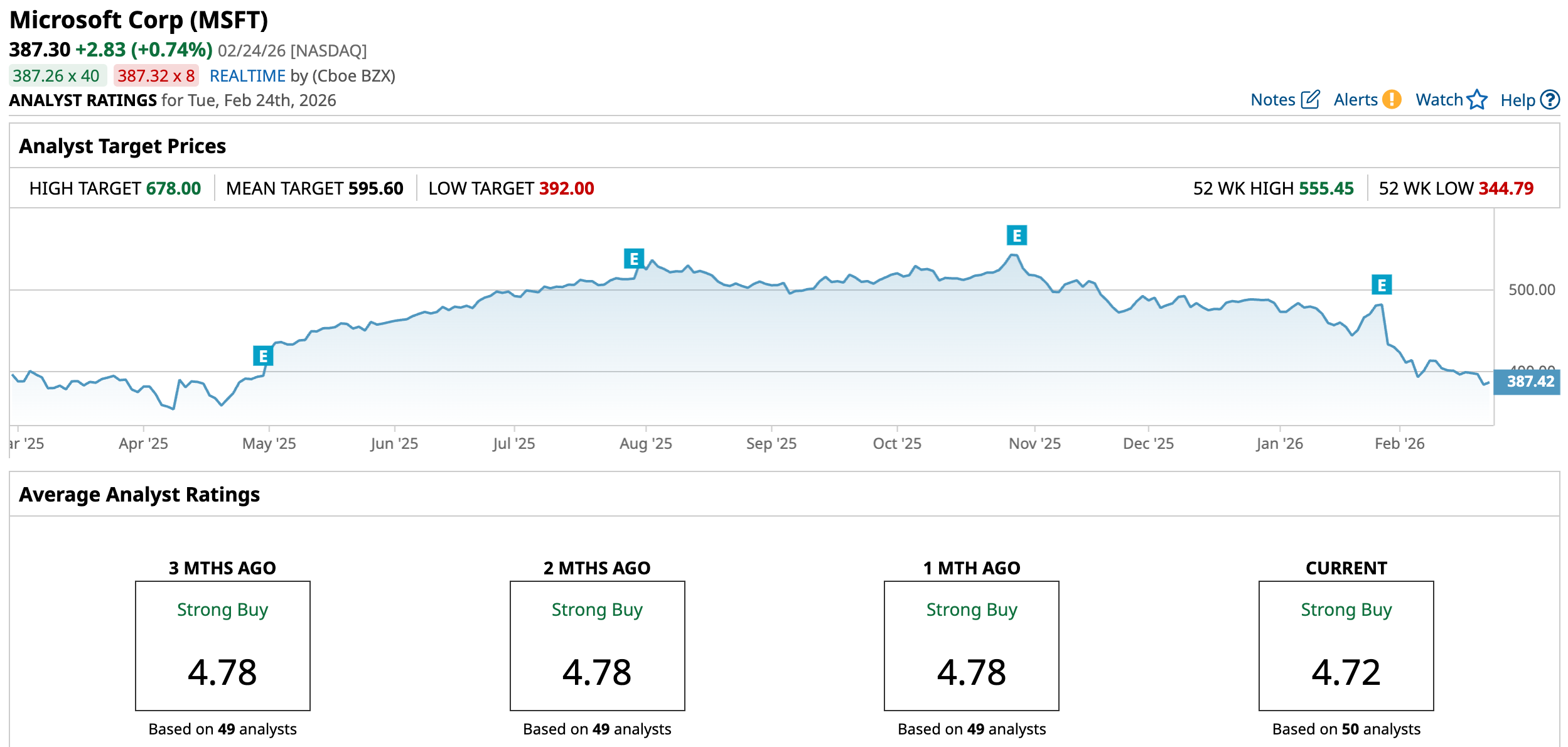
MSFT has an average price target of $595.60, implying roughly 53.8% upside potential from current levels, implying the momentum still has room to build. On the bullish end, the Street-high target of $678 points to even sharper gains of 75%, reinforcing belief in Microsoft’s durable AI and cloud momentum.
Software Stock #2: Autodesk
San Francisco-based Autodesk, founded in 1982, builds software that powers how things are designed and made. From buildings and infrastructure to products and films, its tools like AutoCAD, Revit, Fusion, and Maya are industry staples. With AI increasingly embedded into its platforms, Autodesk helps architects, engineers, manufacturers, and creators work faster and smarter. Its market cap stands at around $46.4 billion.
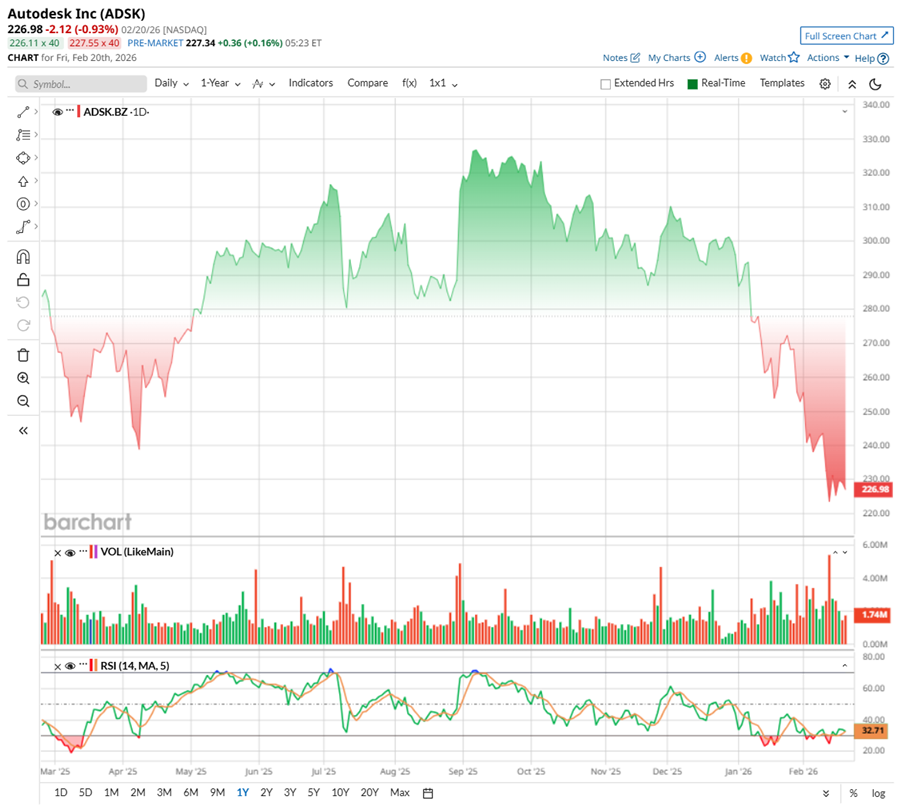
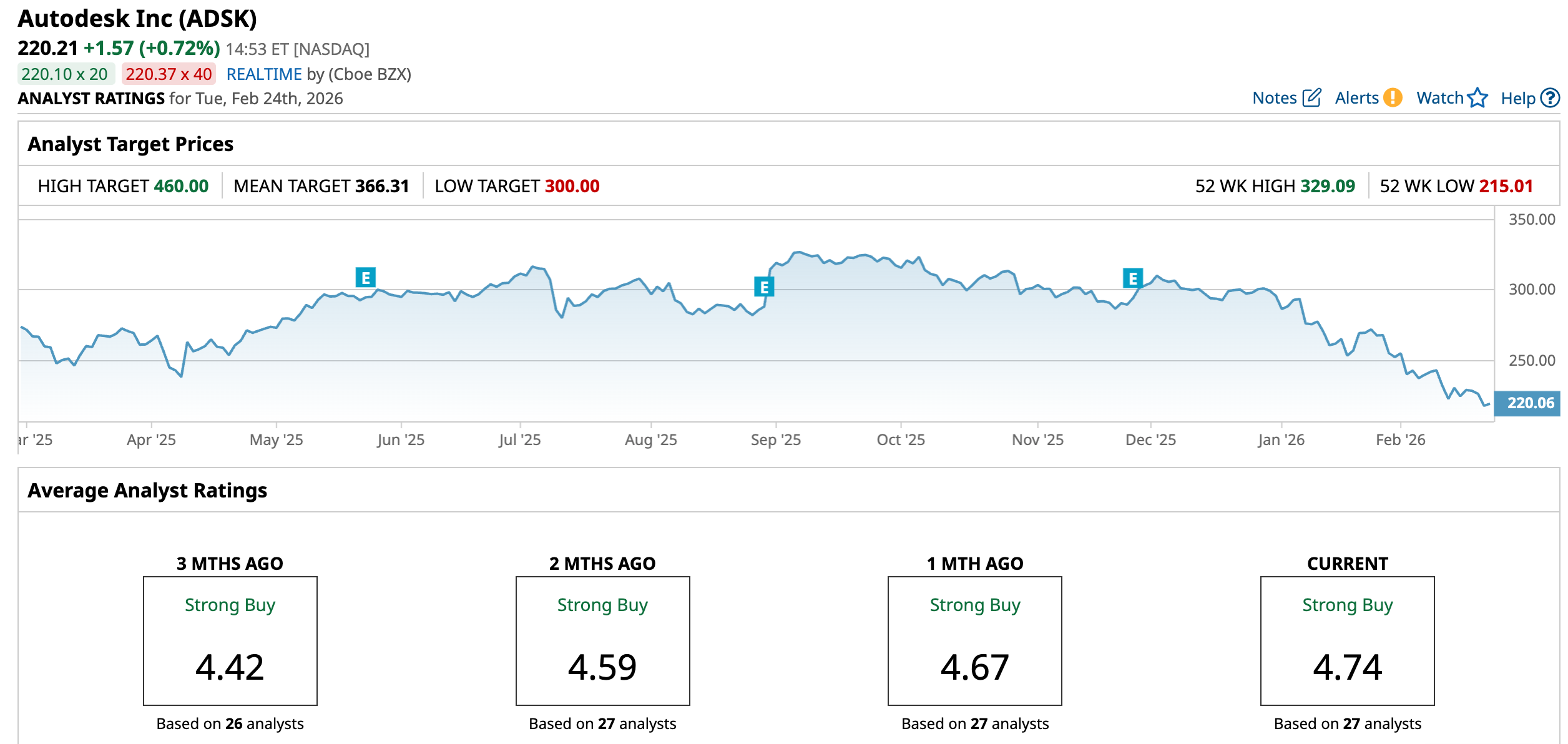
Even with solid fundamentals, Autodesk has not escaped the broader software selloff. Over the past 52 weeks, ADSK stock is down 22.4%, and it has pulled back about 33% from its last year’s September high of $329.09. The pressure has accelerated lately. Shares have fallen 23.64% in the past three months and another 18.03% in just the last month.
So far in 2026, ADSK is off 25.23%, touching a low of $216.01 on February 12. From a technical standpoint, trading volume has cooled, and the 14-day RSI has slipped into oversold territory, signaling stretched short-term conditions.
From a valuation standpoint, Autodesk trades around 27x forward adjusted earnings and roughly 6.46x sales, both below its five-year average multiples. That gap suggests the market may be discounting the strength of its durable subscription model and long-term growth profile. With analysts expecting continued expansion in both top and bottom lines, current levels could represent a compelling entry point for patient investors.
Autodesk reported its Q3 fiscal 2026 results on Nov. 25, 2026, and the numbers outpaced expectations. Revenue climbed 18% YOY to $1.9 billion, while EPS rose 26% annually to $1.60, highlighting solid operating momentum. Meanwhile, non-GAAP EPS came in at $2.67.
Operating income jumped 35.8% to $470 million, while net income increased 24.7% to $343 million compared with last year. Investors welcomed the results, sending shares up 1.6% on the day of the release and another 2.4% in the next session.
Autodesk’s ongoing push into cloud-based platforms and AI-driven tools is clearly paying off. Billings came in at $1.9 billion, and the company generated a healthy $430 million in free cash flow during the quarter, reinforcing both growth and financial discipline.
Autodesk is gearing up to release its Q4 and fiscal 2026 earnings report on Thursday, Feb. 26, after the bell. Management projects fiscal 2026 revenue to be between $7.15 billion and $7.165 billion, while billings are anticipated to be between $7.465 billion and $7.525 billion. The company also estimates annual non-GAAP EPS between $10.18 and $10.25.
Analysts are backing that confidence with solid forward numbers. For fiscal Q4, earnings are projected to climb about 22.2% YOY to $1.93 per share, with revenue expected to be near $1.91 billion. Looking at the full year, fiscal 2026 EPS is anticipated to grow roughly 23.4% annually to $7.23 before rising by another 16.3% in fiscal 2027 to around $8.41.
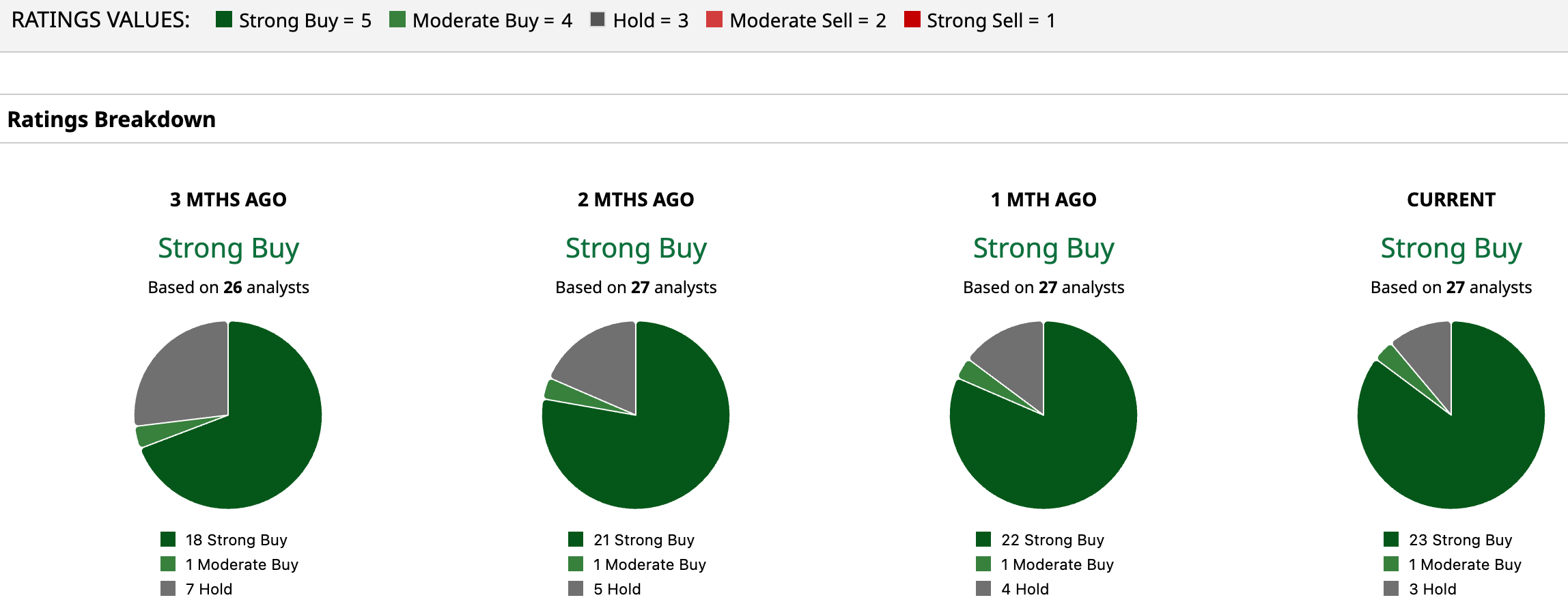
Wall Street is firmly in its corner. ADSK stock carries a “Strong Buy” consensus overall, with a majority of 23 of 27 analysts rating it a “Strong Buy.” Meanwhile, just one analyst has a “Moderate Buy,” while the remaining three are playing it safe, advising a “Hold.”
Price targets also reflect solid confidence. The mean price target of $366.31 suggest upside potential of 66.3% from current levels. More optimistically, the Street-high target of $460 implies ADSK could rally as much as 108.9%, signaling confidence in Autodesk’s long-term growth story.
Software Stock #3: HubSpot
Incorporated in 2005 and headquartered in Cambridge, Massachusetts, HubSpot offers a cloud-based customer relationship management (CRM) platform for businesses across the Americas, Europe, and Asia-Pacific. Its platform brings together tools for marketing, sales, customer service, content management, operations, and commerce – all in one connected system.
The company’s hubs help businesses automate email marketing, manage leads, track sales pipelines, handle customer support, build websites, process payments, and analyze performance. HubSpot also integrates AI through its Breeze tools, which provide automation, insights, and content support to improve productivity.
Beyond software, HubSpot offers training, customer support, and professional services to help clients grow. It primarily serves mid-market B2B companies, with customers including WeightWatchers (WW), Motorola Solutions (MSI), and DoorDash (DASH). Its market capitalization currently stands at $11.5 billion.
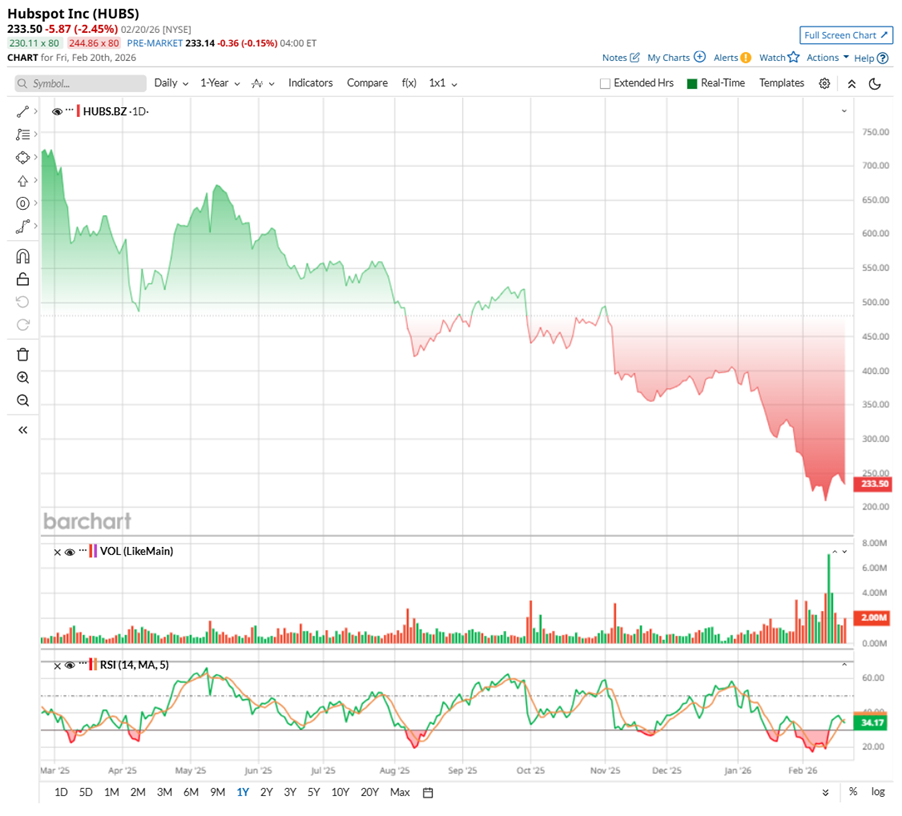
Despite its strong business momentum, HUBS stock has been in a tough stretch. Shares have fallen nearly 70% from their peak of $738.54, sliding 68.6% over the past year and touching a low of $207.20 in February. In 2026 alone, the stock is down 42.17%. On the technical side, trading volume has eased, and the 14-day RSI, which recently dipped into oversold territory, now sits around 37.22, still hovering near stressed levels.
After that sharp pullback, HubSpot’s valuation is starting to look more reasonable. The stock now trades at about 17.46 times forward adjusted earnings – below both its historical median and the broader sector average. Its forward price-to-sales (P/S) ratio stands at 3.10x. While that’s still slightly above some peers, it’s lower than its own five-year average, suggesting valuation pressure has meaningfully eased.
HubSpot reminded investors why it is often viewed by some as one of the steadier growth stories in software. On Feb. 11, the customer platform provider delivered its fourth-quarter and full-year 2025 results, and shares climbed 9.4% the next day after the company topped expectations and laid out a confident outlook.
Fourth-quarter revenue rose 20.4% YOY to $846.7 million, fueled by stronger engagement across its platform. HubSpot’s push to embed advanced AI tools – from AI assistance and AI agents to AI insights and ChatSpot – across its product suite is clearly gaining traction, helping customers automate, analyze, and scale more efficiently.
Adjusted EPS came in at $3.09, up from $2.32 a year ago and ahead of estimates. The company added more than 9,800 net new customers in the quarter, bringing the total to 288,706, up 16% annually. Average subscription revenue per customer ticked up 3% to $11,683.
One standout metric was billings, which surged 26.3% to $969.3 million, indicating a strong signal for future revenue visibility. Cash flow also strengthened. HubSpot generated $247.4 million in operating cash in Q4 and $760.7 million for full-year 2025, ending December with $882.2 million in cash.
HubSpot views 2025 as a pivotal year, marked by strong AI momentum and deeper traction with larger enterprises. CEO Yamini Rangan highlighted that its AI agents are driving tangible customer outcomes, while upmarket clients are adopting HubSpot to streamline tech stacks and lower ownership costs. Entering 2026, management believes the company is well positioned to expand its leadership and deliver consistent, durable growth.
Looking ahead, management estimates Q1 2026 revenue to be between $862 million and $863 million, with non-GAAP EPS between $2.46 and $2.48. For full-year 2026, management guides to $3.69 billion to $3.7 billion in revenue and EPS between $12.38 and $12.46, representing a steady growth, with momentum intact.
Meanwhile, analysts tracking HubSpot expect Q1 revenue to rise to $863.4 million, with EPS expected to be $0.67. Looking further ahead, profit is anticipated to jump nearly 127% to $3.63 per share in fiscal 2026 and surge another 47.7% in 2027 to $5.36 per share.
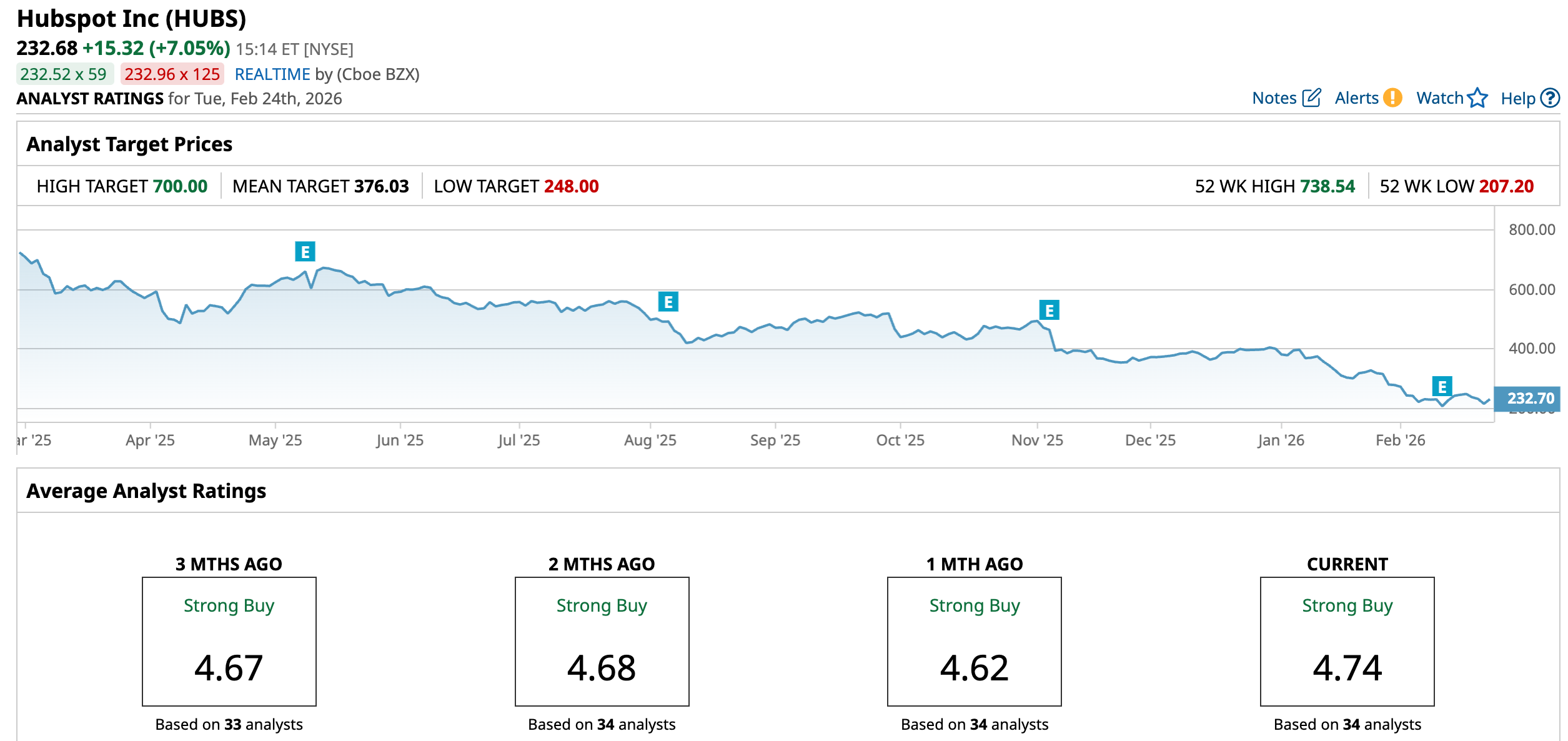
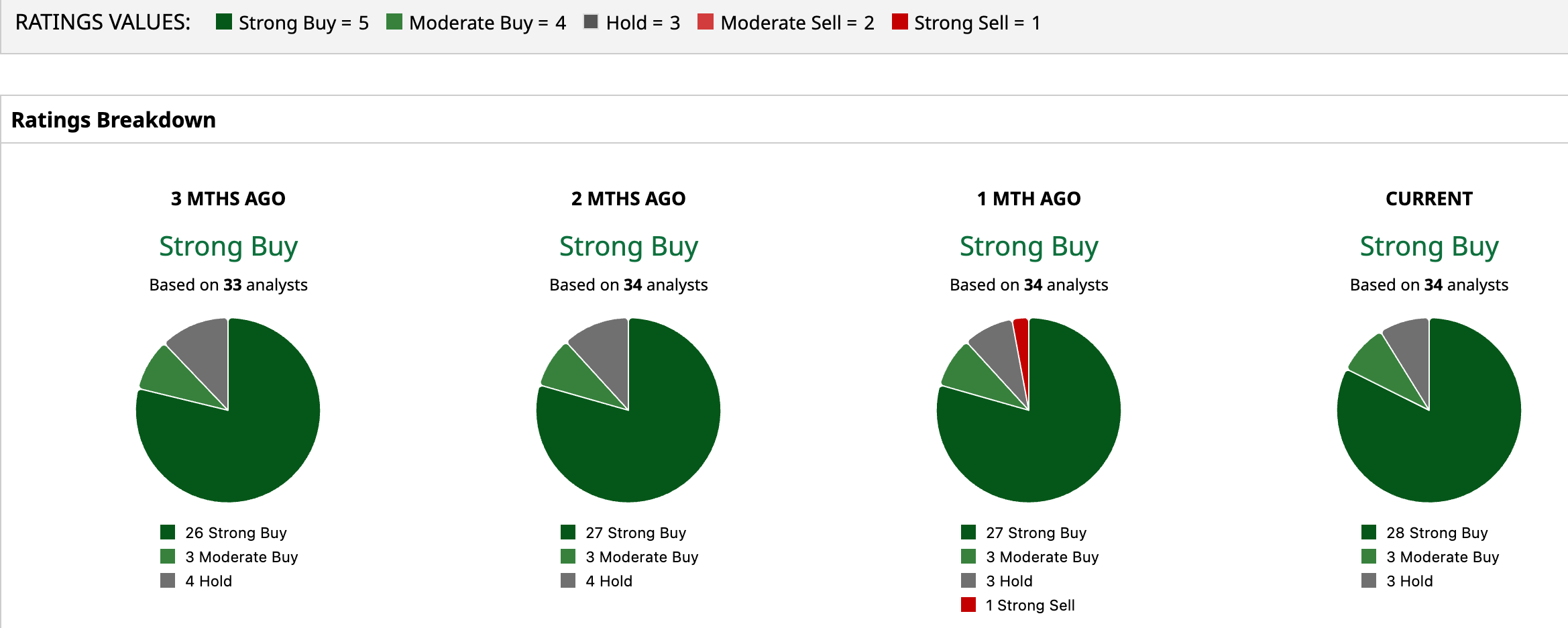
The stock carries a “Strong Buy” consensus overall. Among the 34 analysts tracking the stock, 28 issue a “Strong Buy,” three give a “Moderate Buy,” and the remaining three advise a “Hold.” The average analyst price target of $376.03 suggests an upside potential of 61.6%. The Street-high target of $700 suggests that the software stock can still rally as much as 200% from current levels.
On the date of publication, Sristi Suman Jayaswal did not have (either directly or indirectly) positions in any of the securities mentioned in this article. All information and data in this article is solely for informational purposes. For more information please view the Barchart Disclosure Policy here.
More news from Barchart
- What a $20 Million Horse Race and the Stock Market Have in Common: The Emerging Market Derby of 2026
- What Options Data Tells Us to Expect from Snowflake Stock After February 25 Earnings
- 3 Cheap Software Stocks to Buy on the Dip Now
- What Options Data Tells Us to Expect from Nvidia Stock After February 25 Earnings