Hybrid electrification, smart grid integration, and climate-driven transit policies accelerate global trolley bus adoption and urban fleet modernization.
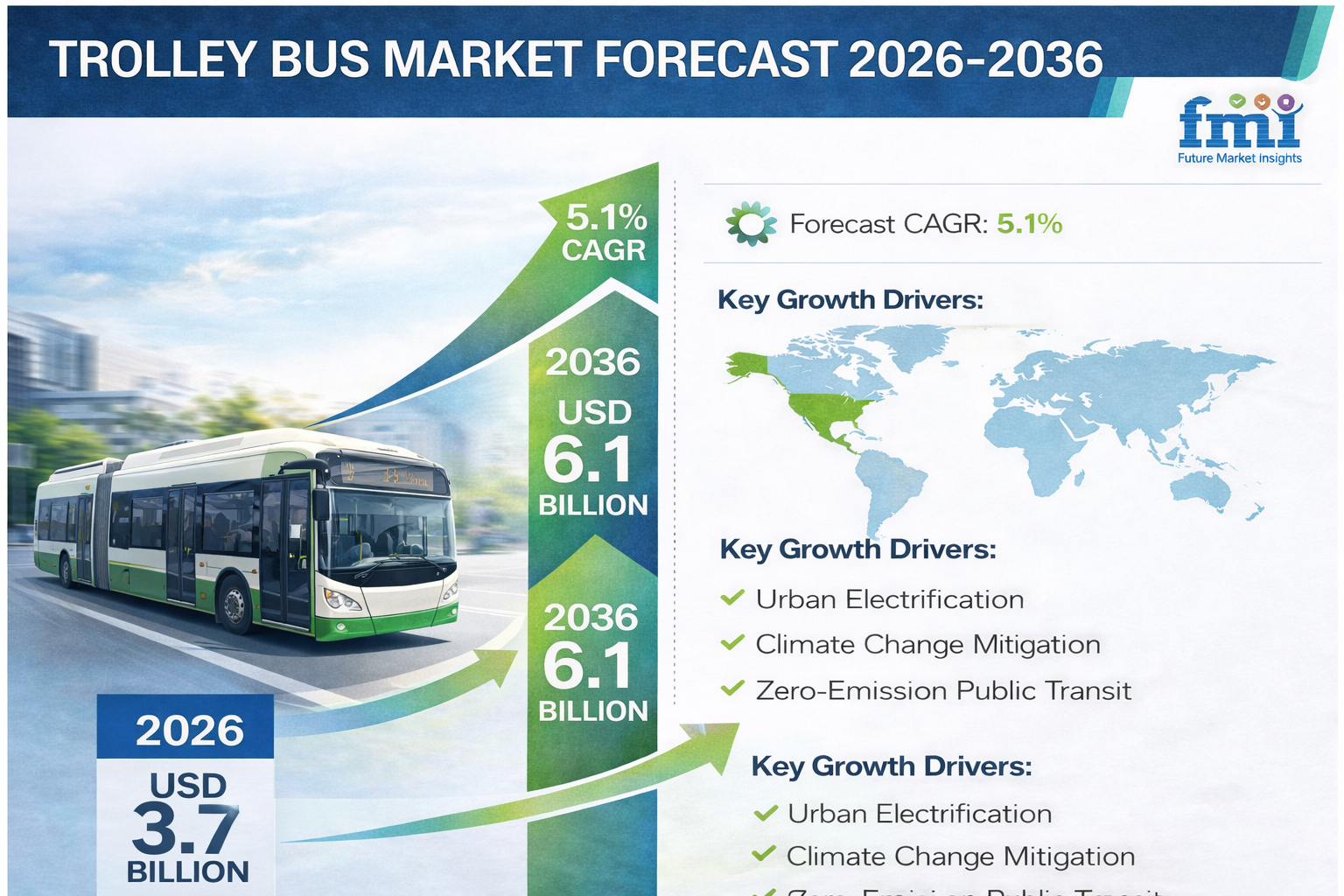
NEWARK, DE / ACCESS Newswire / February 27, 2026 / The global trolley bus industry is entering a decisive transformation phase, driven by accelerating electrification of urban mobility and expanding government mandates to reduce transportation emissions. Valued at USD 3.7 billion in 2026, the market is forecast to reach USD 6.1 billion by 2036, registering a CAGR of 5.1% during the forecast period. This steady growth reflects increasing investments in zero-emission public transportation systems, smart grid integration, and next-generation electric transit technologies.
According to Future Market Insights (FMI), trolley buses are evolving beyond conventional overhead-powered vehicles into intelligent, hybrid transit systems equipped with battery backup capabilities, regenerative braking, and connected fleet management technologies. These advancements enable improved route flexibility, operational efficiency, and integration into modern smart city transportation networks.
Get Access of Report Sample:
https://www.futuremarketinsights.com/reports/sample/rep-gb-6773
Technology Evolution: From Overhead-Dependent Systems to Hybrid Smart Transit Platforms
The trolley bus industry is undergoing a structural shift toward hybrid electrification platforms that combine overhead power supply with onboard energy storage systems. This transformation enables extended off-wire operation, improving route planning flexibility and reducing infrastructure dependency.
Manufacturers are integrating regenerative braking technologies that capture and reuse energy, enhancing operational efficiency and lowering long-term operating costs. Modern trolley buses now support smart grid connectivity, allowing transit agencies to optimize energy consumption, integrate renewable power sources, and maintain grid stability.
An industry analyst notes, "Transit agencies are increasingly prioritizing integrated electrification solutions that combine vehicle innovation with digital fleet management and energy optimization systems."
This transition enables transportation authorities to modernize fleets while improving sustainability, operational resilience, and passenger service reliability.
Urban Electrification and Climate Policy Drive Adoption
Government climate action plans and urban decarbonization initiatives remain primary growth drivers for trolley bus deployment. Municipal authorities are accelerating fleet electrification to meet carbon neutrality targets, improve air quality, and reduce dependence on fossil fuel-powered public transportation.
Transit operators are investing heavily in modern trolley bus procurement programs, incorporating advanced battery systems and intelligent fleet monitoring tools. These investments support long-term environmental objectives while improving operational efficiency and lifecycle cost management.
Beyond environmental benefits, trolley buses contribute to transit equity by providing accessible, reliable transportation in densely populated urban corridors.
Segment Spotlight: Articulated and High-Capacity Trolley Buses Lead Market Demand
Articulated Trolley Buses Dominate Vehicle Segment
Articulated trolley buses account for 56.3% of total vehicle market share in 2026, driven by their superior passenger capacity and operational efficiency in high-demand urban routes. These configurations support efficient passenger flow while reducing per-passenger energy consumption, making them ideal for bus rapid transit (BRT) systems and metropolitan transit corridors.
Public Transit Applications Lead Deployment
Public transit applications represent 78.4% of total market share, reflecting widespread deployment across municipal and regional transportation networks. Governments prioritize trolley bus integration to improve urban mobility while complying with emission reduction mandates and sustainability goals.
18-Meter Configurations Lead Capacity Segment
The 18-meter trolley bus segment holds 52.1% market share, offering an optimal balance between passenger capacity, maneuverability, and compatibility with existing transit infrastructure.
Digital Integration and Intelligent Fleet Management Reshape Operations
The trolley bus industry is rapidly adopting connected vehicle technologies and intelligent fleet management systems to improve operational performance and reduce downtime.
Artificial intelligence-enabled predictive maintenance platforms allow transit agencies to monitor vehicle health, anticipate component failures, and optimize maintenance schedules. These capabilities reduce operational disruptions and extend vehicle lifespan.
Internet of Things (IoT) connectivity enables real-time data collection, allowing transit agencies to optimize route efficiency, energy consumption, and passenger load management.
Additionally, integration with mobile ticketing platforms and real-time passenger information systems enhances user experience and supports data-driven transit planning.
Infrastructure Investment and Smart Grid Integration Accelerate Deployment
Government funding programs and infrastructure investment initiatives are accelerating trolley bus adoption globally. Public-private partnerships, carbon reduction incentives, and dedicated clean transportation funding streams are supporting fleet electrification projects.
Transit agencies are investing in smart charging infrastructure and renewable energy integration to enhance sustainability and operational efficiency. These investments ensure long-term viability and scalability of trolley bus systems.
Emerging economies are increasingly investing in trolley bus networks to address rapid urbanization and improve transportation infrastructure
Regional Leaders:
Country |
CAGR (2026 to 2036) |
|---|---|
Germany |
4.6% |
Switzerland |
4.9% |
China |
6.4% |
Russia |
5.8% |
Canada |
4.1% |
Competitive Landscape: Integrated Electrification Solutions Define Market Leadership
The trolley bus market is becoming increasingly competitive, with manufacturers focusing on integrated electrification solutions rather than standalone vehicle supply.
Leading companies are providing comprehensive mobility solutions that include fleet electrification planning, infrastructure coordination, digital fleet management, and long-term service support.
Key Players in Trolley Bus Market
Solaris Bus & Coach SA
New Flyer Industries Inc.
BYD Company Ltd.
Van Hool NV
Škoda Electric a.s.
Hess AG
VDL Bus & Coach
Alexander Dennis Limited
Irizar e-mobility
Ebusco Bus Technologies
These companies are strengthening their market positions through technological innovation, strategic partnerships, and expansion of service networks.
Future Outlook: Intelligent Electrification and Sustainable Transit Shape Market Growth
Looking toward 2036, several key trends are expected to define the trolley bus industry:
Hybrid trolley buses with extended off-wire capability
Smart grid-integrated electric transit infrastructure
AI-enabled predictive maintenance and fleet optimization
Expansion of electric bus rapid transit systems
Integration of autonomous and connected mobility technologies
As cities worldwide accelerate their transition toward sustainable transportation, trolley buses will play a central role in delivering zero-emission mobility while improving urban transportation efficiency and passenger experience.
For an in-depth analysis of evolving formulation trends and to access the complete strategic outlook for the Trolley Bus Market through 2036, visit the official report page at: https://www.futuremarketinsights.com/reports/trolley-bus-market
Brows More Automotive Industry Reports:
Engine Oil Filters Market - https://www.futuremarketinsights.com/reports/engine-oil-filters-market
Smart EV Charging Adapters and Plug Converters Market - https://www.futuremarketinsights.com/reports/smart-ev-charging-adapters-and-plug-converters-market
Portable AC EV Charger Accessories Market - https://www.futuremarketinsights.com/reports/portable-ac-ev-charger-accessories-market
EV Charge Port Covers Market - https://www.futuremarketinsights.com/reports/ev-charge-port-covers-market
Wall-Mounted EV Charger Holders and Docks Market - https://www.futuremarketinsights.com/reports/wall-mounted-ev-charger-holders-and-docks-market
About Future Market Insights (FMI)
Future Market Insights (FMI) is a leading provider of market intelligence and consulting services, serving clients in over 150 countries. Headquartered in Delaware, USA, with a global delivery center in India and offices in the UK and UAE, FMI delivers actionable insights to businesses across industries including automotive, technology, consumer products, manufacturing, energy, and chemicals.
An ESOMAR-certified research organization, FMI provides custom and syndicated market reports and consulting services, supporting both Fortune 1,000 companies and SMEs. Its team of 300+ experienced analysts ensures credible, data-driven insights to help clients navigate global markets and identify growth opportunities.
For Press & Corporate Inquiries
Rahul Singh
AVP - Marketing and Growth Strategy
Future Market Insights, Inc.
+91 8600020075
For Sales - sales@futuremarketinsights.com
For Media - Rahul.singh@futuremarketinsights.com
For web - https://www.futuremarketinsights.com/
SOURCE: Future Market Insights, Inc.
View the original press release on ACCESS Newswire